Key takeaways
- Find the best LCR meters for electronics work, from bench units to SMD tweezers. Compare accuracy to test capacitors, inductors and resistors.
A capacitor that reads fine on a multimeter can still be the reason a circuit misbehaves. A multimeter measures resistance and checks continuity, but it cannot tell you the capacitance of a capacitor, the inductance of a coil, or the equivalent series resistance that shows whether a capacitor is still healthy. That is the work of an LCR meter: one instrument that measures inductance (L), capacitance (C) and resistance (R), plus the loss factors that reveal a component going bad.
The five meters below cover the ways people actually use one: a classic bench-style handheld, a modern color-display meter, a tweezer meter for surface-mount parts, a low-cost handheld for occasional checks, and a pocket tester that also identifies transistors and diodes.
As an Amazon Associate, we earn from qualifying purchases.
Quick Answer
The DER EE DE-5000 is the best overall LCR meter for a repair bench, with measurement depth for most component work. The FNIRSI LC1020E is the best modern handheld, with a color display and the newest design here. For surface-mount parts, the FNIRSI LCR-ST2 tweezer meter is the practical pick, while the Proster AE121 suits occasional checks and the FORIOT LCR-TC1 suits quick identification of unknown parts.
How to Choose an LCR Meter
An LCR meter is not a multimeter. A digital multimeter measures resistance, voltage and current; an LCR meter applies a small AC signal and measures how a component responds, which is how it reads capacitance and inductance at all. Clamp meters measure current through a jaw, logic analyzers read digital signals, and multi-purpose component testers identify transistors and diodes while giving rough LCR readings. A dedicated LCR meter gives proper L, C and R readings with the accuracy and test frequencies that component work needs.
Test frequencies matter more than the display
A capacitor behaves differently at different frequencies, so the test frequency shapes the reading. A meter that only measures at one frequency can mislead when a capacitor is used in a high-frequency circuit. Meters with several test frequencies — commonly 100 Hz, 120 Hz, 1 kHz, 10 kHz and 100 kHz — let you check a component near the frequency where it will actually work. Audio and power-supply repair mostly needs the lower frequencies; radio circuits and switching regulators need the higher ones.
Accuracy and ESR tell you whether a part is healthy
Basic accuracy describes how close a reading sits to the true value, and for component sorting, 0.3 to 0.5 percent basic accuracy is enough to separate good parts from bad ones. Equivalent series resistance, or ESR, matters just as much: a capacitor can show the right capacitance and still fail in circuit because its ESR has risen with age and heat. Meters that report ESR and the dissipation factor (D) or quality factor (Q) give a fuller picture of a capacitor’s health than capacitance alone.
Form factor follows the parts
Bench-style handheld meters with test leads suit through-hole components and loose parts on a repair bench. Tweezer meters suit surface-mount parts already on a board, because the tweezer tips touch both ends of a tiny component at once. Pocket testers with a socket suit quick identification of unknown parts pulled from a drawer. Match the form to the parts most often handled.
Auto-ranging and auto-identification save time
Auto-ranging removes the need to guess a range before measuring, and auto-identification removes the need to know whether the part in hand is a capacitor, an inductor or a resistor before measuring it. Both features matter most for beginners and for sorting mixed bins of parts, though experienced users can work happily with manual ranges.
1. DER EE DE-5000 — Best Overall LCR Meter for the Repair Bench
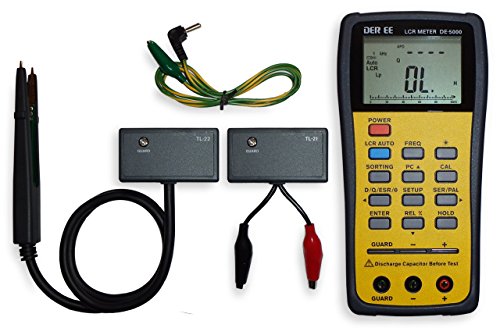
The DE-5000 is the classic bench-style LCR meter that repair benches have relied on for years, and it earns the top spot on measurement depth. It measures inductance, capacitance and resistance, and it reports the dissipation factor, quality factor and ESR that reveal whether a capacitor is still healthy. Several test frequencies cover the range from audio work to higher-frequency circuits, and auto-ranging keeps measurements quick when sorting through a pile of salvaged parts. The handheld form with test leads suits through-hole components and loose parts, and the display reads clearly while both hands hold the probes.
The honest flag is availability. The listing notes that a newer DE-6000 model has replaced the DE-5000 in the maker’s line, and one roundup lists a DE-5000 variant as discontinued. Third-party sellers still listed the meter in December 2025, so confirm the listing is live before ordering. One more note: the IET DE-5000 is the same meter under a different brand, so do not buy both expecting different meters.
Specs
- Brand DER EE; Model DE-5000; Measures inductance, capacitance, resistance, ESR, D and Q; Multiple test frequencies; Auto-ranging; Handheld with test leads; ASIN: B00S298KJO
2. FNIRSI LC1020E — Best Modern Handheld LCR Meter

The LC1020E is the newest meter in this group, and it shows in the design. A color TFT display presents readings clearly, and the layout is built around quick checks rather than menu diving. It measures inductance, capacitance and resistance with ESR, and a buyer on an electronics forum confirmed a purchase on Amazon, which supports the listing being a current one. The compact body fits beside a soldering station without taking over the bench, so it suits a workbench that already holds recent instruments.
The honest flag is that the LC1020E is newer than the established names here, so it carries less long-term history than the DE-5000. The Amazon crawl naming the meter and its code is 298 days old, so confirm the listing is live before ordering.
Specs
- Brand FNIRSI; Model LC1020E; Measures inductance, capacitance, resistance and ESR; Color TFT display; Handheld; ASIN: B0FL7QG7MX
3. FNIRSI LCR-ST2 — Best Tweezer LCR Meter for SMD Parts

Surface-mount parts defeat a normal meter. The parts are too small for test leads, and holding two probes on a component the size of a grain of rice while reading a display takes a third hand. The LCR-ST2 solves this with a tweezer form: the tips touch both ends of the component at once, the meter identifies the part automatically, and the reading appears on the built-in display. It suits replacing a capacitor on a laptop board, checking an inductor on a phone board, or sorting a reel of SMD resistors.
The honest flag is scope. A tweezer meter is a specialist: it excels at small parts on a board and is less convenient for large through-hole components or loose parts in a bin. Buyers who rarely touch surface-mount work will get more use from one of the handheld meters above. The Amazon crawl naming the meter and its code is 203 days old, so confirm the listing is live before ordering.
Specs
- Brand FNIRSI; Model LCR-ST2; Tweezer form for SMD components; Auto-identification of L, C and R; Measures ESR; Built-in display; ASIN: B0G1T9JQ1J
4. Proster LCR Meter AE121 — Best Budget LCR Meter for Occasional Checks
Not every bench needs a flagship meter. The Proster AE121 is the low-cost handheld for occasional component checks: confirming a capacitor before soldering it in, verifying an inductor from a parts bin, or checking a resistor that looks heat-damaged. It measures inductance, capacitance and resistance with auto-ranging, and the handheld form with test leads works the way most people expect a meter to work. There are no extra modes to learn, so a beginner can begin measuring within minutes of opening the box.
The honest flag is that the budget position shows in measurement depth: this meter covers the core L, C and R readings without the wider test-frequency range or the detailed loss-factor reporting of the DE-5000. That is a fair trade for occasional use, and a poor one for daily repair work. The Amazon crawl naming the meter, its model AE121 and its code is 253 days old, so confirm the listing is live before ordering.
Specs
- Brand Proster; Model AE121; Measures inductance, capacitance and resistance; Auto-ranging; Handheld with test leads; ASIN: B071WNNYQT
5. FORIOT LCR-TC1 — Best LCR Tester for Identifying Unknown Parts

The FORIOT LCR-TC1 takes a different approach from the other meters here. It is a pocket tester built around identification: drop an unknown component into the socket, and the meter works out what it is — capacitor, inductor, resistor, transistor, diode or Zener — then reports the values. The color TFT display shows the result clearly, and the built-in rechargeable battery keeps it portable. Its ranges are wide for a pocket instrument: capacitance from 25 picofarads to 100 millifarads, resistance from 0.01 ohms to 50 megohms, and inductance from 0.01 millihenries to 20 henries. A Zener test area covers diodes up to 30 volts, and an infrared decoding function reads remote-control codes.
The honest flags are twofold. First, the LCR-TC1 overlaps with multi-purpose component testers — a category this guide deliberately excludes — so the distinction matters: this tester measures L, C and R properly while also identifying transistors and diodes, whereas a general component tester gives rough LCR readings as a side job. Second, the Amazon crawl naming the meter and its code is 225 days old with no fresh stock signal, so confirm the listing is live before ordering. A code search re-check at writing time confirmed the Amazon listing names the full product title, the model LCR-TC1 and the code in its text, sold by FORIOT-US.
Specs
- Brand FORIOT; Model LCR-TC1; Measures inductance, capacitance, resistance, ESR, transistor, diode and Zener; Capacitance 25pF–100mF; Resistance 0.01–50MΩ; Inductance 0.01mH–20H; 1.8-inch color TFT display; Built-in rechargeable lithium battery; ASIN: B0CJRNW828
Who Should Skip an LCR Meter
An LCR meter is the wrong instrument for several common jobs. Anyone who only needs to check whether a wire is continuous, measure a battery voltage, or confirm a resistor value in a simple circuit already owns the right tool: a digital multimeter does all of that, and an LCR meter adds nothing. Anyone measuring current through a live wire needs a clamp meter, not an LCR meter. Anyone debugging digital signals needs a logic analyzer or an oscilloscope.
A multi-purpose component tester may suit better for buyers who mainly want to identify unknown transistors and diodes and only occasionally need a rough capacitance reading. Anyone who works exclusively with large industrial inductors or high-voltage capacitors should look at specialist bridge instruments, built for power equipment rather than bench-scale electronics.
Frequently Asked Questions
Do I need an LCR meter if I already own a multimeter?
A multimeter cannot measure capacitance or inductance properly, and it cannot report ESR. If the work involves capacitors or coils — repair, restoration, or building filters and power supplies — an LCR meter adds measurements a multimeter cannot provide. For simple continuity and voltage checks, the multimeter remains the right tool.
What test frequency should I use?
Use the frequency closest to where the component will work. Audio and power-supply parts are usually checked at 100 Hz or 120 Hz and 1 kHz, while parts for radio circuits and switching regulators benefit from 10 kHz or 100 kHz. When in doubt, check the datasheet for the frequency the maker used, and match it.
Can an LCR meter measure a capacitor while it is still on the board?
In-circuit readings are unreliable because neighboring components connect in parallel with the part being measured. A tweezer meter gives a useful indication for surface-mount parts, but a definitive reading needs the component removed from the circuit. Desolder one leg before trusting a capacitance or ESR reading.
What is the difference between an LCR meter and a component tester?
A dedicated LCR meter applies a known AC signal and measures inductance, capacitance and resistance with stated accuracy and test frequencies. A component tester identifies part types — transistors, diodes, capacitors — and gives approximate values as a side job. The FORIOT LCR-TC1 in this guide sits between the two: it measures L, C and R properly while also identifying transistors and diodes.
Final Verdict
The DER EE DE-5000 remains the best overall LCR meter for a repair bench, because its measurement depth and test frequencies cover the widest range of component work — with the caveat that the listing should be confirmed live before ordering, since a newer model has replaced it in the maker’s line. The FNIRSI LC1020E is the best modern handheld for a new bench, the FNIRSI LCR-ST2 is the practical choice for surface-mount work, the Proster AE121 covers occasional checks at the lowest outlay, and the FORIOT LCR-TC1 is the fastest way to identify unknown parts. Choose by the parts most often handled.
Product and ASIN Reference
| Product | ASIN |
|---|---|
| DER EE DE-5000 | B00S298KJO |
| FNIRSI LC1020E | B0FL7QG7MX |
| FNIRSI LCR-ST2 | B0G1T9JQ1J |
| Proster LCR Meter AE121 | B071WNNYQT |
| FORIOT LCR-TC1 | B0CJRNW828 |