Key takeaways
- Compare the best field monitors for cameras and video shoots, from Atomos and Blackmagic recorders to bright budget 7-inch screens with focus tools.
A camera screen is small, dim, and hard to read in sunlight. A field monitor fixes all three problems: a bigger screen mounted on the camera, brightness you can see outdoors, and focus tools that show when a shot is sharp before you press record.
The five monitors below cover the full range: a recorder, a monitor-only screen, a 12G-SDI option for cinema cameras, a complete kit with a battery and charger, and a budget 7-inch screen. All five are 5 to 7 inches, run on a battery plate or DC power, and mount through a standard shoe mount or quarter-inch thread.
As an Amazon Associate, we earn from qualifying purchases.
Quick Answer
The Atomos Ninja 5.2-inch is the best field monitor for shooters: a bright touchscreen with recording covers monitoring and capture in one device. The Shinobi suits shooters who record in camera and only need a bigger screen. The Video Assist 5-inch 12G is the pick for SDI cameras, the F5 Pro V4 is the most complete kit, and the A7S is the budget 7-inch option.
How to Choose a Field Monitor
Size is the first decision. A 5-inch monitor keeps a rig compact and light, which matters on a gimbal or a handheld setup. A 7-inch monitor is easier to read at arm’s length and suits tripod work and interviews. A field monitor connects through HDMI or SDI and runs on a camera battery or DC power.
Brightness decides whether you can use the monitor outdoors. A dim screen washes out in sunlight, and a sun hood only helps so much. The Lilliput A7S ships with a foldable sun hood and a rubber case.
Recording is the next fork in the road. A monitor-recorder such as the Atomos Ninja or the Blackmagic Video Assist saves footage to its own media while it displays the image, giving you a backup copy and often a better codec. A monitor-only screen such as the Shinobi or the A7S shows the image and nothing else, which is fine when the camera already records well.
Inputs matter more than most buyers expect. Most mirrorless and DSLR cameras output HDMI, so an HDMI input is essential. Cinema cameras often use SDI, and only a monitor with an SDI input can take that signal. The Video Assist 5-inch 12G here has both 12G-SDI and HDMI. Check your camera’s output before you buy, and check whether the monitor loops the signal to a second device.
Focus and exposure tools separate a field monitor from a big screen. Peaking highlights the edges that are in focus, false color maps exposure, and a histogram shows the tonal range. Every monitor here offers at least peaking and a histogram.
Power is a practical detail that causes trouble on set. Field monitors run on NP-F style battery plates or a DC input, and some accept a second battery type through an included plate. The Lilliput A7S ships with plates for both F970 and LP-E6 batteries. Count your batteries in each type before you buy. Model names here are easy to confuse, so use the exact model and ASIN: Atomos Ninja, Ninja V, Shinobi, and Shinobi II are four different products, and the 12G Video Assist differs from the older 3G model.
1. Atomos Ninja 5.2-Inch — Best Overall Monitor-Recorder
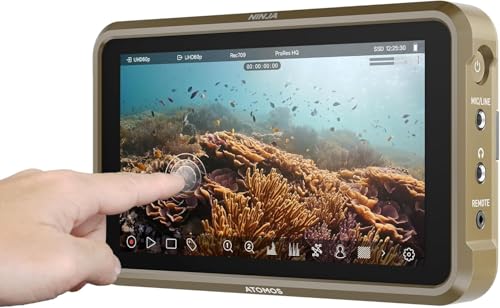
The Atomos Ninja 5.2-inch is the strongest pick here because it does two jobs at once. It is a bright 5.2-inch touchscreen monitor, and it records the signal it receives, so one device covers viewing and capture. An Amazon crawl names the product with this ASIN and model ATOMNJXXX in the text, and Adorama lists it in stock.
The 5.2-inch screen is a useful middle size: larger than the 5-inch screens here without the bulk of a 7-inch panel, so it stays comfortable on a handheld rig and reads well at arm’s length. Recording to the monitor means the camera keeps its own card as a second copy, a sensible safety net on a paid shoot.
The honest flag is that the Ninja is a recorder, so it needs media of its own and a little setup before the first take. Shooters who only need a bigger screen can save money and weight with a monitor-only model such as the Shinobi below. A discontinued kit version sold through B and H is a different listing.
Specs
- Screen 5.2 inches; Touchscreen monitor-recorder; Model ATOMNJXXX; HDMI input; NP-F or DC power; Hot shoe mount; ASIN: B0CFPF7TJ5
2. Atomos Shinobi 5-Inch — Best Monitor-Only Screen

The Atomos Shinobi is the monitor-only counterpart to the Ninja, and it is the right choice when the camera already records well. It gives you a 5-inch HDR screen with focus and exposure tools, without the recording hardware or extra weight of a recorder. A tracker page names the product with this ASIN, model Shinobi, and UPC 814164021265 in the text.
The Shinobi suits mirrorless shooters who want a bigger, brighter view for framing and focus. Peaking and false color are built in, the screen reads well outdoors for a 5-inch panel, and the unit stays light on a gimbal. Because it does not record, there is no media to format and no second file to manage.
The trade-off is clear: if you later want a backup recording or a higher-quality codec, the Shinobi cannot provide it. Do not confuse the Shinobi with the Shinobi II, a different model, or with the Ninja line, which records.
Specs
- Screen 5 inches; Monitor-only, HDR; Model Shinobi; UPC 814164021265; HDMI input; NP-F or DC power; Hot shoe mount; ASIN: B07N7LHJ6V
3. Blackmagic Video Assist 5-Inch 12G — Best for SDI Cameras

The Blackmagic Video Assist 5-inch 12G is the pick here for cameras that output SDI. It carries both 12G-SDI and HDMI inputs, so it works with cinema cameras that use SDI and with mirrorless bodies that use HDMI. It also records 4K footage to its own media. An Amazon crawl names the product with this ASIN and model OB02408 in the text.
The 12G-SDI input is the feature that sets this monitor apart. SDI is the standard connection on cinema cameras and professional switchers, and a monitor without it cannot take that signal. The 5-inch touchscreen is bright and responsive, and recording gives the same backup-copy benefit as the Atomos Ninja. For a shooter whose camera outputs SDI, this is the natural choice.
The honest flag is that the SDI capability is only useful if your camera has an SDI output. Shooters with HDMI-only cameras gain nothing from the 12G input and may prefer the Ninja or the Shinobi. The line also includes older 3G models, so confirm the 12G model and the ASIN below.
Specs
- Screen 5 inches; Touchscreen monitor-recorder; Model OB02408; 12G-SDI and HDMI inputs; Records 4K; NP-F or DC power; Hot shoe mount; ASIN: B07XZLMY6V
4. FEELWORLD F5 Pro V4 — Best Complete Kit

The FEELWORLD F5 Pro V4 is the most complete package here because it arrives as a kit. The box holds the monitor, a battery, a charger, and a bag, so a shooter building a setup from scratch does not need to hunt for power accessories separately. An Amazon crawl names the product with this ASIN and model f5 prov4-6 in the text, but the crawl is the oldest in this group, so confirm the listing is live before ordering.
The monitor itself is a solid mid-range screen with HDMI input and output, focus tools, and a battery plate that takes the included battery. A battery and charger bought separately can cost a noticeable amount on top of a monitor, and a bag keeps the screen protected. For a first field monitor, that completeness beats a small edge in brightness.
The honest flag is the age of the evidence. The crawl naming this ASIN is older than the crawls behind the other picks, so the listing deserves a fresh check at publish time. The F5 line has several revisions, so confirm the Pro V4 model named here.
Specs
- Screen 5.5 inches; Monitor kit; Model f5 prov4-6; HDMI in and loop out; Includes monitor, battery, charger, bag; NP-F or DC power; Hot shoe mount; ASIN: B0C1B52Z24
5. Lilliput A7S 7-Inch — Best Budget 7-Inch Screen

The Lilliput A7S is the budget pick here and the largest screen in the group at 7 inches. It takes a 4K HDMI signal in and loops it out, so a second device can share the feed, and it covers the focus tools a shooter needs: peaking, false color, exposure guides, a histogram, and an audio meter. The 1920 by 1200 panel is bright enough for outdoor use with the included sun hood, and the package adds a rubber case, a hot shoe mount, and a cable.
Power is flexible. The monitor ships with battery plates for both F970 and LP-E6 batteries, so shooters who already own either type can use the batteries they have. At 320 grams it is light for a 7-inch screen. A manual names the A7S 7-inch 4K HDMI field monitor with its F970 plate and HDMI loop.
The honest flag is the strength of the stock evidence. No Amazon crawl names this ASIN in the text, so the code rests on Ubuy pages that name the full product with B07944XH5N in the text and show the USA-store listing in stock, with a crawl one day before this article. That is medium evidence, so confirm the listing is live before ordering.
Specs
- Screen 7 inches; 1920 by 1200; 500 nits; 4K HDMI in and loop out; Peaking, false color, histogram, audio meter; F970 and LP-E6 plates; 320 grams; Includes sun hood, rubber case, hot shoe mount, cable; ASIN: B07944XH5N
Who Should Skip a Field Monitor
A field monitor is not for everyone. If you shoot stills only, the camera screen is usually enough, and a monitor adds weight and another battery to manage. If you shoot short clips for social media on a phone, a phone screen is already large and bright. Shooters on a tight budget may get more value from a spare battery or a better lens first.
A field monitor also needs mounting and power, so it suits rigs rather than pocket cameras. If your camera has no clean HDMI output, a monitor cannot fix that, so check the camera manual before you buy. If you need a screen for editing or for a laptop, buy a computer monitor or a portable USB-C display instead.
Frequently Asked Questions
Do I need a field monitor if my camera already has a flip screen?
A flip screen helps for framing, but a field monitor is larger, brighter, and offers focus tools such as peaking and false color that most camera screens lack. For video work with shallow depth of field, the bigger screen makes focus errors visible before you record.
What is the difference between a monitor and a monitor-recorder?
A monitor only displays the image from the camera, while a monitor-recorder also saves it to its own media. The recorder gives you a backup copy and often a higher-quality codec. The Ninja and the Video Assist in this guide record, while the Shinobi and the A7S only display.
Can a field monitor work with any camera?
It works with any camera that outputs a clean HDMI or SDI signal. Most mirrorless and DSLR cameras output HDMI, while cinema cameras often use SDI. Check your camera’s output type and whether it can send a clean feed without menus on screen.
How do I power a field monitor on a shoot?
Most field monitors run on NP-F style batteries through a plate on the back, or on DC power through a 12-volt input. Carry at least two batteries for a full day, and consider a kit with a battery and charger if you own none. The A7S accepts both F970 and LP-E6 batteries through included plates.
Final Verdict
The Atomos Ninja 5.2-inch is the best field monitor for most video shooters because it combines a bright touchscreen with built-in recording in one compact device. Shooters who record in camera and only need a bigger screen should take the Atomos Shinobi, which is lighter and simpler. Cinema camera owners should take the Blackmagic Video Assist 5-inch 12G for its SDI input. The FEELWORLD F5 Pro V4 kit is the best choice for a first setup because it arrives with a battery, charger, and bag. The Lilliput A7S is the budget 7-inch option, with the honest flag that its stock evidence is the weakest in the group. Match the inputs to your camera and confirm the listing is live at publish time.
Product and ASIN Reference
| Product | ASIN |
|---|---|
| Atomos Ninja 5.2-Inch Monitor-Recorder | B0CFPF7TJ5 |
| Atomos Shinobi 5-Inch Monitor | B07N7LHJ6V |
| Blackmagic Video Assist 5-Inch 12G | B07XZLMY6V |
| FEELWORLD F5 Pro V4 Kit | B0C1B52Z24 |
| Lilliput A7S 7-Inch Field Monitor | B07944XH5N |