Key takeaways
- Watch bright movies at home on these projector screens, picked for vivid images, smooth surfaces, simple setup and sizes that fit living rooms.
A blank wall can show a movie, but a real screen shows it better. A dedicated surface keeps whites bright, blacks deep, and edges sharp, while a painted wall scatters light and softens detail. The five screens in this guide are all 100-inch, 16:9 models built for living rooms and home theaters, each suiting a different room: a manual pull-down for a shared living room, a fixed frame for a dedicated theater, and a motorized screen for a clean look with no visible hardware. Every pick works with standard-throw projectors, mounts on a wall or a ceiling, and uses a matte white surface that keeps the image even from side seats.
As an Amazon Associate, we earn from qualifying purchases.
Quick Answer
For most living rooms, the Elite Screens Manual B M100H is the easiest pick: it pulls down for movie night, retracts into a steel case when done, and its 1.1 gain surface keeps the image bright across a wide seating area. For a dedicated theater, the Silver Ticket STR-169100 fixed frame gives the flattest surface. The Elite Screens Spectrum ELECTRIC100H drops at the touch of a button.
How to Choose a Projector Screen
Begin with the type, which decides how the screen lives in your room. A fixed frame stays on the wall all the time, stretched flat over a frame, and gives the smoothest surface of any type. A manual pull-down rolls up into a case when you are done, so the wall goes back to normal. An electric screen does the same job with a motor and a remote.
Size comes next. A 100-inch diagonal in 16:9 measures about 87 inches wide and 49 inches tall, so measure the wall first and leave room for the case or the frame on each side. Sit about one and a half to two times the screen width back, so the whole image fits comfortably in view. A shorter room calls for a smaller screen.
Gain describes how much light the surface sends back toward the seats. A 1.0 or 1.1 gain surface spreads light evenly and keeps the image consistent from the sides, which suits wide seating. A higher gain, such as 1.3, looks brighter from the center seat but narrows the even-viewing angle. A 180-degree viewing angle holds up from far to the side, while a 120-degree angle still covers a normal couch.
Also check throw compatibility and mounting. Standard-throw projectors work with every screen here, while ultra-short-throw models need a surface made for a steep angle. A fixed frame mounts on a wall, while a pull-down or electric screen can hang from a wall or a ceiling. A black backing stops light from passing through, black borders frame the picture, and brackets, remotes, and wall switches vary by model, so check what comes in the box.
1. Elite Screens Manual B M100H

The Manual B M100H is the classic pull-down screen, and it earns its place as the default pick for a shared living room. It is a 100-inch diagonal, 16:9 screen that pulls down by hand, locks at any height with an auto-lock mechanism, and retracts slowly into a steel case when the movie ends. The slow retract keeps the material from snapping back.
The surface is Elite Screens MaxWhite 2, a matte white material with a 1.1 gain and a 180-degree viewing angle, ready for 4K and 8K Ultra HD, HDR, and Active 3D. The black backing blocks light from passing through the fabric, so the image stays bright. Four sides of black masking border the viewing area and hide slight overshoot. The case hangs on a wall or from a ceiling in black or white, and at 15 pounds it is light enough for two people to hang. One limit: Elite Screens does not recommend this screen for short-throw or ultra-short-throw projectors, so pair it with a standard-throw model.
Specs
- Type manual pull-down; Diagonal 100 inches, 16:9; Surface MaxWhite 2, 1.1 gain, 180-degree viewing angle; Backing black-backed with black masking borders; Mounting wall or ceiling, black or white steel case; Weight 15 pounds; ASIN: B008XGTXWE
2. Elite Screens Sable Frame B2 SB100WH2
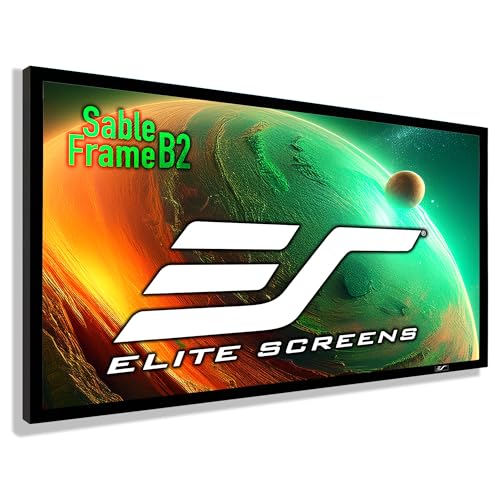
The Sable Frame B2 is the fixed-frame pick for a dedicated theater, and it is the only screen here that Elite Screens rates for ultra-short-throw, short-throw, and standard-throw projectors alike. The frame is a 2.75-inch aluminum border wrapped in plush black velvet, which absorbs light past the edge.
The surface is CineWhite UHD-B, a 1.3 gain material ISF Certified for color accuracy, with 4K and 8K Ultra HD, HDR, and Active 3D support. The higher gain gives a brighter image from the center seat, which suits a theater where the main seating sits straight ahead. A spring tensioning system keeps the material flat and free of wrinkles, which is why a fixed frame looks better than a roll-up screen in a dark room. Installation takes more time than a pull-down, since the frame must be assembled and the material tensioned first. Mounting screws, sliding wall brackets, and drywall anchors come in the box, and it carries a two-year limited warranty.
Specs
- Type fixed frame; Diagonal 100 inches, 16:9; Surface CineWhite UHD-B, 1.3 gain, ISF Certified; Frame 2.75-inch aluminum wrapped in black velvet; Throw compatibility ultra-short-throw, short-throw, and standard-throw; Warranty two-year limited; ASIN: B00Y7XA43O
3. VIVO PS-M-100

The VIVO PS-M-100 is the straightforward pull-down for buyers who want a manual screen without paying for a brand name. It is a 100-inch diagonal, 16:9 screen with a matte white surface, a black backing to stop light passing through, and an auto-locking mechanism that holds the screen at any height. Pull it down for the movie, push it up when done.
The viewing angle is 120 degrees, which covers a normal couch, and the surface supports 4K, 3D, and 1080p HD content. The case mounts on a wall or a ceiling, so it works above a television or in a classroom as well as a living room. At 15.37 pounds it is easy to handle during installation, and the simple design has fewer parts to wear out. The trade-off is a shorter warranty: VIVO covers this screen for 120 days, while the Elite Screens models here carry multi-year coverage. That makes the PS-M-100 a sensible pick for a first screen or a secondary room.
Specs
- Type manual pull-down; Diagonal 100 inches, 16:9; Surface matte white, multilayer, black backing; Viewing angle 120 degrees; Mounting wall or ceiling; Weight 15.37 pounds; ASIN: B00MR57IBK
4. Silver Ticket STR-169100

The Silver Ticket STR-169100 is a fixed-frame screen built around a six-piece aluminum frame, and it is the strongest value among the fixed frames here. The frame is 2 and 3/8 inches wide, wrapped in black velvet. The white vinyl surface has a 1.1 gain and a 160-degree viewing angle, with 4K, 8K Ultra HD, HDR, and Active 3D support.
Assembly is faster than most fixed frames thanks to a tension rod system: a rod slides through a pocket on each side of the material and holds it square all around without tucking or wrinkles. The wall brackets slide sideways, so the frame can be centered after it is hung. The screen weighs 28 pounds and measures about 53.75 by 91.875 inches overall. The surface is mildew and flame resistant and can be washed with soap and water. One limit: Silver Ticket says some ultra-short-throw projectors will not suit this frame and points those buyers to its S7 series, so pair it with a standard-throw or short-throw projector.
Specs
- Type fixed frame; Diagonal 100 inches, 16:9; Surface white vinyl, 1.1 gain, 160-degree viewing angle; Frame six-piece aluminum, 2 and 3/8 inches wide, black velvet wrapped; Assembly tension rod system with sliding wall brackets; Weight 28 pounds; ASIN: B00HZRM9K0
5. Elite Screens Spectrum ELECTRIC100H
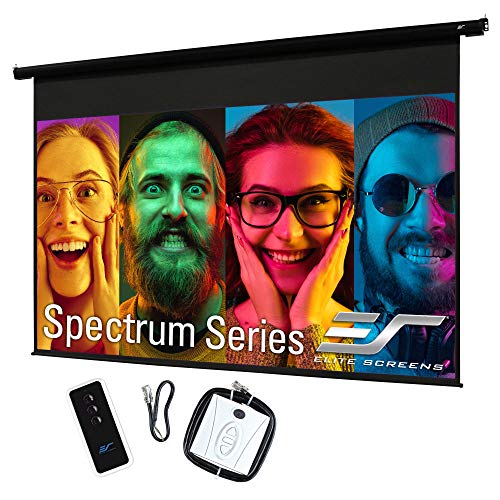
The Spectrum ELECTRIC100H is the motorized pick, and it suits a living room where the screen must vanish between uses. A remote drops the screen from its case and rolls it back up when the movie ends. A detachable three-way wall switch and a 12-volt trigger cable come in the box, so the screen can drop when the projector powers on.
The surface is Elite Screens MaxWhite material with a 1.1 gain and a 180-degree viewing angle, ready for 4K and 8K Ultra HD, HDR, and Active 3D. Black masking borders frame the picture, and the black backing stops light passing through. The multi aspect ratio function shows more than one shape. The case mounts on a wall or a ceiling, an install kit is included, and the screen weighs 17.86 pounds with a two-year warranty. The motor needs a power outlet near the mount, so check before ordering.
Specs
- Type electric motorized; Diagonal 100 inches, 16:9; Surface MaxWhite, 1.1 gain, 180-degree viewing angle; Controls infrared remote, detachable three-way wall switch, 12-volt trigger; Mounting wall or ceiling, install kit included; Weight 17.86 pounds; ASIN: B000YTRFEG
Who Should Skip a Projector Screen
A projector screen is not right for every room. If the room has large windows that cannot be covered, even a bright screen will look washed out during the day, and a television will serve it better. If you rent and cannot drill into the walls, a fixed frame is a poor fit. A motorized screen is also the wrong pick when no power outlet sits near the mount. And if the room is very small, a 100-inch screen can overwhelm the seating distance. Finally, ultra-short-throw owners should choose carefully: most white screens here are built for standard-throw projectors, and only the Sable Frame B2 is rated for ultra-short-throw use by its maker.
Final Verdict
For most homes, the Elite Screens Manual B M100H fits the most rooms: it pulls down for movie night, rolls away when done, and suits a wide couch. A dedicated theater deserves a fixed frame, and the Silver Ticket STR-169100 gives the flattest surface with the least fuss, while the Sable Frame B2 suits color accuracy and ultra-short-throw support. The VIVO PS-M-100 covers a first screen or a second room, and the Spectrum ELECTRIC100H answers when the screen must disappear at a touch. Measure the wall, match the screen type to the room, and confirm the listing.
Frequently Asked Questions
What size screen fits a living room?
A 100-inch diagonal in 16:9 measures about 87 inches wide and 49 inches tall, so it fits most living room walls. Sit about one and a half to two times the screen width away. Measure the wall and the seating distance before ordering.
Is a fixed frame better than a pull-down screen?
A fixed frame gives the flattest surface, since the material stays stretched on a frame, which suits a dedicated theater. A pull-down screen rolls away when not in use, suiting a shared living room. The image difference is small in a dark room, so choose by how the room is used.
What does gain mean on a projector screen?
Gain describes how much light the surface sends back toward the seats. A 1.0 or 1.1 gain surface spreads light evenly and keeps the image consistent from the sides. A higher gain such as 1.3 looks brighter from the center seat but narrows the angle where the image stays even.
Can I use a projector screen with an ultra-short-throw projector?
Most white screens are built for standard-throw projectors, and a steep angle from below can wash out the image. The Elite Screens Sable Frame B2 is rated by its maker for ultra-short-throw, short-throw, and standard-throw projectors. For other fixed frames, check maker guidance first.
Product and ASIN Reference
| Product | ASIN |
|---|---|
| Elite Screens Manual B M100H | B008XGTXWE |
| Elite Screens Sable Frame B2 SB100WH2 | B00Y7XA43O |
| VIVO PS-M-100 | B00MR57IBK |
| Silver Ticket STR-169100 | B00HZRM9K0 |
| Elite Screens Spectrum ELECTRIC100H | B000YTRFEG |