Our Short List of 3
All 5 Picks at a Glance
| Product | Specs | Action |
|---|---|---|
 1. ANCEL BA101 Car Battery Tester | Check price on Amazon | |
 2. TOPDON BT100 Car Battery Tester | Check price on Amazon | |
 3. TOPDON BT200 Car Battery Tester | Check price on Amazon | |
 4. FOXWELL BT705 Car Battery Tester | Check price on Amazon | |
 5. KONNWEI KW208 Car Battery Tester | Check price on Amazon |
Key takeaways
- Compare the best digital battery load testers: conductance testers from ANCEL, TOPDON, FOXWELL and KONNWEI with CCA ranges, system voltages and test functions explained.
As an Amazon Associate we earn from qualifying purchases.
Affiliate Disclosure: This article contains affiliate links. If you buy through a link on this page, we may earn a commission at no extra cost to you. Product specifications are taken from the manufacturers’ published listings and manuals, and we have not personally tested these tools.
A digital battery load tester answers the question a simple voltmeter cannot: not just whether a battery shows voltage, but whether it can still deliver close to the cranking power printed on its label. Modern digital testers do this with a conductance test. They send a small signal through the battery, measure its internal response, and calculate the cold cranking amps the battery can deliver, along with its state of health and state of charge. Most also run a cranking test while the engine starts and a charging test that checks the alternator’s output and ripple. This guide explains how to choose among five established digital testers, what their published ranges and limits are, and how to get a result you can trust.
A note on the name: digital load tester versus carbon-pile load tester
The phrase load tester covers two different tools. A traditional carbon-pile tester applies a heavy real load to the battery for several seconds and shows the voltage sag on a dial. A digital tester, which is what every pick in this guide is, applies no heavy load at all. It uses conductance to estimate the battery’s cranking ability in seconds, without draining the battery or generating heat, and it displays the result as numbers on a screen.
That difference matters for expectations. A digital tester is faster, safer for electronics, and able to test a battery in the vehicle without removing it, and it adds cranking and charging system tests that a carbon-pile unit cannot do. A carbon-pile tester shows behaviour under a genuine heavy draw. For most owners, workshops triaging many vehicles, and anyone diagnosing a no-start complaint, the digital conductance tester is the more useful everyday tool, which is why this guide covers digital models only.
Quick answer
For most drivers, the ANCEL BA101 is the default recommendation: a 12-volt digital tester covering batteries rated from 100 to 2000 CCA, with battery, cranking, and charging tests in a unit powered by the battery under test. The TOPDON BT100 covers the same CCA range with a similar three-test approach, and the TOPDON BT200 adds 24-volt system testing and a colour display for mixed fleets. The FOXWELL BT705 is the heavy-duty option for 12-volt and 24-volt cranking and charging systems, and the KONNWEI KW208 is the simple, widely sold 12-volt option that can also read a deeply discharged battery. The right choice depends mainly on whether you ever need 24 volts, and how much display and guidance you want while you test.
How we chose these testers
Every tester here is a handheld digital conductance tester for lead-acid automotive batteries, sold under a named brand with a published model number, a stated CCA test range, and stated battery, cranking, and charging test functions in its listing or manual. We used only specifications the maker publishes, such as system voltage, CCA range, supported battery chemistries and rating standards, display type, and power source. We left out analogue-only load testers, simple voltmeters, and unbranded listings with no verifiable model or specification, because a diagnostic tool you cannot identify is a tool you cannot trust.
The picks in detail
1. ANCEL BA101 Car Battery Tester
The ANCEL BA101 is one of the most widely sold digital battery testers, and its specification explains why. ANCEL lists it for 12-volt batteries rated from 100 to 2000 CCA and from 30 to 220 Ah, covering flooded, VRLA, AGM, and GEL starting, deep-cycle, and marine batteries, against rating standards including JIS, SAE, EN, DIN, and IEC. It runs three tests: a battery test that reports health, charge, internal resistance, and a plain-language verdict from good through to replace; a cranking test that records cranking time, voltage, and status; and a charging test that reports loaded and unloaded voltage, ripple, and charging system status.
The BA101 has no internal battery. It powers itself from the battery it is clipped to, working on an input range of 9 to 15 volts, which means it is always ready in a toolbox but also means a battery that has fallen far below that range may not power it up. ANCEL states plainly that it is for traditional lead-acid batteries and is not compatible with lithium batteries, and that the battery being tested should be rated at 30 Ah or more. The screen is a basic backlit LCD rather than a colour display.
Choose the BA101 if you maintain 12-volt cars, trucks, boats, or recreational vehicles and want one proven tester that covers the battery, the starter circuit, and the alternator in a single session. Note for pre-purchase checking: an older indexed crawl of this listing showed no featured offer at the time it was captured, so confirm the current offer on the listing before relying on availability.
2. TOPDON BT100 Car Battery Tester
The TOPDON BT100 is TOPDON’s entry digital tester, listed for 12-volt batteries from 100 to 2000 CCA, supporting flooded, AGM, EFB, and GEL chemistries. Like the ANCEL, it offers battery, cranking, and charging tests, so it can separate a weak battery from a weak starter or a failing alternator instead of leaving you guessing between the three most common causes of a no-start.
Listing information describes LED status indicators for a quick health read, copper clamps, and protection against reverse polarity and sparks, in a compact unit of about nine ounces that suits a glovebox or a mobile technician’s bag. TOPDON lists a 12-month warranty for the BT100. Its limits are the same broad limits of this class: it is a 12-volt tool, so it does not cover the 24-volt systems found on larger trucks and equipment, and as a conductance tester it estimates cranking ability rather than applying a carbon-pile load.
Choose the BT100 if you want a compact 12-volt tester from a diagnostic-tool brand, with the three core tests and simple status indicators. If you also work on 24-volt vehicles, look at its larger sibling below instead of buying two tools.
3. TOPDON BT200 Car Battery Tester
The BT200 is the step up in TOPDON’s range for owners and workshops with both 12-volt and 24-volt vehicles. Its listing describes testing for 12-volt and 24-volt batteries from 100 to 2000 CCA, including regular flooded, AGM flat plate, AGM spiral, and GEL types, with battery, cranking, and charging tests. TOPDON markets it as an upgraded version of the BT100, with a 2.4-inch colour LCD that is designed to stay readable in bright light, plus LED status indication.
The published operating temperature range runs from well below freezing to hot workshop conditions, and TOPDON lists warranty and lifetime technical support for the model, though the exact warranty term is stated differently in different listing text, so check the current listing for the term that applies. One honest caution from comparative testing coverage: the BT200 was among the testers that called a very cold but serviceable battery bad in one published comparison, which is a reminder that any conductance verdict on a deeply chilled battery should be repeated after the battery warms or after a proper charge.
Choose the BT200 if one tool must cover a car and a 24-volt truck, boat, or item of equipment, and if a colour screen you can read outdoors matters to you. Note for pre-purchase checking: an indexed crawl of this listing also showed no featured offer at capture time, so verify the live offer before ordering.
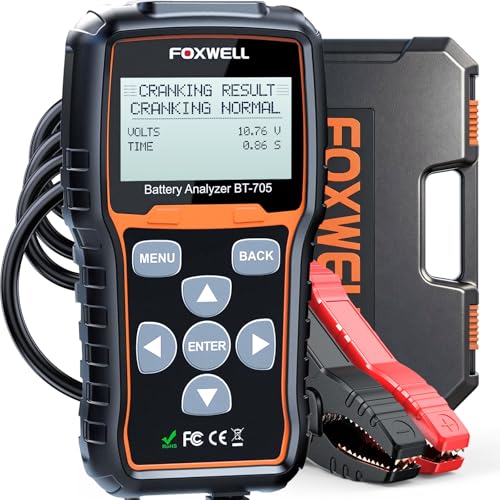
4. FOXWELL BT705 Car Battery Tester
The FOXWELL BT705 is the heavy-duty pick in this group. FOXWELL’s listing describes a tester for 12-volt regular flooded, AGM flat plate, AGM spiral, and GEL batteries rated from 100 to 2000 CCA, with cranking and charging system tests that also work on 24-volt systems. That distinction is stated carefully by the maker: the BT705 tests 12-volt batteries, and it can test the starting and charging systems of 24-volt vehicles, but it is not a tool for testing a standalone 24-volt battery or a 6-volt battery.
The unit is larger than the pocket testers above, with a long test cable that comparative coverage notes is long enough to let one person run the cranking test alone, and it provides a printer port, although the printer itself is a separate purchase. It suits workshops, fleet maintenance, and owners of heavy-duty trucks, boats, and marine equipment who test batteries often enough to value the bigger screen and cable over pocket size.
Choose the BT705 if 24-volt cranking and charging systems are part of your work and you test batteries frequently. Note for pre-purchase checking: an indexed crawl of this listing showed no featured offer at capture time and pointed buyers to a newer model in the same range, so confirm which current FOXWELL model and offer applies before buying.
5. KONNWEI KW208 Car Battery Tester
The KONNWEI KW208 is the simplest pick here: a 12-volt digital tester for batteries rated from 100 to 2000 CCA, covering flooded, VRLA and maintenance-free, AGM flat plate and spiral, EFB, and GEL types according to the maker’s manual and retailer summaries. It reports voltage, internal resistance, measured cranking amps, capacity, state of health, and state of charge, and it runs cranking and charging tests, with a backlit display and multiple menu languages.
Two practical traits stand out in the published material. The KW208 is described as able to test batteries in the vehicle or out of it, and to read even a deeply discharged battery, which is useful when the vehicle in front of you will not start at all and other testers that power themselves from the battery may struggle. Some current retailer coverage also credits the KW208 with support for 12-volt lithium iron phosphate starter batteries, which is unusual in this class; because listings and versions change, confirm that claim on the exact listing before buying it for that purpose.
Choose the KW208 if you want the most straightforward 12-volt tester that still gives health, charge, cranking, and charging results, and if reading a flat battery matters to you. It does not cover 24-volt systems, so mixed-fleet users should choose the BT200 or BT705 instead.
Digital battery load tester comparison
All five testers cover the 100 to 2000 CCA range that spans almost every passenger vehicle and light truck battery, and all five test flooded and AGM batteries and run cranking and charging checks. The real differences are system voltage and form. The BA101, BT100, and KW208 are 12-volt-only tools. The BT200 extends testing to 24-volt systems with a colour display. The BT705 is the largest unit, aimed at frequent and heavy-duty use, with 24-volt cranking and charging system tests but not standalone 24-volt battery testing. Display ranges from the BA101’s basic backlit LCD to the BT200’s colour screen, and only the KW208 makes a specific published point of reading deeply discharged batteries.
How to get a trustworthy result
A conductance tester is only as honest as the connection and the information you give it. Clean the battery terminals before testing, because corrosion between the clamp and the post adds resistance that the tester can mistake for a weak battery. Clip directly onto the lead posts where possible, not onto a loose cable end or a bolt.
Enter the battery’s rating exactly as printed on its label, using the same standard the label uses. If the label gives a CCA figure, select the CCA standard and that number; entering a rating in the wrong standard, or guessing a higher figure, distorts the health percentage the tester calculates. Follow the tester’s prompt about whether the battery is in the vehicle, and switch off lights, heaters, and other loads before a battery test unless the tool tells you otherwise.
Treat a borderline verdict with care. A battery tested stone cold, or one that has just been jump started and surface charged, can read worse or better than it really is. Charge the battery fully, let it rest, and test again before spending money on a replacement. If the battery tests good but the vehicle still cranks slowly, run the cranking and charging tests: the fault may be the starter motor, a poor earth connection, or an alternator that is quietly undercharging every battery fitted to the vehicle.
What the results mean
State of charge is how full the battery is right now, expressed from its voltage and conductance. State of health is how much of its original cranking ability remains, and it is the figure that predicts whether the battery will survive the next cold snap. Internal resistance rises as a battery ages and sulfates, so a rising resistance trend across tests is an early warning even before the health verdict turns to replace.
The charging test matters as much as the battery test. A healthy alternator should hold system voltage in its normal running range and show low ripple; high ripple points to a failing diode, and low charging voltage will leave a new battery chronically undercharged until it fails early as well. Replacing a battery without checking the charging system is how the same vehicle comes back with the same complaint a few months later.
Frequently asked questions
Is a digital tester the same as a load tester?
Not exactly. A traditional load tester applies a heavy real load with a carbon pile. A digital tester estimates cranking ability using conductance, in seconds and without draining the battery, and adds cranking and charging system tests. The digital tool is what most owners and workshops use day to day.
Can these testers test a battery without removing it?
Yes. All five picks are designed to test batteries in the vehicle as well as out of it. Make sure the clamps reach clean metal on the posts and that vehicle loads are off when the tester asks for them off.
Can a digital battery tester test lithium batteries?
Usually not. The ANCEL BA101, for example, is stated by its maker to be incompatible with lithium batteries. Some current coverage credits the KONNWEI KW208 with lithium iron phosphate starter battery support, but you should confirm that on the exact listing and manual for the unit you buy, and never assume a lead-acid tester reads a lithium battery correctly.
Which tester do I need for a 24-volt truck?
The TOPDON BT200, which is listed for 12-volt and 24-volt testing, or the FOXWELL BT705, which tests 12-volt batteries and runs cranking and charging tests on 24-volt systems. The 12-volt-only BA101, BT100, and KW208 will not cover a 24-volt system.
Why did my tester say a good battery is bad?
Common causes are corroded terminals, clamps on cable ends instead of posts, the wrong rating standard or figure entered, or testing a battery that is deeply cold or only surface charged. Clean the posts, enter the label rating exactly, charge and rest the battery, and test again before replacing it.
How often should I test a vehicle battery?
Twice a year is a sensible rhythm for a daily vehicle, before winter and before summer, and immediately whenever starting becomes slow or an electrical fault appears. Fleets and workshops typically test at every service.
Bottom line
The best digital battery load tester for most people is the ANCEL BA101 (ASIN: B01M0ARG3X), because it covers the full 100 to 2000 CCA range for 12-volt lead-acid batteries and combines battery, cranking, and charging tests in one self-powered unit. The TOPDON BT100 (ASIN: B07Z67MMGC) is the compact alternative in the same class, the TOPDON BT200 (ASIN: B08CMPY86M) is the pick when 24-volt systems and a colour screen matter, the FOXWELL BT705 (ASIN: B01ANF1D7U) serves heavy-duty and frequent use, and the KONNWEI KW208 (ASIN: B08MPXGSGN) is the simple option that can still read a flat battery. Whichever you choose, clean terminals and the correct label rating matter more to the result than small differences between these tools, and the featured-offer notes in the ANCEL, TOPDON BT200, and FOXWELL sections above should be checked on the live listings before you publish or purchase.