Our Short List of 3

- Best for: Most people. If you want one folding bike with a track record, a generous weight capacity, and basic heart-rate feedback, start here.
- Resistance: Magnetic, 8 levels
- Weight capacity: 300 lb (per manufacturer listing)
- Assembled size: About 31 x 19 x 46 inches
- Bike weight: About 39 lb
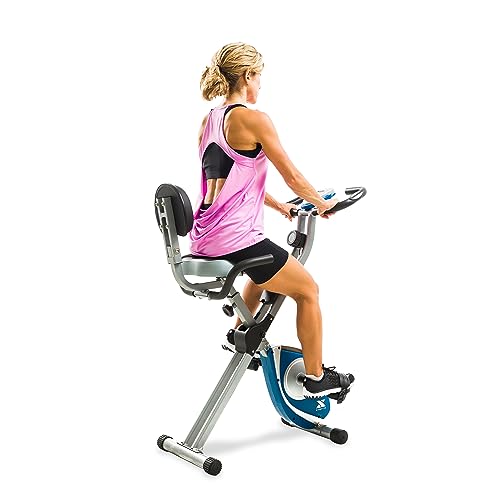
- Best for: Lighter and average-size riders who want a tidy console, cordless setup, and a frame that feels planted during daily rides.
- Resistance: Magnetic, 8 levels
- Weight capacity: 225 lb (per manufacturer listing)
- Design: Solid X-frame folding design, cordless and battery powered console
- Extras: Padded seat and handlebars, adjustable foot straps

- Best for: Small spaces and simple routines. If you want to unfold, ride, fold, and forget, this is your bike.
- Resistance: Magnetic, 8 levels
- Weight capacity: 250 lb (per manufacturer listing)
- Display: LCD showing time, speed, distance, calories, and odometer
- Design: Compact upright folder for tight spaces
All 4 Picks at a Glance
| Product | Specs | Action |
|---|---|---|
| 1. Exerpeutic Folding Magnetic Upright Exercise Bike with Pulse |
| Check price on Amazon |
| 2. XTERRA Fitness FB350 Folding Exercise Bike |
| Check price on Amazon |
| 3. Marcy Foldable Upright Exercise Bike NS-652 |
| Check price on Amazon |
 4. pooboo Folding Magnetic X-Bike |
| Check price on Amazon |
Key takeaways
- Looking for the best foldable stationary bike? Compare four compact folding exercise bikes with magnetic resistance, pulse tracking, and small folded footprints.
As an Amazon Associate we earn from qualifying purchases.
Affiliate Disclosure: This article contains affiliate links. If you buy through a link on this page, we may earn a commission at no extra cost to you.
A foldable stationary bike solves the oldest problem in home fitness: the workout equipment that slowly becomes a permanent piece of furniture. A standard upright or indoor cycling bike claims a fixed patch of floor forever, which is fine in a dedicated gym room and miserable in a studio apartment, a shared living room, or a home office that has to go back to being an office by nine in the morning. A folding model rolls out when you want to ride, then collapses along an X-frame hinge and tucks into a closet, a corner, or the gap beside a sofa.
The trade-offs are real and worth naming up front. Folding bikes are almost always upright designs with modest flywheels, a limited number of resistance levels, and a more relaxed riding position than a studio spin bike. They are built for steady cardio, daily movement, and consistency, not for out-of-the-saddle sprint intervals. If your goal is thirty to sixty minutes of low-impact exercise most days, in a space you cannot dedicate to equipment, this category is one of the most practical purchases in home fitness.
Below are four foldable stationary bikes that cover the main ways people shop this category: a long-running budget classic, a slightly sturdier frame with a proper console, a simple no-frills folder for tight corners, and a newer model with a backrest for longer, gentler sessions. Every specification below comes from the manufacturer’s listing information, and you should confirm current availability and the exact configuration on the product page before ordering, because folding bikes are sold in several seat and console variants.
Our Picks at a Glance
- Exerpeutic Folding Magnetic Upright Exercise Bike with Pulse — the proven all-rounder with a high weight capacity
- XTERRA Fitness FB350 Folding Exercise Bike — a sturdy X-frame with a clear workout console
- Marcy Foldable Upright Exercise Bike NS-652 — the simplest, most compact option for small corners
- pooboo Folding Magnetic X-Bike — a backrest and arm bands for comfort-focused riders
1. Exerpeutic Folding Magnetic Upright Exercise Bike with Pulse
- Best for: Most people. If you want one folding bike with a track record, a generous weight capacity, and basic heart-rate feedback, start here.
- Resistance: Magnetic, 8 levels
- Weight capacity: 300 lb (per manufacturer listing)
- Assembled size: About 31 x 19 x 46 inches
- Bike weight: About 39 lb
Most people. If you want one folding bike with a track record, a generous weight capacity, and basic heart-rate feedback, start here.
The eight resistance levels top out quickly for strong riders, and the odometer behavior on this long-running design has quirks reported by owners. Buy it for daily moderate cardio, not for athletic training.
The Exerpeutic folding upright is the bike that defined this category, and it is still the safest starting point for most buyers. Its steel X-frame folds to roughly half its assembled footprint, and transport wheels let one person tilt and roll it into storage without dragging it across the floor. At around 39 pounds, it is light enough for most adults to reposition daily, which matters more than almost any other spec: a folding bike only saves space if moving it is easy enough that you actually do it.
The magnetic resistance system offers eight tension levels adjusted with a dial. Magnetic resistance is the right technology for this category because it is quiet, needs no friction pads that wear down, and produces a smooth pedal stroke at the low-to-moderate intensities these bikes are designed for. The three-piece crank and precision-balanced flywheel keep pedaling consistent rather than choppy, and the larger pedals with safety straps stop your feet slipping during faster cadences.
Comfort and tracking are where this model pulls ahead of the cheapest folders. The seat is larger than typical and adjusts to fit riders roughly between 5 feet 3 inches and 6 feet 1 inch, according to the brand. The LCD shows time, speed, distance, calories burned, and pulse, with hand pulse sensors in the handlebars. Pulse feedback is genuinely useful on a bike like this: the whole point is steady aerobic work, and keeping your heart rate in a target zone is how you know the session is doing what you intended.
Watch out for: The eight resistance levels top out quickly for strong riders, and the odometer behavior on this long-running design has quirks reported by owners. Buy it for daily moderate cardio, not for athletic training.
2. XTERRA Fitness FB350 Folding Exercise Bike
- Best for: Lighter and average-size riders who want a tidy console, cordless setup, and a frame that feels planted during daily rides.
- Resistance: Magnetic, 8 levels
- Weight capacity: 225 lb (per manufacturer listing)
- Design: Solid X-frame folding design, cordless and battery powered console
- Extras: Padded seat and handlebars, adjustable foot straps
Lighter and average-size riders who want a tidy console, cordless setup, and a frame that feels planted during daily rides.
The 225 lb capacity is the hard ceiling in this roundup. Check it against your weight plus workout clothing before anything else.
The XTERRA FB350 takes the same basic formula — an X-frame that folds to cut the footprint nearly in half — and puts more emphasis on frame solidity and the riding position. XTERRA lists the folded width at roughly 21 inches against about 37 inches long assembled, so the stored bike stands in a slim vertical package that fits the side of a closet or a narrow hallway alcove.
The console is battery powered, so there is no cord to run across the room and no outlet dictating where the bike lives. That sounds minor until you have tripped over a power cable in a small apartment; on a bike you move twice a day, cordless operation is a genuine quality-of-life feature. The display tracks the standard workout metrics, including time, distance, calories, and pulse, and the padded seat and handlebars plus adjustable foot straps aim at the same steady-session comfort as the Exerpeutic.
Where the FB350 differs is capacity. XTERRA rates this model at 225 lb, noticeably below the 300 lb rating of the Exerpeutic above. That is not a flaw so much as a filter: riders comfortably under the limit get a solid, well-finished folder, while heavier riders should take the higher-capacity option instead of pushing a frame past its design intent.
Watch out for: The 225 lb capacity is the hard ceiling in this roundup. Check it against your weight plus workout clothing before anything else.
3. Marcy Foldable Upright Exercise Bike NS-652
- Best for: Small spaces and simple routines. If you want to unfold, ride, fold, and forget, this is your bike.
- Resistance: Magnetic, 8 levels
- Weight capacity: 250 lb (per manufacturer listing)
- Display: LCD showing time, speed, distance, calories, and odometer
- Design: Compact upright folder for tight spaces
Small spaces and simple routines. If you want to unfold, ride, fold, and forget, this is your bike.
No heart-rate tracking, and the stock seat is firm on longer rides. Riders who want pulse data should look at the Exerpeutic or XTERRA instead.
Marcy’s NS-652 is the minimalist of the group. It has been sold for years in essentially the same form, and its appeal is that it does the folding-bike job with the least bulk and the least fuss. The frame folds flat enough for genuinely tight storage, the magnetic resistance adjusts through eight levels with a simple knob, and the small LCD covers the five metrics most riders check: time, speed, distance, calories, and an odometer for total mileage.
There is no pulse sensor party trick and no app connectivity, and that is the point. Every feature removed is one less thing to set up, pair, charge, or break, and the bike’s open footprint is among the smallest here, which makes it the natural pick for a bedroom corner, a dorm room, or a small flat where the bike must disappear completely between sessions.
The seat adjusts for different rider heights, the pedals carry straps, and the whole machine is light enough to move without planning the maneuver in advance. Owners of this model have historically mentioned the seat as the first thing they upgrade for longer rides, which is a fair expectation at this end of the category: the bike is a cardio tool first, and a inexpensive padded seat cover is a reasonable companion purchase if you settle into forty-minute sessions.
Watch out for: No heart-rate tracking, and the stock seat is firm on longer rides. Riders who want pulse data should look at the Exerpeutic or XTERRA instead.
4. pooboo Folding Magnetic X-Bike
- Best for: Comfort-focused riders, beginners, and anyone whose back complains on a standard upright saddle.
- Resistance: Magnetic, 8 levels
- Weight capacity: 300 lb (per manufacturer listing)
- Flywheel: About 6.6 lb
- Extras: Back support cushion, arm resistance bands on related configurations
Comfort-focused riders, beginners, and anyone whose back complains on a standard upright saddle.
Multiple variants exist under similar names. Match the configuration on the product page to the features you expect before checkout.
The pooboo Folding Magnetic X-Bike is the comfort-first entry. Its defining feature is the back support cushion behind the seat, which changes the character of the ride: instead of perching upright for the whole session, you can lean back slightly and pedal in a semi-supported position that many beginners, older riders, and people returning from injury find far easier to sustain for thirty minutes or more. On a category of bike bought specifically for consistency, the most comfortable option often wins in practice.
The basics match the rest of the group: an X-frame that folds for storage, eight levels of magnetic resistance, a roughly 6.6 lb flywheel, and a 300 lb stated capacity. The listing family also includes arm resistance bands on some configurations, which let you add light upper-body work while pedaling — not a strength program, but a sensible way to keep a gentle session varied. A monitor tracks the usual ride metrics.
Because pooboo sells this bike in several colors and closely related variants, read the exact listing carefully before ordering: confirm the ASIN, the seat and backrest configuration, and whether the resistance bands are included in the variant you select. Variant confusion is the most common source of disappointment with multi-configuration listings, and it is entirely avoidable with thirty seconds of checking.
Watch out for: Multiple variants exist under similar names. Match the configuration on the product page to the features you expect before checkout.
How to Choose a Foldable Stationary Bike
Measure the folded space first. The unfolded footprint of these bikes is similar; the folded dimensions are what decide whether the bike lives in your closet or in your way. Measure the storage spot, then compare it with the folded width and height on the listing, leaving room to tilt the bike onto its transport wheels.
Respect the weight capacity. Capacity is a frame and stability rating, not a marketing suggestion. Stay comfortably under it. In this roundup the ratings run from 225 lb to 300 lb, which is the single most important sorting step for many buyers.
Match resistance to your real workouts. Eight magnetic levels is the norm here and is plenty for steady-state cardio, warm-ups, and active recovery. If you plan standing climbs or sprint intervals, no folding upright is the right tool; that is what indoor cycling bikes are for.
Decide whether you need pulse tracking. A pulse readout helps you hold an aerobic zone without a separate wearable. If you already wear a fitness watch, a simpler display like the Marcy’s is fine. If the bike is your only tracker, the Exerpeutic’s hand pulse sensors earn their place.
Think about who else will ride it. Seat height range decides household harmony. Check the stated rider height range against the shortest and tallest people who will use the bike, and favor models whose seat adjusts without tools.
Plan the daily move. Weight, transport wheels, and cordless consoles decide whether folding becomes a habit or a chore. The best foldable stationary bike is the one that is back in the closet in under a minute, because that is the one still being used in six months.
Folding Bike Care Basics
Keep the hinge and folding mechanism clean and check its locking hardware regularly; a folding frame earns its keep through a joint that a fixed frame does not have, and that joint should feel tight, not loose. Wipe sweat off the frame and console after sessions, since moisture is what corrodes adjustment knobs and battery contacts over time. Magnetic resistance systems need almost no drivetrain maintenance, which is one of the quiet advantages of this category, but pedal straps and seat adjustment rails benefit from a quick monthly inspection. Store the bike upright in its folded position out of direct damp — a garage corner that floods in winter will shorten the life of any of these machines.
Frequently Asked Questions
Are foldable stationary bikes sturdy enough for daily use?
Yes, within their stated weight capacities and intended intensity. The X-frame designs here are built for daily moderate cardio. They flex more than a fixed studio bike under hard sprinting, which is a design trade-off for folding, not a defect.
How much space does a folding exercise bike actually save?
Typically about half the floor footprint when folded, based on manufacturer figures, and the folded package is slim enough for a closet or the space beside furniture. Always compare the specific folded dimensions on the listing with your storage spot.
Is magnetic resistance better than friction resistance on a folding bike?
For home use, generally yes. Magnetic systems are quieter, feel smoother at low speeds, and have no pads to wear out and replace. Every bike in this roundup uses magnetic resistance.
Can a folding bike replace a gym membership?
For general cardiovascular fitness, daily movement, and weight management support, a bike you use five days a week at home beats a gym you visit twice a month. It will not replicate heavy strength training or top-end cycling performance work, and it does not need to.
What is the best foldable stationary bike overall?
For most buyers, the Exerpeutic Folding Magnetic Upright with Pulse balances capacity, tracking, and a long sales history. Riders who prioritize comfort should look at the pooboo X-Bike’s backrest, riders in the smallest spaces at the Marcy NS-652, and riders who want a cordless console and solid frame at the XTERRA FB350 — provided its capacity fits.
The Bottom Line
The best foldable stationary bike is not the one with the longest feature list; it is the one whose folded size fits your storage, whose capacity fits your body, and whose setup is easy enough that riding becomes a daily default. Start with the Exerpeutic if you want the proven all-rounder, choose the pooboo if a backrest will keep you riding longer, take the Marcy for the tightest corners, and consider the XTERRA if you are under its capacity limit and want a clean cordless console. Confirm the current configuration and availability on the product page, and then put the bike where you will actually see it — unfolded, ready, and in the way just long enough to remind you to ride.