Key takeaways
- Bring big room-filling sound home with these floorstanding speakers, picked for deep bass, clear highs, solid cabinets and easy placement in living rooms.
A floorstanding speaker fills a room in a way a small speaker cannot. The tall cabinet holds large woofers and a dedicated tweeter, with enough volume to move air for movies and music alike. The five towers in this guide are passive floorstanding models made for home theater and stereo listening. Each one connects to a receiver with speaker wire, and each is sold as a single cabinet or as a pair, so check the listing before ordering two. None is a bookshelf speaker, a desktop speaker, or part of a soundbar bundle.
As an Amazon Associate, we earn from qualifying purchases.
Quick Answer
For most living rooms, the Klipsch RP-8000F II leads with dual 8-inch woofers and a large horn that fills big spaces with ease. The RP-6000F II suits mid-size rooms, the ELAC F5.2 balances detail and bass, the Sony SSCS3 fits smaller rooms, and the Polk T50 opens the door for modest budgets. All five are passive towers, so each one needs a receiver or amplifier.
How to Choose a Floorstanding Speaker
Room size comes first. Dual 8-inch woofers suit a large living room or theater room, where the extra driver area fills the space. A tower with 5.25-inch or 6.5-inch woofers suits a mid-size room, while a compact tower fits a smaller room. Measure the wall, leave room for the rear ports to breathe, and remember a pair needs space on both sides of the screen.
Sensitivity decides how much amplifier power a tower needs. A sensitive tower near 96 dB plays loud from a modest receiver. A less sensitive tower near 86 dB needs a stronger amplifier to reach the same volume. All five picks are passive, which means none carries a built-in amplifier, and each needs speaker wire from a receiver.
Frequency response shows how low a tower reaches and how high it extends. A tower reaching 35 Hz gives deep bass for films, while one stopping near 45 Hz still covers most music with warmth. A subwoofer can add the lowest octave later, so a tower need not reach the deepest notes. Look for a smooth midrange, where voices and dialogue live.
Placement shapes the sound as much as the drivers do. Rear-ported towers need a gap behind the cabinet, while front-ported designs sit closer to a wall. Toe the towers toward the main seat, keep them clear of corners unless the bass needs a lift, and use the binding posts for a firm connection. A braced MDF cabinet resists vibration, a grille protects the drivers, and solid feet keep the cabinet stable.
1. Klipsch RP-8000F II — Best Overall Floorstanding Speaker

The Klipsch RP-8000F II is the flagship tower in this guide, built around dual 8-inch Cerametallic woofers and a 1-inch titanium tweeter in a large 90 by 90 degree Tractrix horn. The horn spreads highs wide, while the dual woofers move enough air for deep bass in films. A sensitivity of 98 dB means a modest receiver drives it to room-filling volume, and the braced cabinet with dual rear ports keeps the sound composed at high output.
Each cabinet stands 43.1 inches tall and weighs 61.4 pounds, suiting a large living room rather than a small flat. Dual binding posts allow bi-wiring or bi-amping, and hidden rear connections take a Dolby Atmos module. The listing covers a single Ebony cabinet, so order two for a stereo pair, and note that the Walnut finish carries its own listing. The original RP-8000F is an earlier model, so confirm the II suffix.
Specs
- Tweeter: 1-inch LTS titanium, vented, 90 x 90 degree Tractrix horn; Woofers: dual 8-inch Cerametallic with Faraday rings; Frequency response: 35–25,000 Hz (±3 dB); Sensitivity: 98 dB; Power handling: 150 watts continuous, 600 watts peak; Impedance: 8 ohms; Crossover: 1,630 Hz; Cabinet: braced MDF, dual rear Tractrix ports; Height: 43.1 inches; Weight: 61.4 pounds; Sold as: single, Ebony; ASIN: B09V3BZFGK
2. Klipsch RP-6000F II — Best Mid-Size Tower for Home Theater

The Klipsch RP-6000F II is the middle tower of the Reference Premiere II range, the sweet spot for many rooms. Dual 6.5-inch Cerametallic woofers and a 1-inch titanium tweeter in the same large horn give the flagship character in a smaller cabinet. At 96 dB sensitivity it is easy to drive, and a response down to 38 Hz covers most film soundtracks without a subwoofer.
The pair listing covers two Ebony cabinets, so one order sets up a stereo pair. Each cabinet stands 39.6 inches tall and weighs 49.4 pounds, fitting a mid-size living room without dominating the wall. One honest flag belongs here: a major retailer lists the Walnut finish on backorder with an expected date in mid-December, so confirm the Ebony pair listing is live before ordering, and do not confuse it with the smaller RP-5000F II or the larger RP-8000F II.
Specs
- Tweeter: 1-inch LTS titanium, vented, 90 x 90 degree hybrid Tractrix horn; Woofers: dual 6.5-inch Cerametallic; Frequency response: 38–25,000 Hz (±3 dB); Sensitivity: 96 dB; Power handling: 125 watts RMS, 500 watts peak; Impedance: 8 ohms; Crossover: 1,770 Hz; Cabinet: MDF, dual rear Tractrix ports; Height: 39.6 inches; Weight: 49.4 pounds each; Sold as: pair, Ebony; ASIN: B09ZTGH6HB
3. ELAC Debut 2.0 F5.2 — Best Balanced Three-Way Tower
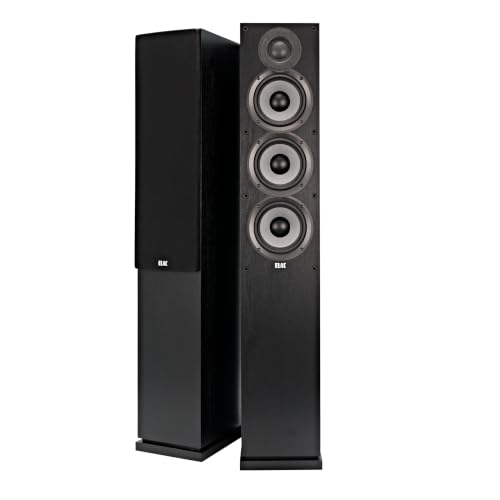
The ELAC Debut 2.0 F5.2 takes a different path to big sound, with a three-way design that gives each part of the range its own driver. A 1-inch cloth dome tweeter handles the highs, a dedicated 5.25-inch aramid-fiber midrange covers voices, and dual 5.25-inch woofers handle the bass. The result is a smooth, even sound for music and movies, and the braced MDF cabinet with three rear flared ports keeps the bass clean at higher volumes.
At 86 dB sensitivity, the F5.2 needs a stronger amplifier than the Klipsch towers here, so pair it with a receiver with real output. The cabinet stands 40 inches tall and weighs 34.4 pounds, suiting a mid-size room, and the black ash vinyl finish blends with dark furniture. The listing covers a single cabinet, so order two for stereo, and the maker confirms the model is not discontinued. Do not confuse the F5.2 with the larger F6.2.
Specs
- Tweeter: 1-inch cloth dome with wide-dispersion waveguide; Midrange: 5.25-inch aramid fiber; Woofers: dual 5.25-inch aramid fiber; Frequency response: 42–35,000 Hz; Sensitivity: 86 dB; Impedance: 6 ohms; Maximum power: 140 watts; Crossover: 90 Hz and 2,200 Hz; Cabinet: braced MDF, black ash vinyl, three rear flared ports; Height: 40 inches; Weight: 34.4 pounds; Sold as: single; ASIN: B07B4WFWZF
4. Sony SSCS3 — Best Compact Tower for Smaller Rooms

The Sony SSCS3 is the most compact tower in this guide, standing 36.3 inches tall and 9 inches wide, fitting beside a TV stand in a smaller room. A three-way, four-driver layout pairs a 1-inch main tweeter with a 0.75-inch super tweeter for sound up to 50 kHz, while dual 5.12-inch mica-reinforced woofers give the bass a firm edge. The wooden bass-reflex cabinet keeps the sound warm, and the black finish suits most rooms.
With 145 watts maximum input and 6-ohm impedance, the SSCS3 works with most receivers, and its modest size makes it the easiest tower here to place. The listing covers a single cabinet, so order two for a stereo pair, and note that a pair bundle listing carries its own code. Do not confuse it with the newer SS-CS3M2, a different 2025 model, and confirm the SSCS3 model name before ordering.
Specs
- Tweeter: 1-inch soft dome main tweeter plus 0.75-inch super tweeter; Woofers: dual 5.12-inch mica-reinforced; Frequency response: 45 Hz–50 kHz; Maximum input: 145 watts; Impedance: 6 ohms; Cabinet: wood, bass reflex, black; Height: 36.3 inches; Width: 9.05 inches; Depth: 10.24 inches; Weight: about 25 pounds; Sold as: single; ASIN: B00O8YLL8E
5. Polk Audio T50 — Best Entry Tower for Modest Budgets

The Polk Audio T50 opens the door to floorstanding sound for listeners who want a full tower without a large outlay. A 1-inch Terylene dome tweeter and a 6.5-inch Dynamic Balance midwoofer sit above two 6.5-inch bass radiators, giving surprising low-end weight for a tower of this size. Polk’s Power Port design smooths airflow at the base, and the response runs from 35 Hz to 40 kHz, covering most music and film soundtracks.
The cabinet stands 40.4 inches tall and weighs 35 pounds, suiting a bedroom or small living room, and the black wood-grain finish matches most furniture. The listing covers a single cabinet, so order two for stereo; the tower connects to most receivers with standard wire. One honest flag belongs here: Polk marks the T50 as archived on its own storefront, so confirm the single-unit listing is current before ordering, and do not confuse it with the older TSi300 from an earlier line.
Specs
- Tweeter: 1-inch Terylene dome; Midwoofer: 6.5-inch Dynamic Balance; Bass radiators: two 6.5-inch; Frequency response: 35 Hz–40 kHz total; Sensitivity: 89 dB; Impedance: 4- and 8-ohm compatible; Recommended amplifier: 25–200 watts per channel; Crossover: 2,700 Hz; Cabinet: wood, black, Power Port; Height: 40.4 inches; Weight: 35 pounds; Sold as: single; ASIN: B013LIN5W2
Who Should Skip These Floorstanding Speakers
Skip this guide if the room is small and the seat sits close to the speakers, since a tall tower can overwhelm a tight space and a bookshelf pair on stands may suit it better. Skip it too if no receiver or amplifier is on hand, since all five towers are passive and need external power. Renters who move often may prefer a smaller setup, and anyone who wants wireless sound should look at powered speakers. A tower also needs floor space on both sides of the screen, so a room with no free wall space fits poorly.
Final Verdict
For most living rooms, the Klipsch RP-8000F II is the pick, with dual 8-inch woofers and a large horn that fill a big space. The RP-6000F II is the better fit for a mid-size room, the ELAC F5.2 suits listeners who put music first, the Sony SSCS3 fits smaller rooms, and the Polk T50 opens the door for modest budgets. Measure the room, match the tower to a receiver with enough output, and leave space behind the cabinet. Any of the five brings real theater sound home.
Frequently Asked Questions
Do floorstanding speakers need a receiver?
Yes. All five towers here are passive, so each one needs a receiver or a stereo amplifier. Connect the towers with speaker wire, match the impedance to the amplifier, and use the receiver volume to control the sound.
How much floor space does a tower need?
Allow a gap behind the cabinet for the rear ports, plus space on both sides of the screen. Most towers here stand about 40 inches tall and need a footprint near 10 inches wide and 12 to 18 inches deep. Keep them clear of corners unless the bass needs a lift, and toe them slightly toward the main seat.
Is one tower enough for a home theater?
One tower gives sound from one side only, so a stereo pair is the normal setup for movies and music. Two towers create a soundstage across the screen, with dialogue centered. A single tower can replace a damaged unit or join a larger surround setup built over time.
Do I need a subwoofer with floorstanding speakers?
Not always. Towers with dual 8-inch woofers reach low enough for most film soundtracks, while smaller towers benefit from a subwoofer for the deepest notes. Add a subwoofer later if the lowest octave feels thin, and use the receiver crossover to blend it with the towers.
Product and ASIN Reference
| Product | ASIN |
|---|---|
| Klipsch RP-8000F II | B09V3BZFGK |
| Klipsch RP-6000F II | B09ZTGH6HB |
| ELAC Debut 2.0 F5.2 | B07B4WFWZF |
| Sony SSCS3 | B00O8YLL8E |
| Polk Audio T50 | B013LIN5W2 |