Key takeaways
- Compare the best pinking shears for fabric, from Fiskars and Gingher to SINGER, with zigzag blades, comfort handles and tips for fray-resistant seams.
Pinking shears are the simplest way to finish a raw fabric edge without a serger. Their sawtooth blades cut a row of small zigzag notches instead of a straight line, and that jagged edge slows fraying because loose threads have far less room to work free. Sewists use them to finish seam allowances inside garments, to tidy quilting cotton before assembly, and to give felt, fleece and craft fabric a decorative edge that needs no hemming.
The five pairs below cover the main styles worth buying: a classic lightweight Fiskars, a forged all-steel Gingher, a spring-action Fiskars for tired hands, and two SINGER pairs at the value end of the range. Every pair here cuts a zigzag edge on fabric; none of them is a paper craft scissor or a rotary pinking blade, so the comparison stays focused on hand shears you squeeze, not wheels you roll.
As an Amazon Associate, we earn from qualifying purchases.
How to Choose Pinking Shears
Start with the fabric you cut most. Pinking works on woven fabrics such as cotton, linen and light wool, where the zigzag interrupts the straight grain that frays. It does little for stretch knits, which do not fray the same way, and at least one maker below warns against using its shears on jersey. For loosely woven cloth or seams that will be washed often, treat pinking as a helpful finish rather than a permanent one, and pair it with a stitched edge when the garment needs to last.
Blade material shapes how long a pair stays useful. Stainless steel blades resist rust and suit most home sewing. Forged, plated steel, as on the Gingher, costs more but can be resharpened by a professional, which extends the working life of the tool. Whatever the steel, reserve pinking shears for fabric only. Cutting paper, card or plastic with them dulls the fine teeth quickly, and a dull pinked cut chews cloth instead of clipping it cleanly.
Handle design matters more than most buyers expect, because a pinked cut takes more squeeze force than a straight cut. Hard plastic handles keep weight and cost down. Soft grip and cushioned handles spread pressure across the fingers during long sessions. A spring-action pair reopens the blades for you after every cut, which helps if your hands tire or your grip strength is limited. Bent handles keep the lower blade flat on the table, so fabric stays put while you work along a seam.
Length is the last variable. Shorter shears around 7.5 inches are easier to steer around curves and notches, while longer pairs near 10 inches cover straight seam allowances in fewer strokes. Tooth size is rarely published by makers, so where a listing does not state it, the specs below say so rather than guessing. When you finish cutting, wipe lint out of the teeth, store the shears closed, and keep them away from moisture so the pivot stays smooth.
1. Fiskars Pinking Shears, 8 Inch

The orange-handled Fiskars is the default first pair for many home sewists, and it earns that place with a simple formula: precision-ground stainless steel blades, a bent handle that keeps fabric flat on the table, and an extended lower blade that slides under the cloth to lift it into the cut. The zigzag edge it leaves is clean enough for everyday seam finishing on cotton, linen and quilting fabrics, and the 8-inch size is long enough for straight seam allowances without feeling clumsy around curves.
Because the handles are hard plastic rather than cushioned, this is a better match for short and medium cutting sessions than for an afternoon of continuous pinking. The light build also asks for a little more patience on heavy denim or canvas, where a forged pair has an easier time. For general dressmaking and quilting, though, the balance of weight, edge quality and durability is hard to beat, and the maker backs the shears with a full lifetime warranty.
Specs
- Overall length: 8 inches
- Blade material: high-grade stainless steel, precision-ground
- Edge: zigzag pinking teeth, tooth size not stated
- Handle: plastic, orange, bent ergonomic design
- Hand orientation: ambidextrous
- Model number: 194450
- Weight: not stated
- Warranty: full lifetime warranty
Who it’s for: Home sewists and quilters who want one dependable, lightweight pair for everyday seam finishing on woven fabrics.
Who should skip: Anyone who cuts heavy yardage in long sessions and wants cushioned or spring-assisted handles, or who needs a forged pair that a sharpener can restore.
2. Gingher Pinking Shears, 7.5 Inch

Gingher builds its pinking shears the old way: hot drop-forged steel, hand-finished, with a double-plated chrome-over-nickel finish that gives the whole tool a bright, polished look. The sawtooth blades are ground with sharp points, the bent handle keeps material flat against the table, and the maker recommends cutting one layer of fabric at a time to protect the factory-set blade alignment. A protective sheath is included for storage.
At 7.5 inches, this is the shortest pair in the guide, which makes it easy to control when trimming seam allowances and clipping around facings. The trade-off is weight and effort: an all-steel pair is noticeably heavier than the plastic-handled competition, and owners with smaller hands or weaker grips may find long sessions tiring. In return you get a tool built to be resharpened and kept for decades rather than replaced, which is exactly what Gingher’s dressmaking audience buys it for.
Specs
- Overall length: 7.5 inches
- Blade material: forged steel, double-plated chrome-over-nickel finish
- Edge: sawtooth pinking teeth, tooth size not stated
- Handle: steel, bent design
- Hand orientation: right-handed
- Included: protective sheath
- Weight: not stated
- Warranty: not stated
Who it’s for: Dressmakers and serious sewists who want a forged, resharpenable pair with a premium finish and precise control on single layers.
Who should skip: Beginners on a budget, anyone with limited hand strength, and sewists who routinely pink several layers at once.
3. Fiskars Easy Action Pinking Shears, 10.5 Inch
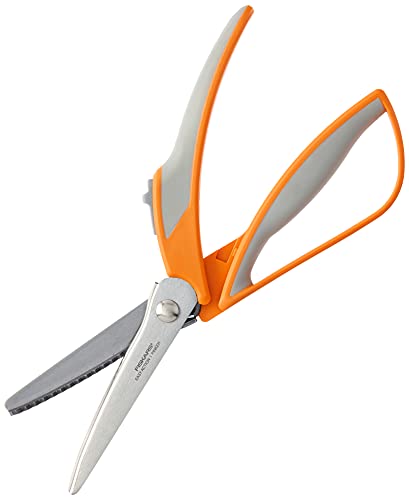
The Easy Action pair solves the biggest complaint about pinking shears: the effort of reopening the blades after every squeeze. A spring-action mechanism gently pushes the blades back open, so your hand only does half the work on each cut. At 10.5 inches overall, these are also the longest shears in this guide, and the extended lower blade helps lift fabric for a steady, precise cut along long, straight seam allowances.
Softgrip touchpoints cushion the handles, and an easy-open lock keeps the blades closed in a drawer. The length that helps on straight seams can feel unwieldy around tight curves and small pattern pieces, and a spring is one more part that plain shears do not have. For sewists with arthritis, tired hands or a lot of yardage to finish, though, the reduced strain is the whole point, and the stainless blades still cut cleanly to the tip.
Specs
- Overall length: 10.5 inches
- Blade material: stainless steel
- Edge: zigzag pinking teeth, tooth size not stated
- Handle: spring-action with Softgrip touchpoints, easy-open lock
- Hand orientation: ambidextrous
- Model number: 191000-1001
- Weight: 6.4 ounces
- Warranty: not stated
Who it’s for: Sewists with hand fatigue or reduced grip strength, and anyone pinking long, straight seams on garments or quilts.
Who should skip: Anyone who mostly trims small, curved pieces, or who prefers the simplest possible tool with no spring mechanism.
4. SINGER Pinking Shears, 9 Inch
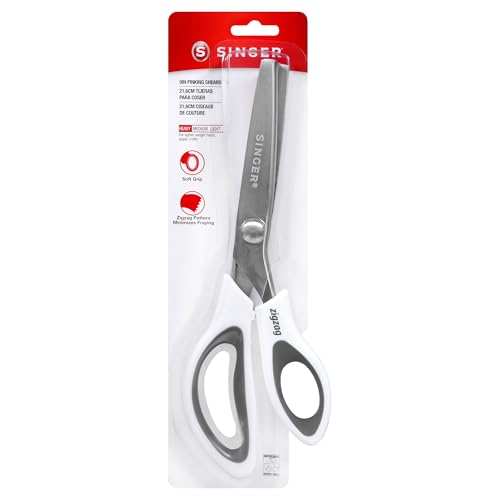
SINGER’s standard 9-inch pinking shears are the straightforward value pick: stainless steel blades that cut a precise zigzag, a soft grip handle with grey accents, and a size that sits comfortably between the compact Gingher and the long Easy Action. The soft grip makes them pleasant for everyday sewing and craft projects, and the 9-inch length handles hems, seam allowances and light upholstery fabrics without fuss.
This pair is aimed at lighter, more precise fabric work rather than heavy-duty cutting, so thick stacks and very heavy cloth are better left to a forged pair. The listing does not publish a tooth size, which is common at this level. For garment sewing, quilting and general craft use where the fabric is light to medium weight, it covers the job at an entry-level cost.
Specs
- Overall length: 9 inches
- Blade material: stainless steel
- Edge: zigzag pinking teeth, tooth size not stated
- Handle: soft grip
- Hand orientation: ambidextrous
- Model number: 00488
- Weight: 5.6 ounces
- Warranty: not stated
Who it’s for: Beginners and casual sewists who want a comfortable, affordable pair for light to medium woven fabrics.
Who should skip: Anyone cutting heavy denim, canvas or many layers at once, who should look at the forged Gingher instead.
5. SINGER ProSeries Pinking Shears, 9 Inch

The ProSeries is SINGER’s heavier-duty take on the same 9-inch format. Its stainless steel blades carry teeth spaced at 5-millimeter intervals, one of the few published tooth sizes in this category, and that fine, even spacing produces a uniform zigzag that suits cotton and other crisp fabrics especially well. An ergonomic handle with a thermoplastic rubber grip keeps the pair steady during longer cuts.
SINGER rates these shears for both lightweight and heavyweight materials, but draws one clear line: they are not suitable for non-woven fabrics such as knit jersey or sweater knit, which can snag instead of cutting cleanly. That makes them a woven-fabric tool through and through. If your projects are mostly crisp cottons, linens and similar cloth, the published tooth spacing and firmer build make this the more capable of the two SINGER pairs.
Specs
- Overall length: 9 inches
- Blade material: stainless steel
- Edge: sawtooth pinking teeth, 5-millimeter spacing
- Handle: ergonomic soft grip, thermoplastic rubber
- Hand orientation: not stated
- Model number: 00170
- Weight: 5.76 ounces
- Warranty: not stated
Who it’s for: Sewists who work mainly with cotton and other crisp wovens and want a published tooth size with a heavier-duty build.
Who should skip: Anyone finishing knit or jersey fabrics, and anyone who wants a spring-action or cushioned handle for long sessions.
Frequently Asked Questions
Do pinking shears stop fabric from fraying completely?
No. A pinked edge slows fraying by breaking up the straight grain, but it does not seal the edge the way a serged or bound finish does. On loosely woven fabric or items washed often, combine pinking with a stitched finish for the most durable result.
Can I cut paper or card with pinking shears?
It is not a good idea. Paper and card dull the fine sawtooth teeth quickly, and dull pinking shears chew fabric instead of cutting it. Keep one pair dedicated to fabric only, and use ordinary craft scissors for paper.
How do I care for pinking shears?
Wipe lint out of the teeth after use, keep the blades dry, and store the shears closed, in a sheath if one is included. A drop of scissor oil at the pivot keeps the action smooth. Forged steel pairs such as the Gingher can be resharpened by a professional; most stamped stainless pairs are replaced when they dull.
Which size should I choose?
Match the length to your work. Shears around 7.5 to 8 inches steer best around curves and small pieces, while 9 to 10.5 inch pairs cover long, straight seam allowances in fewer cuts. If your hands tire easily, a spring-action design matters more than length.
Final Verdict
For most home sewists, the Fiskars 8 Inch is the pair to start with: light, precise, and backed by a lifetime warranty. Choose the Gingher 7.5 Inch if you want forged, plated steel you can resharpen and keep for years, and the Fiskars Easy Action if hand strain is your main obstacle. The two SINGER pairs round out the range for value shoppers, with the standard 9 Inch for light everyday work and the ProSeries for crisp wovens where its published 5-millimeter teeth give a fine, even edge.
Product and ASIN Reference
| Product | ASIN |
|---|---|
| Fiskars Pinking Shears, 8 Inch, Orange | B0DPY3PR1L |
| Gingher Pinking Shears, 7.5 Inch | B000MWXPKI |
| Fiskars Easy Action Pinking Shears, 10.5 Inch | B00VU4TITE |
| SINGER 9″ Pinking Shears | B08N2PQP4X |
| SINGER ProSeries 9″ Pinking Shears | B0CTW8SSRT |