Our Short List of 3

- Best for: Deer hunters whose longest realistic field shot is around 300 yards.
- Magnification: 3-9x
- Objective lens diameter: 40 mm
- Reticle: Dead-Hold BDC
- Focal plane: Second
- Best for: Open-country deer and antelope hunting where 300-yard shots are a normal part of the day.
- Magnification: 4-12x
- Objective lens diameter: 44 mm
- Reticle: Dead-Hold BDC (MOA)
- Part number: CF2-31015

- Best for: Hunters who prefer dialing to an exact distance over holding over with reticle marks.
- Magnification: 3-9x
- Objective lens diameter: 40 mm
- Reticle: Duplex
- Adjustment: 1/4 MOA finger clicks with CDS elevation dial
All 4 Picks at a Glance
| Product | Specs | Action |
|---|---|---|
| Vortex Crossfire II 3-9×40 Dead-Hold BDC |
| Check price on Amazon |
| Vortex Crossfire II 4-12×44 Dead-Hold BDC |
| Check price on Amazon |
| Leupold VX-Freedom 3-9×40 CDS Duplex |
| Check price on Amazon |
 Vortex Crossfire II 6-24×50 AO Dead-Hold BDC |
| Check price on Amazon |
Key takeaways
- Four rifle scopes with the magnification 300-yard shooting actually needs, from classic 3-9x hunting glass to a 6-24x scope with an adjustable objective.
The magnification question at 300 yards is not how much zoom you can buy, but how much you will honestly use. A whitetail at 300 yards through a 9x scope looks like one standing 33 yards away, which is plenty for a chest shot, while small targets such as prairie dogs or a steel plate’s scoring ring ask for more. Extra zoom also narrows your field of view and magnifies every wobble in your hold, so the right range is a compromise between reach and control.
This shortlist serves deer hunters who take long field shots now and then, varmint and predator shooters working small targets at known distances, and range shooters who watch their hits on paper at 300. Every scope below was picked from its Amazon listing, using the magnification range and objective size printed in that listing, and each covers 300 yards in a different way: two versatile hunting ranges, one dial-based hunting scope, and one high-zoom option with an adjustable objective.
Quick Picks
As an Amazon Associate we earn from qualifying purchases.
| Product | Best for | Key spec from title |
|---|---|---|
| Vortex Crossfire II 3-9×40 Dead-Hold BDC | Deer hunting with shots out to 300 yards | 3-9x magnification, 40 mm objective |
| Vortex Crossfire II 4-12×44 Dead-Hold BDC | Open-country shots at the full 300 | 4-12x magnification, 44 mm objective |
| Leupold VX-Freedom 3-9×40 CDS Duplex | Hunters who dial elevation for distance | 3-9x magnification, CDS dial system |
| Vortex Crossfire II 6-24×50 AO Dead-Hold BDC | Varmints and range work at and past 300 | 6-24x magnification, adjustable objective |
How to Choose
Magnification Range That Matches the Shot
Most 300-yard shooting happens between 6x and 12x, even on scopes that zoom far higher. At 9x, a deer-size target fills enough of the view for a steady hold on the chest, and 12x adds the detail needed to judge a rack or pick a spot on a smaller animal. Push past roughly 14x and two costs appear: the field of view shrinks until finding the target takes real effort, and every pulse and breath shows up as movement in the reticle. Match the top end to your smallest honest target, and keep a low end of 3x or 4x for close shots in cover.
Reticle Marks and Holdover Help
A bullet fired at a deer load drops several inches between 200 and 300 yards, so you either hold over or dial up. BDC reticles print extra marks below the center crosshair that stand in for those longer distances, which is fast in the field and needs no turret work. A plain duplex reticle keeps the view clean but leaves the hold to your memory or a dial. One caution applies to every second focal plane scope here: the spacing of BDC marks is correct at only one magnification, usually the highest, so confirm that setting and use it when you rely on the marks.
Objective Size and Light at First and Last Shooting Light
Objective diameter decides how much light the scope gathers and how large the exit pupil stays as you zoom in. A 40 mm lens at 9x gives an exit pupil near 4.4 mm, which most eyes handle well in dim woods, while a 44 or 50 mm lens keeps the image brighter at 12x and beyond, when the pupil would otherwise shrink. Lens coatings matter as much as raw size, since they decide how much of that gathered light reaches your eye. Bigger objectives also sit higher above the barrel, so budget attention for ring height and a consistent cheek weld.
Turrets, Clicks and Parallax at Distance
Click value turns into real distance at 300 yards: a quarter-MOA click moves the point of impact roughly three quarters of an inch per click at that range, so small errors in counting clicks are forgiving, but a turret that does not track true will undo careful math. Capped turrets protect a hunting zero from brush and bumps, while finger-adjustable dials suit shooters who change settings often. Parallax deserves a look too, because most hunting scopes are set parallax-free at 100 yards; an adjustable objective lets you remove that error exactly at 300, at the cost of one more ring to turn before the shot.
The 4 Best Options
Vortex Crossfire II 3-9×40 Dead-Hold BDC
- Best for: Deer hunters whose longest realistic field shot is around 300 yards.
- Magnification: 3-9x
- Objective lens diameter: 40 mm
- Reticle: Dead-Hold BDC
- Focal plane: Second
Deer hunters whose longest realistic field shot is around 300 yards.
The BDC marks only match their printed holdover values at one magnification setting, so verify your load against the marks at the range before trusting them in the field.
The classic deer scope formula still covers 300 yards well, and this is the straightforward version of it. The 3-9x range keeps a wide, forgiving view for woods shots at the low end, and 9x is enough magnification to place a careful shot on a deer-size target at the full distance. The Dead-Hold BDC reticle adds holdover marks for the longer shots, so you can hold on a lower mark instead of guessing above the back. A one-inch tube and moderate size keep the rifle handy for carrying, and the capped turrets hold a zero through a season of bumps.
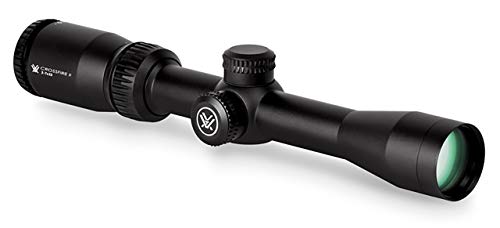
Vortex Crossfire II 4-12×44 Dead-Hold BDC
- Best for: Open-country deer and antelope hunting where 300-yard shots are a normal part of the day.
- Magnification: 4-12x
- Objective lens diameter: 44 mm
- Reticle: Dead-Hold BDC (MOA)
- Part number: CF2-31015
Open-country deer and antelope hunting where 300-yard shots are a normal part of the day.
Parallax is fixed at the factory setting rather than adjustable, so keep your eye centered behind the ocular lens on long shots to avoid a shifted point of impact.
This is the step up for hunters whose 300-yard shots are routine rather than rare. The 12x top end gives a clearer look at distant game, which helps you judge an animal and pick an exact aiming point across a field or canyon, and the 44 mm objective keeps the picture bright when you use that top end near dusk. It shares the Dead-Hold BDC reticle with its smaller sibling, so the holdover system stays familiar. The trade is a slightly narrower view at the 4x low end and a bit more scope on top of the rifle, both fair costs for open country.
Leupold VX-Freedom 3-9×40 CDS Duplex
- Best for: Hunters who prefer dialing to an exact distance over holding over with reticle marks.
- Magnification: 3-9x
- Objective lens diameter: 40 mm
- Reticle: Duplex
- Adjustment: 1/4 MOA finger clicks with CDS elevation dial
Hunters who prefer dialing to an exact distance over holding over with reticle marks.
A CDS dial is engraved for one specific load, so changing bullet weight or velocity afterward means the yardage marks no longer match your bullet drop.
Leupold takes the other route to 300 yards: instead of holdover marks, the CDS system lets you dial elevation to the distance. You send Leupold your load data and receive a custom dial marked in yards, then turn it to 300 and hold the plain Duplex crosshair on center. Finger clicks of a quarter MOA make range adjustments simple without tools, and the uncluttered reticle suits hunters who find BDC marks busy. The aluminum build keeps weight low on a carry rifle, and the 3-9x range matches the distances most deer hunters actually shoot.
Vortex Crossfire II 6-24×50 AO Dead-Hold BDC
- Best for: Varmint shooters and range use at known distances of 300 yards and beyond.
- Magnification: 6-24x
- Objective lens diameter: 50 mm
- Reticle: Dead-Hold BDC (MOA)
- Focal plane: Second
Varmint shooters and range use at known distances of 300 yards and beyond.
The 6x low end is too much magnification for close or moving targets in timber, and heat mirage often caps the useful zoom well below 24x on warm days.
Small targets change the math completely, and this scope is built for them. The 6-24x range lets you watch a prairie dog town at distance or read your own hits on a 300-yard target, and the adjustable objective removes parallax at whatever distance you set, which matters when the target is a few inches wide. The 50 mm objective feeds enough light to keep the high settings usable. It is a long, heavy scope on a 30 mm tube, so it belongs on a varmint or range rifle that is shot from a rest rather than carried up a ridge.
Which One Fits Your Situation
Deer Hunting in Mixed Timber and Open Fields
Pick the Crossfire II 3-9×40. Most deer in broken country appear well inside 200 yards, where its wide low-end view and forgiving eye box help you get on target quickly, and the 9x top end plus BDC marks still cover the occasional field-edge shot at 300. It also keeps the rifle light and simple, which matters more over a full day of walking than one extra turn of zoom.
Open-Country Hunting Where 300 Is Normal
Pick the Crossfire II 4-12×44. Across basins, crop fields and sage flats, the extra reach at 12x helps you judge game and place a precise hold at the full distance, and the larger objective holds brightness together in the low light when animals move. The BDC marks give you a fast holdover method when there is no time to dial.
One Trusted Load and a Rangefinder Habit
Pick the Leupold VX-Freedom CDS. If you hunt with a single load and confirm distances with a rangefinder, dialing to the exact yardage and holding center is the most repeatable method of the group. The plain Duplex reticle keeps the sight picture clean, and the light build suits a rifle carried far from the truck.
Varmints, Prairie Dogs and Paper at Known Distance
Pick the Crossfire II 6-24×50 AO. Small targets at 300 yards and beyond reward magnification and exact parallax control more than carry weight, and this scope provides both. Shot from a bench or prone position, its narrow field of view is no handicap, and spotting your own hits speeds up every correction.
Common Mistakes
- Buying the highest zoom on the shelf for deer hunting, then fighting a narrow field of view and a shaky picture at the moment of the shot.
- Trusting BDC holdover marks without ever firing your own load at 300 yards to see where the marks truly land.
- Zeroing at 100 yards and assuming the hold at 300 will match a chart, instead of confirming it on targets.
- Mounting a large 50 mm objective on rings that sit too low, leaving the lens touching the barrel or forcing an awkward head position.
- Forgetting that second focal plane reticle marks change value as you zoom, then using them at the wrong setting.
Frequently Asked Questions
How Much Magnification Do You Need at 300 Yards?
For deer-size targets, 6x to 9x is enough for a confident hold, and 12x adds comfort for judging the animal and choosing an exact spot. Smaller targets such as varmints reward 16x or more. Distance alone does not set the requirement; target size does, which is why one scope range cannot be right for every shooter.
Is a 3-9x Scope Enough for 300 Yards?
Yes, for big game it remains a proven combination. At 9x, a deer at 300 yards appears about as large as one at 33 yards with the naked eye, which is a familiar and manageable sight picture. The limits show up on small targets, in poor light, and when you need to judge fine detail before deciding to shoot.
What Does a BDC Reticle Do at 300 Yards?
A BDC reticle prints extra aiming marks below the center crosshair, each one standing in for the bullet drop at a longer distance. Instead of holding above the target and guessing the gap, you place the 300-yard mark on the spot you want to hit. The marks are approximations built around common loads, so confirm them with your own ammunition.
Does Objective Size Matter More Than Magnification at 300 Yards?
Neither wins outright. Magnification decides how large the target appears, while objective size and coatings decide how bright and clear that image stays, especially at dawn and dusk. A 40 mm lens at 9x serves most hunters well; stepping to 44 or 50 mm mainly pays off when you use higher zoom in weak light.