Our Short List of 3

- Best for: Birders and range shooters who want one bright 80mm scope for everything
- Magnification: 20-60x zoom eyepiece
- Objective lens diameter: 80mm
- Focal length: 480mm
- Field of view: 105 ft at 20x, 53 ft at 60x (at 1,000 yards)

- Best for: First-time buyers who want a working setup without separate accessory purchases
- Magnification: 20-60x
- Objective lens diameter: 80mm
- Field of view: 82.9 ft at 1,000 yards
- Prism: BaK4
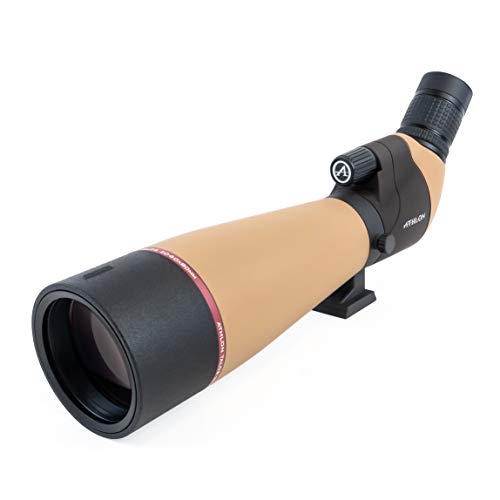
- Best for: Hunters and hikers who want 80mm brightness in a lighter carry
- Magnification: 20-60x
- Objective lens diameter: 80mm
- Field of view: 82.9-48 ft at 1,000 yards
- Eye relief: 0.7-0.6 in
All 4 Picks at a Glance
| Product | Specs | Action |
|---|---|---|
| Celestron Ultima 80 Angled Spotting Scope |
| Check price on Amazon |
| Gosky DiamondEdge 20-60×80 Spotting Scope |
| Check price on Amazon |
| Athlon Optics Talos 20-60×80 Spotting Scope |
| Check price on Amazon |
 SVBONY SV28 Plus 25-75×70 Spotting Scope |
| Check price on Amazon |
Key takeaways
- Four spotting scopes compared for range and field use, with zoom range, objective size, prism glass and weather sealing taken from each Amazon listing.
Picking a spotting scope is really a decision about distance and steadiness. A scope that reads bullet holes on paper at 200 yards has to hold a narrow, bright image at high zoom without shaking apart on a light tripod, while a scope for watching shorebirds needs a wide, calm view at low power and enough brightness for grey mornings. Buyers often fixate on the biggest zoom number on the box, then discover that weight, eye relief and the quality of the front glass matter more once the scope is mounted and pointed at a real subject.
This guide is for range shooters who need to call their own shots, birders and wildlife watchers who scan wetlands and ridgelines, and hunters who glass country from a tripod. Every model below is a dedicated spotting scope sold on Amazon, chosen from the zoom range, objective size, prism glass and sealing stated in its own listing title and product details, so the comparison rests on published numbers rather than marketing claims.
Quick Picks
As an Amazon Associate we earn from qualifying purchases.
| Product | Best for | Key spec from title |
|---|---|---|
| Celestron Ultima 80 Angled | All-round birding and range use | 20-60x zoom, 80mm objective |
| Gosky DiamondEdge 20-60×80 | A complete kit in one box | Tripod, bag and phone holder included |
| Athlon Optics Talos 20-60×80 | Hunters watching the weight | 80mm objective at 38.5 oz |
| SVBONY SV28 Plus 25-75×70 | Top-end zoom for target work | 25-75x zoom, IP65 sealing |
How to Choose
Zoom Range and What It Really Changes
Most scopes in this class zoom from 20-60x, and that span covers nearly every job: 20x gives a wide view for finding a bird or a steel plate, while 60x resolves feather detail or a tight group on paper. Ranges that run to 75x reach further on paper targets, but every extra increment of magnification also magnifies tripod shake, heat shimmer and hand tremor. A wider low end is usually worth more than a higher top end, because locating the subject quickly at 20x or 25x decides whether the top of the range gets used at all.
Objective Size and Low-Light Brightness
The front lens diameter, the second number in a scope’s name, controls how much light the system gathers. An 80mm objective keeps the image usable at dawn, dusk and under heavy cloud, and it holds brightness at 60x where smaller lenses dim quickly. A 70mm lens gives up a little of that reach in exchange for a shorter, lighter body, and a 60mm scope suits bright midday viewing and short walks. Match the glass to your light: regular low-light sessions justify the bigger lens, while fair-weather range days do not need it.
Prism Glass and Lens Coatings
Inside the body, a prism folds the light path, and its glass grade shows up directly in edge sharpness and contrast. BaK-4 glass is the better grade found in the stronger listings here, while BK7 appears in lighter entry models. Coatings matter just as much: multi-coated and fully multi-coated optics pass more light through each surface, which keeps colours honest and stops the image washing out when you look toward the sun. When two scopes share the same zoom and objective size, the one listing BaK-4 glass and fuller coatings is normally the clearer instrument.
Body Style, Sealing and the Tripod Question
Angled bodies, where the eyepiece sits at 45 degrees, let several people of different heights share one tripod setting and work well from a bench or a car window mount. Straight bodies aim like a rifle and suit prone shooters. Waterproof and fogproof sealing, usually from nitrogen filling and O-rings, protects the scope in rain and stops internal fogging on cold mornings. Finally, no zoom range performs without support: check whether a tripod is included, and expect a bundled tabletop tripod to be a starting point rather than the final answer at high power.
The 4 Best Options
Celestron Ultima 80 Angled Spotting Scope
- Best for: Birders and range shooters who want one bright 80mm scope for everything
- Magnification: 20-60x zoom eyepiece
- Objective lens diameter: 80mm
- Focal length: 480mm
- Field of view: 105 ft at 20x, 53 ft at 60x (at 1,000 yards)
Birders and range shooters who want one bright 80mm scope for everything
No tripod is included, so budget for a sturdy one before the first outing
The Celestron Ultima 80 Angled is the steady all-rounder of this group, built around an 80mm refractor body with a 20-60x zoom eyepiece and a 45-degree viewing angle that suits both a range bench and a shared tripod at a wetland overlook. Its listing highlights multi-coated optics over a BaK-4 prism, waterproof and fogproof sealing, and a T-adapter thread in the eyepiece for attaching a camera, which gives it a second life for digiscoping. The soft carrying case and extended mounting plate in the box round out a package aimed at owners who want one scope for several jobs.
Gosky DiamondEdge 20-60×80 Spotting Scope
- Best for: First-time buyers who want a working setup without separate accessory purchases
- Magnification: 20-60x
- Objective lens diameter: 80mm
- Field of view: 82.9 ft at 1,000 yards
- Prism: BaK4
First-time buyers who want a working setup without separate accessory purchases
The bundled tripod is a starter support; high zoom in wind will push its limits
The Gosky DiamondEdge 20-60×80 answers the most common beginner problem, which is buying a scope and then discovering the extras it still needs. Gosky ships this 80mm angled scope with a tripod, a carrying bag and a quick phone holder in the same box, so it can go from delivery to the range or the lake shore in one trip. The listing specifies BaK4 prism glass and a waterproof build, and at 2.41 pounds the scope itself stays light enough for a day pack. For buyers who want to photograph through the eyepiece on day one, the included phone holder removes the guesswork of matching an adapter.
Athlon Optics Talos 20-60×80 Spotting Scope
- Best for: Hunters and hikers who want 80mm brightness in a lighter carry
- Magnification: 20-60x
- Objective lens diameter: 80mm
- Field of view: 82.9-48 ft at 1,000 yards
- Eye relief: 0.7-0.6 in
Hunters and hikers who want 80mm brightness in a lighter carry
The listing is for the scope alone, with no tripod or case in the box
The Athlon Optics Talos 20-60×80 is the hunter’s route into 80mm glass without the usual carry penalty, since the listing puts it at 38.5 ounces in a 16.5-inch body. That is light for a scope with this much front lens, and it matters on long approaches where the tripod, water and rifle already compete for pack space. The angled eyepiece works well for glassing hillsides from a seated position, and the 82.9 to 48 foot field of view keeps scanning at 20x practical before you zoom in to judge an animal. Athlon sells the scope on its own, so the tripod choice stays with you.
SVBONY SV28 Plus 25-75×70 Spotting Scope
- Best for: Target shooters who value top-end zoom for spotting hits at distance
- Magnification: 25-75x
- Objective lens diameter: 70mm
- Field of view: 64-43 ft at 1,000 yards
- Prism: BAK4, fully multi-coated optics
Target shooters who value top-end zoom for spotting hits at distance
The 25x starting power and narrow view make finding subjects slower than with a 20x scope
The SVBONY SV28 Plus pushes the zoom range further than the 80mm models here, running from 25x to 75x through a 70mm objective, which makes it the natural pick for reading small bullet holes and scoring rings at longer range sessions. Its listing specifies fully multi-coated optics with a BAK4 prism, IP65 waterproof and fogproof sealing, and a twist-up eyecup that helps glasses wearers hold the full picture. A tripod and a phone adapter come in the box, and the angled body keeps bench work comfortable. The narrower field of view is the trade for that extra reach at the top end.
Which One Fits Your Situation
You Shoot Paper Targets and Call Your Own Shots
Reading .22 or .30 calibre holes at 100 to 300 yards is a resolution job, and the SVBONY SV28 Plus earns this spot with its 75x top end and angled body for bench use. The Celestron Ultima 80 is the alternative when the light drops late in the day, because its 80mm objective holds brightness at 60x that the smaller lens gives up.
You Watch Birds and Wildlife on Weekend Walks
For scanning a marsh at 20x and then zooming onto a heron or a distant raptor, the Celestron Ultima 80 fits best: the wide 105-foot field at low power finds subjects quickly, and the T-adapter lets a camera join later. The Gosky DiamondEdge suits the same walks when you would rather carry one bag with the tripod and phone holder already inside it.
You Glass Big Country on Foot
When the scope rides in a pack for hours before it ever meets the tripod, the Athlon Talos is the sensible 80mm choice at 38.5 ounces, light enough that it does not get left at the truck. Its field of view at 20x is wide enough for systematic hillside scans, and 60x is there when an animal needs a closer judgement call.
You Want to Photograph Through the Scope
Phone photography through an eyepiece is mostly an alignment problem, and the Gosky DiamondEdge removes it with the quick phone holder in the box. The SVBONY SV28 Plus also includes a phone adapter and adds sealing for wet viewing platforms. The Ultima 80 takes a different route with its threaded T-adapter, which suits a camera body rather than a phone.
Common Mistakes
- Choosing a scope by its highest zoom number, then finding the image shakes too much to use on a light tripod
- Buying a straight body for shared viewing, so shorter and taller users fight the tripod height all day
- Ignoring eye relief when you wear glasses, which cuts off the edges of the picture at the eyepiece
- Assuming every scope includes a tripod, then discovering the box holds the scope and nothing to stand it on
- Carrying a full-size 80mm scope on steep backpack hunts where a smaller lens would have come along instead
Frequently Asked Questions
What magnification do I need to see bullet holes at 100 yards?
Most shooters read holes at 100 yards comfortably inside a 20-60x range, working around 30-45x where the image stays bright and steady. Small .22 holes in dark paper ask for the upper half of the range and good light on the target. Beyond 200 yards, mirage and air quality limit the view more than magnification does, so a stable tripod matters as much as zoom.
Should I choose an angled or a straight spotting scope?
Choose angled if the scope will sit on a bench, a shared tripod or a window mount, because the 45-degree eyepiece keeps your neck relaxed and lets people of different heights take turns. Choose straight if you shoot prone or need to swing onto a subject fast, since a straight body points where you look. All four scopes in this guide use angled bodies.
Can I take phone photos through these scopes?
Yes, with the right holder. The Gosky DiamondEdge and the SVBONY SV28 Plus include phone adapters in the box, so the phone clamps over the eyepiece and aligns with the exit pupil. The Celestron Ultima 80 instead carries a T-adapter thread for a camera. Keep the phone’s digital zoom off, brace the tripod, and expect the sharpest results at the scope’s lower magnifications.
Is an 80mm objective worth the extra size over a 70mm?
For dawn, dusk and overcast work, yes: the larger lens keeps the picture brighter at high zoom, which is exactly when smaller scopes fade. In bright midday light the difference narrows, and a 70mm model like the SV28 Plus answers with more zoom in a handier body. Decide by the light you actually shoot and watch in, not by the biggest number.