Key takeaways
- Learn the best time to turn off sprinklers for winter: the temperature signals that matter, shutdown timing by region, and the full winterizing steps.
The best time to turn off sprinklers is before the first hard freeze reaches your area, and in most of the United States that means shutting the system down in the window between mid-autumn and the end of autumn, once night temperatures keep falling to near freezing and the lawn has stopped growing. Turning the controller off is only the visible part of the job. The real deadline is the water sitting in the pipes: once that water freezes it expands, and the expansion is what cracks pipe walls, splits valve bodies and ruins backflow preventers over winter.
This guide works through the decision in the order it actually happens. First, the temperature signals that matter more than any calendar date. Then a region-by-region timing table, the signs that your own yard is ready, the cases where you should hold off a little longer, and the full shut-down procedure step by step. It closes with the mistakes that cause most spring repair bills and answers to the questions homeowners ask most about switching a system off for the season.
As an Amazon Associate, we earn from qualifying purchases.
The Short Answer: Watch the Thermometer, Not the Calendar
A sprinkler system is in danger when water inside it freezes, and water freezes at 32 degrees Fahrenheit. The practical trigger used by irrigation professionals is not the first frosty morning but the approach of a hard freeze, usually defined as temperatures at or below 28 degrees for several hours. A light frost that touches the grass at dawn and melts by breakfast rarely harms buried pipe. A long night in the twenties can freeze water in above-ground backflow preventers, valve manifolds and shallow laterals, and those are the parts that fail.
So the working rule is this: plan the shut-down for roughly one to two weeks before your area’s typical first hard freeze, and be finished before the first forecast that calls for a night in the mid-twenties. Night temperatures matter more than daytime highs, because the coldest hours arrive while the system is idle and full of standing water. If your forecast shows several nights in a row dipping to 32 degrees or below, treat that as your signal even if the days still feel mild.
There is a second, quieter signal: the lawn itself. Cool-season grasses slow down sharply once soil temperatures fall, and warm-season grasses go dormant after the first real frosts. When you are mowing noticeably less often and the grass has stopped putting on new growth, it needs little water, and every extra watering mostly sits in the soil and in the lines. Shutting down at that point costs the lawn nothing.
Shut-Down Timing by Region
Climate decides the calendar. The table below gives the usual shut-down window for broad regions of the United States, based on when hard freezes typically arrive. Treat the dates as a planning window, and let your local forecast make the final call in any given year.
| Region | Typical shut-down window | Notes |
|---|---|---|
| Upper Midwest and New England | Early to mid-autumn | Earliest hard freezes in the country; many pros book blow-outs weeks ahead |
| Great Plains and Mountain West | Mid-autumn | Elevation changes everything; high-altitude yards freeze weeks before nearby valleys |
| Mid-Atlantic and lower Midwest | Mid to late autumn | Watch for the first forecast night in the mid-twenties rather than a fixed date |
| Pacific Northwest | Late autumn | Mild but wet; the goal is beating the first cold snap, which can arrive suddenly |
| South and Gulf Coast | Late autumn to early winter | Some years need only a partial shut-down and insulation of exposed parts |
| Deep South, South Florida, low desert Southwest | Often no full shut-down | Freezes are brief and rare; many systems run year-round with freeze precautions only |
Two cautions about the table. First, microclimates beat regions: a shaded north-facing yard at elevation can freeze a fortnight before a sheltered yard a few miles away. Second, municipal and neighbourhood watering rules sometimes set their own seasonal dates, and in drought-prone areas the water authority may publish a recommended winter schedule. A quick check of your local guidance takes minutes and can save a wasted trip.
Signs Your Yard Is Ready
Dates and forecasts set the plan, but your own yard gives the confirmation. Look for several of these signs together:
- Growth has stalled. You are mowing every two weeks or less, and clippings are minimal.
- Nights are consistently cold. Several nights at or below freezing in the forecast, not just one.
- Leaves are mostly down. Fallen leaves blanket the lawn and slow evaporation, so the soil holds moisture far longer than it did in summer.
- Rain is doing the job. Autumn rainfall keeps the soil moist without help from the system.
- The soil stays damp. A screwdriver pushed into the soil in the morning still comes out cool and moist from the day before.
When most of these line up, watering has stopped earning its keep. Anything the system adds from that point is runoff, mud and risk.
When to Hold Off a Little Longer
Shutting down too early has its own costs, and a few situations justify keeping the system live a little later into autumn, provided no hard freeze is imminent:
- New seed or overseeding. Fresh seed needs consistent moisture until it germinates and roots. If you overseeded in autumn, keep watering on a light schedule until the new grass is established, then shut down promptly.
- New sod. Sod laid late in the season needs water until its roots knit into the soil beneath.
- A dry, warm autumn. In an unusually dry spell with daytime temperatures still warm, established lawns benefit from an occasional deep watering so roots go into winter hydrated. Roots that enter dormancy in moist soil handle cold better than roots in dust.
- Mild climates with rare freezes. If your area sees only a handful of freezing nights a year, the standard approach is different: keep the system operational, insulate the exposed backflow assembly, and drain only the most exposed sections ahead of a cold night.
The balance point is simple. Keep watering while the grass is genuinely using the water, and stop the moment the forecast threatens a hard freeze, whatever the calendar says.
How to Turn Off and Winterize the System, Step by Step
Turning a system off for winter means more than switching the controller to its off setting. Done properly, the sequence below takes most homeowners an afternoon, and it is the same sequence whether you drain by gravity or blow the lines out with air.
Step 1: Shut off the water supply. Find the shut-off valve dedicated to the irrigation system, often in the basement, crawl space or a valve box near the meter, and close it. This isolates the sprinkler lines from the house supply so nothing refills them over winter.
Step 2: Set the controller for winter. Switch the controller to its off or rain mode rather than unplugging it. Off and rain modes stop scheduled watering while keeping your programs and clock settings stored, which makes spring setup far easier. If the controller has a seasonal adjust feature, some owners simply dial it to zero, but a full off setting is the safer choice where freezes are hard.
Step 3: Relieve the pressure. Run one zone briefly from the controller, or open a manual drain, to let pressure fall out of the main line. Working on a pressurised system is how fittings get damaged.
Step 4: Drain the water. This is the step that protects the pipes, and there are three accepted methods. Manual drain systems have valves at the low points that you open by hand and leave open. Automatic drain systems empty themselves each time pressure drops, though you should still confirm the drains have opened. Most systems in cold regions use the blow-out method, where compressed air pushes water out zone by zone through the heads. Air pressure must be regulated: too much can shred rotors and fittings, and blow-outs are the one step many homeowners hand to a professional with a suitably sized compressor.
Step 5: Deal with the backflow preventer. The backflow assembly is the most freeze-sensitive part of most systems because it sits above ground full of water. Open its small test cocks and drain valves, and leave the ball valves half open, at roughly a 45-degree angle, so trapped water has room to expand instead of cracking the body. Never leave the valves fully closed with water inside.
Step 6: Insulate what stays outside. Wrap the backflow preventer and any exposed pipe with insulation or a fitted cover once it is drained. Insulation alone does not protect a component that is still full of water, which is why this step comes after draining, not instead of it.
Step 7: Handle hoses, timers and above-ground gear. Disconnect garden hoses and store them under cover. Hose-end timers and hose bib attachments should be drained, brought indoors and have their batteries removed, because the small passages inside them freeze faster than anything else in the yard.
Step 8: Make notes for spring. Photograph valve positions, note which zones you drained and anything that looked worn. Future you, standing in the yard in spring, will be grateful.
One Tool That Automates the Freeze Decision
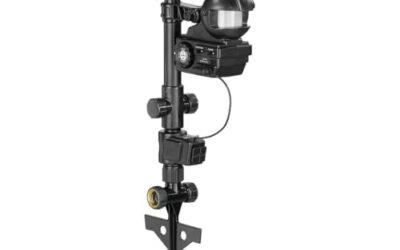
Timing the shut-down well depends on reacting to temperature, and one small category of hardware handles the in-season version of that job for you: a rain and freeze sensor wired or linked to the controller. It suspends watering automatically when rain arrives or the air temperature falls to the freeze threshold, then lets the schedule resume when conditions clear. It is not a substitute for draining the system in a cold climate, but it covers the risky shoulder weeks when a surprise cold night lands before your planned shut-down date.
Hunter Wireless Rain-Clik with Freeze Shutoff (WRCLIK)

The WRCLIK pairs a wireless sensor with a receiver that connects to the controller’s sensor terminals, so there is no cable to run across the yard. Its Quick Response feature shuts irrigation off within minutes of rain beginning, and its freeze function suspends watering when air temperature falls to 37 degrees Fahrenheit, just above the point where exposed water begins to freeze. An adjustable vent ring on the sensor controls how long it waits before allowing watering again after it dries out, which lets you match the reset behaviour to your soil and climate.
Specs
- Wireless rain and freeze sensor system with receiver; freeze shutoff at 37 degrees Fahrenheit; Quick Response rain shutoff; wireless range up to 800 feet line of sight; adjustable vent ring for reset delay; mounts to a gutter, wall, fence or eave; sensor runs on a built-in battery; item weight 14.4 ounces; plastic housing; model WRCLIK
Best for: Homeowners in climates with unpredictable autumn cold snaps, who want the system to protect itself on the nights they are not watching the forecast
Watch out for: It suspends watering; it does not drain pipes, so a full winterization is still required anywhere hard freezes are routine. Confirm your controller has sensor terminals before ordering, and click the listing to confirm the current offer before relying on it.
Common Mistakes
Turning the controller off and calling it done. A silent controller leaves every pipe full of water. The freeze does not care that the schedule stopped; it cracks whatever is full.
Waiting for the first hard freeze warning. By the time a hard freeze is in tonight’s forecast, irrigation companies are booked out and hardware shops are out of insulation. Work a week or two ahead of the weather, not behind it.
Blowing out with unregulated air pressure. A big compressor set too high can destroy rotor gears, seals and fittings in seconds. Volume of air matters more than pressure, and pressure limits differ for different pipe materials. If you are unsure of either figure for your system, this is the step to hire out.
Leaving the backflow valves fully closed. A drained backflow preventer with both ball valves shut can still trap a pocket of water between them. Half-open, at about 45 degrees, is the position that survives winter.
Insulating instead of draining. Foam covers and blankets slow heat loss; they do not stop a component full of water from freezing during a long cold night. Drain first, insulate second.
Forgetting hose-end equipment. The timer on the hose bib and the hose itself hold water in thin passages and are usually the first casualties of an early freeze, weeks before the in-ground system is at risk.
Shutting down before autumn seed has established. The opposite error: turning everything off on a fixed date while new grass is still germinating. The freeze deadline governs, but until it approaches, new seed wins.
FAQ
What temperature is too cold to run sprinklers?
Running sprinklers as air temperature approaches freezing is risky for two reasons: water in exposed parts of the system can begin to freeze, and spray landing on paths and driveways can turn to ice. Most freeze sensors suspend watering at about 37 degrees Fahrenheit, a few degrees above freezing, to leave a safety margin. Below that point, keep the system off.
Do I need to blow out my sprinklers, or is draining enough?
It depends on how the system was built and how cold your winters get. Systems designed with manual or automatic drain valves at their low points can often be drained by gravity alone. Systems without drains, and most systems in regions with long, hard winters, need the blow-out method to clear water from lines that slope the wrong way or hold water in low spots. If you do not know which type you have, a single professional visit will tell you, and the answer stays valid for the life of the system.
When should I turn sprinklers back on in spring?
Wait until the risk of a hard freeze has passed and the soil has thawed fully, which for most regions falls in mid to late spring. Turning on too early exposes a charged, full system to exactly the freeze damage you spent autumn avoiding. When you do switch back on, open the water supply slowly, check the backflow preventer and each zone for leaks, and only then restore the normal schedule.
Can I just turn off the controller and leave the water on?
That is the riskiest of the common shortcuts. With the supply still live, a leaking valve can slowly refill the lines all winter, a controller fault can run a zone on a freezing night, and the backflow preventer stays full and pressurised. Closing the dedicated shut-off valve takes a minute and removes all three risks.
Final Verdict
The best time to turn off sprinklers is one to two weeks before your area’s first hard freeze, once nights are regularly near freezing and the lawn has stopped growing, which lands anywhere from early autumn in the coldest regions to early winter in the mild South. Watch the forecast rather than the calendar, drain the system properly instead of just silencing the controller, leave the backflow valves half open, and bring hose timers indoors. Do that, and spring opening becomes a quick inspection rather than a repair project.