Our Short List of 3

- Best for: high-mileage commuters who follow long, manufacturer-approved drain intervals.
- Viscosity: SAE 0W-20
- Volume: 5 quarts
- Type: full synthetic gasoline engine oil
- Standards named on listing: ILSAC GF-6
- Best for: home mechanics maintaining one or two 0W-20 cars on a regular schedule.
- Viscosity: SAE 0W-20
- Pack format: case of 3, 5-quart jugs
- Type: full synthetic gasoline engine oil
- Base oil: made from natural gas (gas-to-liquid)

- Best for: hard-driven compacts and hybrids whose engines see frequent restarts and high load.
- Viscosity: SAE 0W-20
- Volume: 5 quarts
- Type: advanced full synthetic gasoline engine oil
- Standards named for current formulation: API SP, ILSAC GF-6, GM dexos1 Gen 3
All 5 Picks at a Glance
| Product | Specs | Action |
|---|---|---|
| Mobil 1 Extended Performance Full Synthetic Motor Oil 0W-20, 5 Quart |
| Check price on Amazon |
| Pennzoil Platinum Full Synthetic 0W-20 Motor Oil (5-Quart, Case of 3) |
| Check price on Amazon |
| Castrol EDGE 0W-20 Advanced Full Synthetic Motor Oil, 5 Quarts |
| Check price on Amazon |
 Valvoline Advanced Full Synthetic SAE 0W-20 Motor Oil 5 QT |
| Check price on Amazon |
 Mobil 1 Advanced Fuel Economy Full Synthetic Motor Oil 0W-20, 5 Quart |
| Check price on Amazon |
Key takeaways
- Five 0W-20 full synthetic motor oils for 4 cylinder engines compared, covering Mobil 1, Pennzoil, Castrol and Valvoline picks with API SP and GF-6 specs.
Picking oil for a modern 4 cylinder engine is really a decision about matching three things at once: the viscosity grade printed on the filler cap, the industry specification your manual names, and how far you actually drive between changes. Most current four-cylinder cars from Toyota, Honda, Ford, Hyundai and others call for 0W-20 full synthetic meeting API SP and ILSAC GF-6, and turbocharged versions add low-speed pre-ignition protection to that list. Buy the wrong grade or an older specification and the engine still runs, just with less protection where a small, hard-working engine needs it most.
This roundup is for daily commuters, owners of turbocharged compacts, hybrid drivers whose engines cycle on and off all day, and anyone maintaining an older four-cylinder that still specifies 0W-20. Every pick below is a 0W-20 full synthetic gasoline engine oil chosen from the product names and specification lines on its Amazon listing, so the approvals quoted here come from the listing itself rather than from outside sources.
Quick Picks
As an Amazon Associate we earn from qualifying purchases.
| Product | Best for | Key spec from title |
|---|---|---|
| Mobil 1 Extended Performance 0W-20 | Long drain intervals | 0W-20, 5 quart |
| Pennzoil Platinum Full Synthetic 0W-20 | Stocking up for several changes | 0W-20, case of 3 jugs |
| Castrol EDGE 0W-20 | Hard-driven and hybrid engines | 0W-20, 5 quarts |
| Valvoline Advanced Full Synthetic 0W-20 | Everyday commuting | 0W-20, 5 quart |
| Mobil 1 Advanced Fuel Economy 0W-20 | Fuel economy focus | 0W-20, 5 quart |
How to Choose
Start with the grade and specification in the manual
The single most important check happens before any brand comparison: open the owner’s manual and confirm the viscosity grade and the specification line. The majority of recent 4 cylinder engines specify 0W-20 with API SP and ILSAC GF-6A, while GM engines add a dexos1 approval. A thinner winter grade matters because small engines rely on fast oil flow at startup to protect the timing chain and variable valve timing components. All five oils in this article sit on that same 0W-20 axis, so the choice between them comes down to approvals, interval and driving pattern rather than basic fit.
Match the oil to turbo and direct-injection hardware
Many modern four-cylinder engines pair a turbocharger with gasoline direct injection, and that combination created a failure mode called low-speed pre-ignition, where the fuel-air mixture ignites before the spark at low rpm under load. API SP and ILSAC GF-6 were written partly to control that risk, and dexos1 Gen 3 adds its own layer of protection for GM engines. If your engine is turbocharged, treat those specification lines on the listing as mandatory, not optional background detail. Naturally aspirated engines are less exposed, but there is no downside to the newer specification in an engine that allows it.
Decide how far you really drive between changes
Drain interval claims differ sharply across these listings. Mobil 1 Extended Performance is positioned for protection up to 20,000 miles or one year between changes, while Pennzoil Platinum carries a 15,000-mile protection guarantee in its listing copy. Those figures only apply when the vehicle maker allows the interval and driving conditions are not severe. Short trips, dusty roads, towing and long idling all shorten the safe interval regardless of the jug in the trunk. Pick the oil that matches the schedule you will honestly keep, then follow the oil life monitor or the manual, whichever comes first.
Check sump size and jug format before ordering
Most 4 cylinder engines hold between roughly four and six quarts with a filter change, which is why the 5-quart jug dominates this category: one jug covers the change with a small amount left for topping up. The Pennzoil listing in this roundup is a case of three 5-quart jugs, which suits households running two cars on the same grade or owners who change oil at home several times a year. Confirm your exact sump capacity in the manual, because overfilling a small engine is as unhelpful as running it low, and leftover oil should be stored sealed, upright and out of temperature extremes.
The 5 Best Options
Mobil 1 Extended Performance Full Synthetic Motor Oil 0W-20, 5 Quart
- Best for: high-mileage commuters who follow long, manufacturer-approved drain intervals.
- Viscosity: SAE 0W-20
- Volume: 5 quarts
- Type: full synthetic gasoline engine oil
- Standards named on listing: ILSAC GF-6
high-mileage commuters who follow long, manufacturer-approved drain intervals.
the long interval only applies where the vehicle maker allows it; severe service still shortens it.
Drivers who rack up serious annual mileage and want the longest supported interval between changes are the natural audience here. The listing positions this as Mobil 1’s long-interval formula, with protection for up to 20,000 miles or one year between oil changes, and copy that highlights control of oxidation to prevent oil breakdown across that span. It meets ILSAC GF-6, which brings low-speed pre-ignition and timing chain wear protection relevant to turbocharged four-cylinder engines, plus help keeping pistons and internals clean. For a commuter covering long highway distances in a Camry, Accord or similar sedan, that combination of interval and cleanliness is the core appeal.
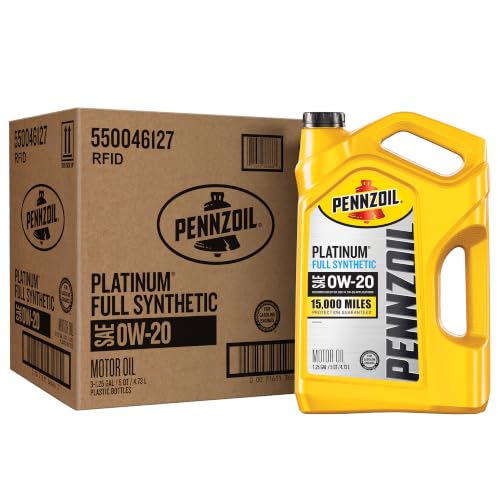
Pennzoil Platinum Full Synthetic 0W-20 Motor Oil (5-Quart, Case of 3)
- Best for: home mechanics maintaining one or two 0W-20 cars on a regular schedule.
- Viscosity: SAE 0W-20
- Pack format: case of 3, 5-quart jugs
- Type: full synthetic gasoline engine oil
- Base oil: made from natural gas (gas-to-liquid)
home mechanics maintaining one or two 0W-20 cars on a regular schedule.
you are storing three jugs, so check you have dry shelf space and will use them while fresh.
This listing suits owners who change oil at home and would rather keep the next two changes on the shelf than order one jug at a time. Pennzoil builds the Platinum line from natural gas through a gas-to-liquid process, and the listing copy leans on the cleanliness that base oil supports, alongside a 15,000-mile protection guarantee. Each jug is the standard 5-quart size that matches most four-cylinder sumps, so a case covers a single car for a long stretch or two cars sharing the same grade. It is a sensible pick for methodical home maintainers who track their own service schedule.
Castrol EDGE 0W-20 Advanced Full Synthetic Motor Oil, 5 Quarts
- Best for: hard-driven compacts and hybrids whose engines see frequent restarts and high load.
- Viscosity: SAE 0W-20
- Volume: 5 quarts
- Type: advanced full synthetic gasoline engine oil
- Standards named for current formulation: API SP, ILSAC GF-6, GM dexos1 Gen 3
hard-driven compacts and hybrids whose engines see frequent restarts and high load.
confirm the dexos1 Gen 3 line on the jug if your GM manual requires that exact approval.
Castrol frames EDGE as its strength-focused formula, and the listing describes it around wear protection, viscosity control and thermal stability, which maps well onto four-cylinder engines that rev hard or cycle constantly in hybrid service. The current United States formulation meets API SP and ILSAC GF-6 and carries GM dexos1 Gen 3 approval, so it covers the specification needs of most Japanese, Korean, American and GM four-cylinder engines in one jug. Drivers who merge aggressively, climb grades daily or run a hybrid that restarts its engine dozens of times per trip get the clearest benefit from an oil built around film strength under pressure.
Valvoline Advanced Full Synthetic SAE 0W-20 Motor Oil 5 QT
- Best for: daily-driven four-cylinder cars that need a mainstream, fully approved 0W-20.
- Viscosity: SAE 0W-20
- Volume: 5 quarts
- Type: full synthetic gasoline engine oil
- Standards named in listing material: API SP, ILSAC GF-6A, GM dexos1 Gen 3
daily-driven four-cylinder cars that need a mainstream, fully approved 0W-20.
this is the standard Advanced formula, not Valvoline’s high-mileage variant, so older engines with seal seepage may want that sibling instead.
Valvoline’s Advanced line is the straightforward everyday choice in this group, aimed at the four-cylinder sedan or crossover that does a mix of school runs, errands and highway commuting. Its specification sheet, as shown in the listing material, meets or exceeds ILSAC GF-6A and API SP, carries GM dexos1 Gen 3 approval, and lists Ford and Chrysler specification numbers used by common four-cylinder applications. The formula is presented around defense against wear, friction, heat and deposits, the four causes of engine breakdown Valvoline names in its own copy. Nothing about it is exotic, which is exactly the point for a daily driver.
Mobil 1 Advanced Fuel Economy Full Synthetic Motor Oil 0W-20, 5 Quart
- Best for: efficiency-minded commuters on standard manufacturer drain intervals.
- Viscosity: SAE 0W-20
- Volume: 5 quarts
- Type: full synthetic gasoline engine oil
- Standards named in listing material: API SP, ILSAC GF-6A
efficiency-minded commuters on standard manufacturer drain intervals.
it is not the long-interval formula, so do not stretch changes beyond the manual or oil life monitor.
Where the Extended Performance jug above chases interval length, this Mobil 1 line is tuned around efficiency. The listing copy says the formula is engineered to help improve fuel economy and extend engine life in vehicles of all ages, which fits the way most 4 cylinder engines are actually used: steady commuting where small efficiency gains accumulate over thousands of miles. It meets or exceeds API SP and ILSAC GF-6A, so turbocharged and direct-injected engines still get low-speed pre-ignition and timing chain wear protection. For an owner whose manual allows a conventional interval and who tracks fuel use closely, this is the Mobil 1 variant that matches the goal.
Which One Fits Your Situation
You cover long highway miles every week
Mobil 1 Extended Performance is the pick built for this pattern, because its listing supports the longest interval in the group and emphasizes oxidation control across extended use. Long, steady driving is also the gentlest duty cycle for oil, so the pairing of highway miles and a long-interval formula is coherent, provided your manual allows the schedule and the oil life monitor agrees.
Your four-cylinder has a turbo and direct injection
Any oil here meets API SP and ILSAC GF-6, which is the specification pair written for low-speed pre-ignition protection, but Castrol EDGE adds dexos1 Gen 3 and a film-strength focus that suits boosted engines working hard at low rpm. Whichever you choose, keep intervals conservative, because turbo engines punish stretched schedules faster than naturally aspirated ones.
You maintain two cars at home
The Pennzoil Platinum case of three jugs removes the reorder step from your routine and keeps the same oil on the shelf for both vehicles, assuming both specify 0W-20. Buying in case format also means the oil for the next change is already there when a free Saturday appears, which is when home maintenance actually happens.
Your engine is older but still specifies 0W-20
Valvoline Advanced covers the mainstream approvals an older four-cylinder needs and is easy to find in this grade, while Mobil 1 Advanced Fuel Economy suits engines of all ages per its listing copy. On an older engine, check the level between changes rather than assuming the interval is the only variable, since consumption often rises before wear becomes visible.
Common Mistakes
- Pouring in 5W-20 or 5W-30 because it was already in the garage, when the filler cap and manual specify 0W-20.
- Stretching a drain interval to a jug’s headline figure even though the vehicle maker sets a shorter limit or the car sees severe service.
- Ignoring the specification line and buying any 0W-20, including older stock that predates API SP, for a turbocharged direct-injection engine.
- Overfilling a small sump by emptying the whole 5-quart jug without checking the dipstick against the actual capacity.
- Mixing up gasoline engine oil with diesel or transmission fluid that happens to share shelf space and similar packaging.
Frequently Asked Questions
Can I use 0W-20 if my older 4 cylinder engine originally specified 5W-20?
Only if the manufacturer has approved that substitution for your exact engine, which some have and many have not. The grades behave differently at operating temperature in engines designed around one of them. Check the manual or the maker’s current guidance for your model year, and keep using the grade printed on the filler cap until you find written approval to change.
How often should oil be changed in a 4 cylinder engine?
Follow the interval in the owner’s manual or the reading of the oil life monitor, whichever the maker prioritizes. Long-interval oils in this roundup support up to 15,000 or 20,000 miles only under the conditions their listings describe, and short trips, towing or dusty driving move any engine into the severe schedule with shorter gaps between changes.
Does a turbocharged four-cylinder need a specific oil?
It needs the current specification more than it needs a specific brand. API SP and ILSAC GF-6 were developed with turbocharged direct-injection engines in mind, including protection against low-speed pre-ignition and timing chain wear. Every oil in this article carries that specification pair, so the practical task is confirming the grade and approval lines against your manual before buying.
Is one 5-quart jug enough for a full oil change?
For most 4 cylinder engines, yes, because typical sump capacity with a filter change falls between about four and six quarts. Some engines sit at the top of that range and need a little more, and a few take noticeably less. Confirm the exact figure in your manual, pour gradually, and let the dipstick, not the empty jug, decide when the level is right.