Key takeaways
- Compare the best weather stations for home use, from WiFi color consoles to a solid-state sensor array, with wireless range, sensors and update speeds.
A home weather station puts a sensor array in your own yard and a live display on your wall or desk, so the temperature, wind and rainfall you see are the ones outside your door rather than at an airport miles away. The five stations below all pair a wireless outdoor sensor with an indoor display console, and they range from a simple color forecast station to WiFi models that publish your data online and a solid-state array with no moving parts.
Choosing between them comes down to three things: what the outdoor sensor actually measures, how the console presents and shares the data, and how far the wireless link reliably reaches through your walls. This guide walks through those points first, then looks at each station in turn.
As an Amazon Associate, we earn from qualifying purchases.
How to Choose a Home Weather Station
Start with the sensor array. Full stations combine temperature, humidity, wind speed, wind direction and rainfall in one outdoor unit, sometimes adding UV and solar radiation. Simpler forecast stations measure only indoor and outdoor temperature and humidity and lean on barometric pressure for their forecast icons. Neither approach is wrong, but a gardener watching rainfall totals and a homeowner who only wants a reliable morning forecast need very different hardware.
Next, look at the console and connectivity. Every station here includes an indoor display, but WiFi models go further: they upload readings to services such as Weather Underground, WeatherCloud or the manufacturer’s own dashboard, so you can check conditions from a phone and keep a long-term record. Non-WiFi consoles keep everything local, which suits buyers who want a glanceable display without accounts or apps.
Wireless range deserves a realistic reading. Manufacturers quote line-of-sight distances in open space, and walls, roofing material and metal siding all shorten the working range. A station rated at 300 feet will usually serve a typical house and yard comfortably, while longer-rated links give more freedom to mount the sensor on a roof or at the far end of a property. Update interval matters too: fast-reporting sensors catch gusts and sudden changes, while slower intervals stretch battery life.
Finally, think about power and mounting. Most outdoor arrays run on batteries, solar panels or both, and the console usually needs a mains adapter with optional battery backup. Plan a mounting spot that is clear of roof overhangs and heat-radiating surfaces, because placement affects accuracy more than small differences between brands.
Ambient Weather WS-2902 WiFi Smart Weather Station
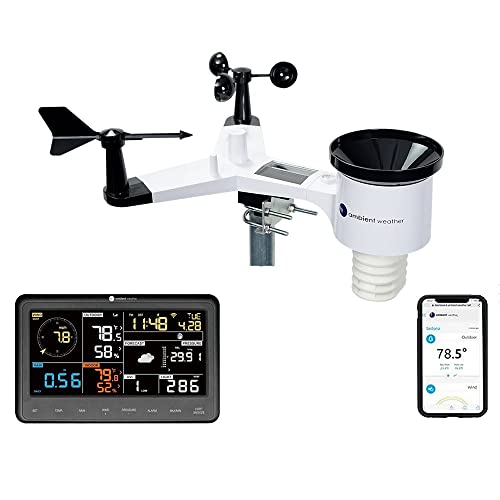
The WS-2902 is the balanced all-rounder of this group. Its outdoor Osprey sensor array measures temperature, humidity, wind speed, wind direction, rainfall, UV index, solar radiation and barometric pressure, and sends readings to a color LCD console indoors. Built-in WiFi connects the console to the Ambient Weather network and Weather Underground, so your station data is viewable in a browser or app and can feed smart home routines.
Specs
- Sensor array: integrated unit measuring temperature, humidity, wind, rain, UV, solar radiation and pressure
- Display: color LCD console with indoor temperature and humidity
- Connectivity: WiFi with Ambient Weather dashboard and Weather Underground support
- Wireless range: up to 300 feet line of sight
- Power: solar panel with battery backup for the array; console uses a mains adapter
- Model: WS-2902C
Who it’s for / who should skip
This is the pick for buyers who want one station that covers nearly every measurement, plus online access, without moving into professional pricing territory. Skip it if you have no interest in WiFi or cloud dashboards, because a simpler console station will do the same local job with less setup.
Ambient Weather WS-2000 Smart Weather Station
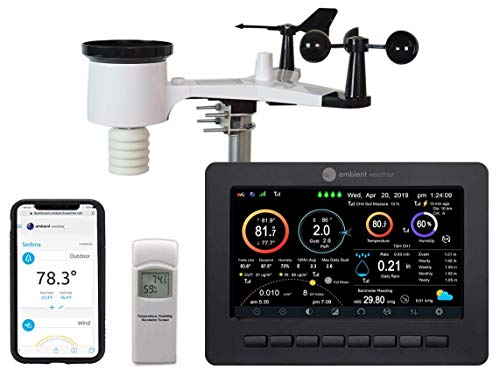
The WS-2000 uses the same Osprey outdoor array as the WS-2902 but pairs it with a larger, higher-resolution TFT display console and a more expandable platform. It supports additional wireless sensors, including extra thermo-hygrometer sensors for other rooms or outbuildings and an optional lightning detector, all shown on the console’s tablet-style screen. WiFi uploading to the Ambient Weather dashboard and Weather Underground is built in.
Specs
- Sensor array: Osprey array measuring temperature, humidity, wind, rain, UV, solar radiation and pressure
- Display: TFT color display console
- Connectivity: WiFi with Ambient Weather dashboard and Weather Underground support
- Expandability: supports up to 8 additional thermo-hygrometer sensors, plus optional lightning and soil sensors
- Wireless range: up to 300 feet line of sight
- Model: WS-2902-ARRAY+2000C console bundle
Who it’s for / who should skip
Choose the WS-2000 if you expect to grow the system over time with extra sensors, or if the bigger, clearer console will live in a prominent spot. Skip it if a single outdoor array and a standard console cover your needs, because the WS-2902 measures the same outdoor conditions for less complexity.
AcuRite Iris (5-in-1) Weather Station with HD Display (01535M)
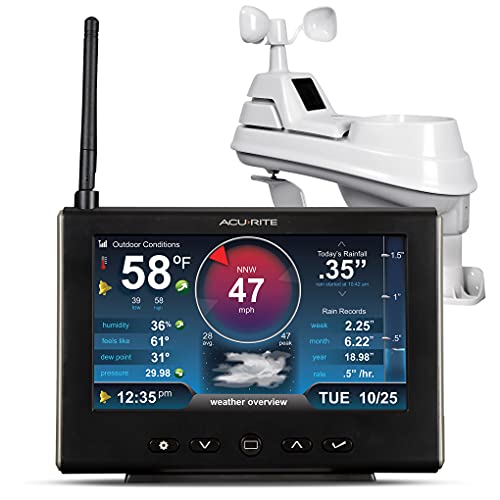
The AcuRite Iris takes a simpler, display-first approach. Its 5-in-1 outdoor sensor measures temperature, humidity, wind speed, wind direction and rainfall, and reports to an HD color display with a built-in barometer. There is no WiFi on this version; instead, the console builds a self-calibrating forecast from your local pressure trend and shows derived readings such as heat index, dew point and wind chill alongside the raw numbers.
Specs
- Sensor: 5-in-1 unit measuring temperature, humidity, wind speed, wind direction and rainfall
- Display: HD color display with built-in barometer and self-calibrating forecast
- Wireless: 433 MHz link with up to 330 feet range
- Update interval: wind speed every 18 seconds; other readings every 36 seconds
- Temperature range: -40 to 158 degrees Fahrenheit
- Power: sensor uses 4 AA batteries; display uses an AC adapter
Who it’s for / who should skip
The Iris suits buyers who want a complete wind and rain station with a bright, easy console and no network setup at all. Skip it if remote viewing on your phone matters, because this model keeps its data on the display; AcuRite sells separate WiFi versions and hubs for that.
Ecowitt Wittboy Pro Weather Station HP2564

The Wittboy Pro replaces moving parts with solid-state sensing. Its WS90 outdoor array measures wind ultrasonically, detects rain with a haptic sensor plate rather than a tipping bucket, and also records temperature, humidity, light and UV. The HP2560 console is a 7-inch TFT display with WiFi, and the station can publish to Weather Underground, WeatherCloud, WOW and Ecowitt’s own servers. The sensor reports every 8.8 seconds, and Ecowitt’s wide accessory ecosystem lets owners add soil, lightning and air quality sensors later.
Specs
- Sensor array: WS90 7-in-1 with ultrasonic wind sensor and haptic rainfall sensor
- Measures: temperature, humidity, wind speed and direction, rainfall, light and UV; console adds barometric pressure
- Display: HP2560 7-inch TFT color console with WiFi
- Wireless: 915 MHz; up to 1,000 feet in open space, about 500 feet with obstacles
- Power: solar panel with AA battery backup; IPX5 weather resistance
- Servers: Weather Underground, WeatherCloud, WOW and Ecowitt
Who it’s for / who should skip
Pick the Wittboy Pro if you like the idea of no spinning cups or tipping buckets to wear out, and if fast updates and an expandable sensor ecosystem appeal. Skip it if pinpoint rainfall accuracy is your top priority, because Ecowitt itself notes that haptic rain readings can deviate in some conditions and suggests adding its separate tipping-bucket gauge for demanding rain data.
La Crosse Technology Weather Station (C85845-INT)

The La Crosse C85845-INT is the straightforward forecast station of the group. A wireless outdoor sensor sends temperature and humidity to a large color display that adds animated forecast icons driven by barometric pressure, plus heat index, dew point, daily high and low records and customizable alerts for temperature and humidity. An atomic clock sets itself from the WWVB signal, and the display brightness adjusts for day and night viewing.
Specs
- Sensor: wireless outdoor temperature and humidity sensor (TX141TH-B)
- Display: large color LCD with animated forecast icons and trend arrows
- Wireless range: up to 300 feet
- Features: atomic time and date, heat index, dew point, HI/LO records, customizable alerts
- Power: display uses a 5V power cord with optional 3 AA battery backup; sensor uses 2 AA batteries
- Note: forecast calibration period of 7 to 10 days stated by the manufacturer
Who it’s for / who should skip
This station fits buyers who mainly want dependable indoor and outdoor temperature and humidity, a clear forecast and alerts on an easy display, without wind or rain hardware to mount. Skip it if you need wind speed, wind direction or rainfall measurement, because this model does not include those sensors.
Frequently Asked Questions
Where should I mount the outdoor sensor?
Mount it clear of roof edges, vents and heat-radiating surfaces, with the wind and rain sensors exposed to open air. A pole in the yard or a high, unobstructed roof position works well; placement has a bigger effect on accuracy than small spec differences between stations.
Do these stations need WiFi to work?
No. Every station here shows live data on its included console without any network. WiFi models such as the WS-2902, WS-2000 and Wittboy Pro add phone access, online dashboards and data sharing on top of the local display, while the AcuRite Iris and La Crosse C85845-INT work fully offline.
How accurate are home weather stations?
They are best understood as accurate for your exact location rather than laboratory instruments. Temperature and pressure readings are generally dependable when the sensor is sited well, while wind and rain figures depend heavily on mounting height and exposure. Solid-state rain sensing, as on the Wittboy Pro, can deviate in some conditions compared with a tipping bucket.
How often do batteries need changing?
It varies by model and climate. Battery-only sensors typically run many months per set, solar-assisted arrays use their panels as the primary source with batteries as backup, and consoles mostly run on mains adapters with batteries only holding settings during outages. Cold weather shortens battery life, and lithium cells are the usual recommendation for freezing climates.
Final Verdict
For most households, the Ambient Weather WS-2902 is the sweet spot: a full set of outdoor measurements, a clear color console and WiFi publishing in one package. The WS-2000 is the upgrade path for a bigger screen and room to add sensors, while the Ecowitt Wittboy Pro is the forward-looking choice with its solid-state array and fast reporting. The AcuRite Iris keeps things simple and offline with a strong display, and the La Crosse C85845-INT covers the basics of temperature, humidity and forecasting for buyers who do not need wind or rain data. Match the sensor list to what you actually want to watch, and any of the five will give you weather that is truly local.
Product and ASIN Reference
| Product | ASIN |
|---|---|
| Ambient Weather WS-2902 WiFi Smart Weather Station | B01N5TEHLI |
| Ambient Weather WS-2000 Smart Weather Station | B07GRBY9NP |
| AcuRite Iris (5-in-1) Weather Station with HD Display (01535M) | B0721JT8SJ |
| Ecowitt Wittboy Pro Weather Station HP2564 | B0BM3BQ425 |
| La Crosse Technology Weather Station (C85845-INT) | B071VKV4HJ |