Key takeaways
- Compare five soldering fume extractors for hobby and pro benches, from compact carbon fan boxes to HEPA purifier units with flexible capture hoses.
Every solder joint sends a thin plume of flux smoke drifting upward, and on a long bench session that plume passes straight through your breathing zone. A soldering fume extractor pulls that smoke away from your face and traps the odor and particles in a filter, which makes a small electronics bench far more comfortable to work at for hours at a time. The category splits into two broad families: simple fan boxes that draw smoke through an activated carbon pad, and larger purifier units that add HEPA filtration and a hose or hood so the intake can sit right next to the joint.
This guide compares five extractors sold on Amazon US, covering both families and a range of bench sizes. The picks include a long-running ESD-safe fan box from Hakko, a three-stage HEPA purifier from FumeClear, a hose-equipped KOTTO unit, a quiet Weller absorber with published airflow figures, and a compact tiltable YIHUA fan that ships with a stack of spare filters. For each one you will find the verified specifications, who it suits, and who should skip it, so you can match the extractor to your bench, your solder, and how often you actually sit down to use it.
As an Amazon Associate, we earn from qualifying purchases.
How to Choose a Soldering Fume Extractor
Start with capture distance, because it decides how well any unit works in practice. A plain fan box has to sit within a few inches of the joint to pull smoke in before it disperses, so it needs bench space right beside your work. A hose or articulated-arm model solves the same problem differently: the fan and filter stay at the back of the bench while the hood travels to the board. If your bench is crowded or you move between projects, a hose design is usually easier to live with than a box that must always sit in the same spot.
Next, look at the filter stack. A single activated carbon pad mainly adsorbs flux odor and some of the gaseous compounds in the smoke; it does not trap fine particles the way a HEPA stage does. Multi-stage purifiers add a pre-filter for larger dust and a HEPA element for fine particulate, which matters if you solder daily, work with rosin-heavy flux, or share the room with other people. The trade-off is cost and upkeep: carbon pads are cheap and swap in seconds, while HEPA and main carbon cartridges are larger consumables that need replacing on a schedule.
Airflow figures are the third thing to compare, with one caution: brands measure them under different conditions, and some publish the number without the filter fitted. Treat CFM and cubic-meters-per-hour ratings as a rough guide to fan strength rather than a laboratory ranking. Noise matters too, since the fan runs the whole session; a published decibel figure in the mid-forties to mid-fifties is typical for this category. Finally, check the practical details: whether the housing is ESD safe for electronics work, how the unit is powered, how much bench footprint it takes, and whether replacement filters for that exact model are easy to find.
Hakko FA400-04 Smoke Absorber

The Hakko FA400-04 is the reference design for the simple bench fan box, sold by one of the best-known names in soldering equipment. It can stand upright behind the work or lie flat at a lower profile, and Hakko publishes airflow for both positions, which is rarer in this category than it should be. The housing is ESD safe, so it can sit next to sensitive boards without adding a static risk, and the standard A1001 activated carbon filter can be swapped for the optional 999-198 high-efficiency filter when you want finer filtration from the same box.
Specs
- Model: FA400-04
- Airflow: 38.8 CFM upright, 17.7 CFM lying flat (manufacturer figures, measured without filter)
- Filter: A1001 activated carbon filter; optional 999-198 high-efficiency filter
- Housing: ESD safe
- Dimensions: 166 x 212 x 113 mm
- Power: 120 VAC (US model)
- Power consumption: not stated
Who it’s for: Hobbyists and repair techs who want a documented, ESD-safe absorber from an established soldering brand, and who have room to park it close to the work.
Who should skip it: Anyone who wants true HEPA particle filtration as standard, or whose bench layout forces the intake to sit far from the joint; a hose model will serve you better.
FumeClear FC-100A Solder Fume Extractor
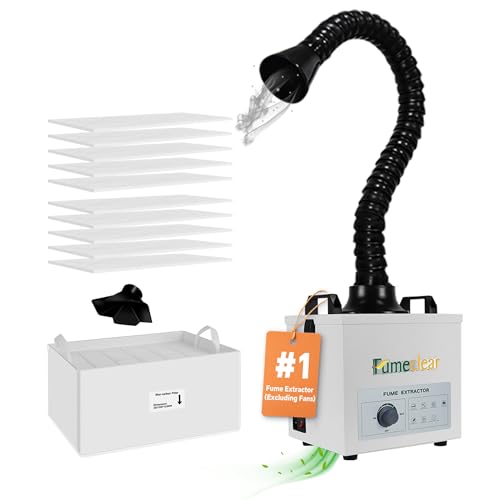
The FumeClear FC-100A is the heavy-duty end of this lineup: a metal-bodied purifier with a 100 W motor, a capture hose, and a three-stage filter stack built around a high-iodine activated carbon main filter. A pre-filter catches larger dust first, a HEPA stage handles fine particles down to 0.3 microns, and the carbon stage adsorbs gases and odors. FumeClear rates the main carbon filter for long service intervals and bundles a dozen filters in the box, so the running costs stay predictable even with regular use.
Specs
- Model: FC-100A
- Power: 100 W, 110 V
- Airflow: 200 cubic meters per hour (manufacturer figure)
- Filtration: 3 stages — pre-filter, HEPA filter, high-iodine activated carbon main filter
- Housing: metal, white finish
- Dimensions: 10.6 x 8.7 x 10.8 inches
- Weight: 19.86 lb
- Sound level: 50 dB (manufacturer figure)
- Hose length: 47 inches
Who it’s for: Daily solderers, small workshops, and anyone who also runs a desktop laser engraver or does light welding at the same bench and wants one purifier to cover all three jobs.
Who should skip it: Occasional kit builders. At nearly twenty pounds with a hose to route, it is far more machine than a once-a-month hobby bench needs.
KOTTO Strong Suction Smoke Absorber with Hose
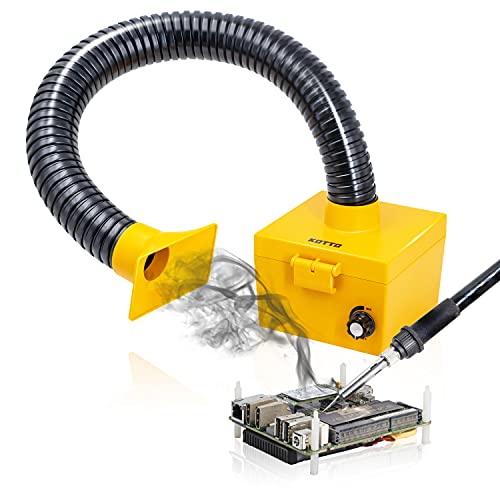
KOTTO’s hose-equipped extractor (model FAN_SLD) keeps the fan box at the back of the bench and puts a 24-inch flexible tube with an adjustable fume hood at the front, so the intake can hover five to six inches from the joint without the box crowding your hands. The fan is speed-adjustable and rated at 6,000 RPM with a maker-stated life expectancy of 50,000 hours, and the unit accepts either an activated carbon filter or a HEPA filter, which lets you choose between simple odor control and finer particle capture in the same housing.
Specs
- Model: FAN_SLD
- Power: 40 W
- Fan speed: 6,000 RPM, adjustable
- Airflow: 52 CFM (manufacturer figure)
- Noise: 55 dB (manufacturer figure)
- Hose: 24-inch flexible tube with adjustable fume hood, pre-attached
- Filter: activated carbon or HEPA filter options
- Effective capture distance: 5 to 6 inches
Who it’s for: Solderers with crowded benches who need the intake close to the board but the fan out of the way, plus makers who also want fume control for a 3D printer enclosure.
Who should skip it: Buyers who want published, independently documented specifications; KOTTO’s figures come from the listing alone, and a fan box from Hakko or Weller is the more conservative choice.
Weller WSA350 Bench Top Smoke Absorber
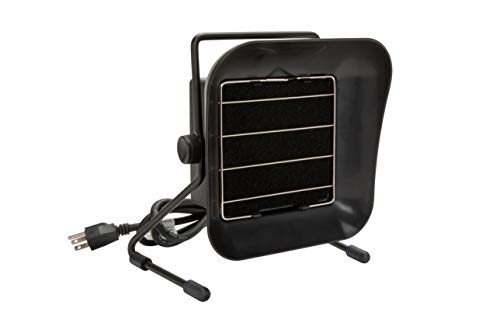
The Weller WSA350 is a quiet, adjustable-angle fan box from the other big heritage name in soldering. Weller’s catalog data gives it an absorption capacity of 1.25 to 1.37 cubic meters per minute with a sound level of 45 to 50 dB(A), which puts it at the quiet end of this category, and the unit is ESD safe and UL and cUL listed. The stand tilts so the intake can be aimed at the work, and the activated carbon filter uses Weller’s WSA350F replacement packs, which have been sold for years and are easy to source.
Specs
- Model: WSA350
- Power: 20 W, 120 V
- Airflow: 87 to 107 CFM (manufacturer catalog figures)
- Sound level: 45 to 50 dB(A)
- Filter: activated carbon, WSA350F replacement packs
- ESD safe: yes
- Certifications: UL and cUL listed
- Weight: 2 lb
- Included: one WSA350F replacement filter
Who it’s for: Anyone who solders near other people or records audio at the bench and wants the quietest documented fan box, backed by a brand with long-term filter availability.
Who should skip it: Users who need particle-level filtration; like most single-pad absorbers, this one is aimed at flux fume and odor rather than fine dust.
YIHUA 948DQ-I Solder Fume Extractor Fan

The YIHUA 948DQ-I is the compact budget pick: a small five-blade fan box on a stand that tilts up to 30 degrees, with fenders on both sides to shield the intake from cross-drafts that would otherwise push smoke past it. Its standout feature is the box contents — eight activated carbon filtration pads are included for the front and rear filter positions, so a light-duty user can go a long time before buying refills. YIHUA is candid that the capture range is short: fumes within a straight-line distance of about 10 cm are adsorbed effectively, so this unit wants to sit close.
Specs
- Model: 948DQ-I
- Power: 5 W rated, 110 V
- Fan: 5-blade
- Stand: tiltable to 30 degrees, with 2 side fenders
- Filters included: 8 activated carbon adsorber pads (front and rear)
- Carbon filter thickness: 9 mm
- Dimensions: 90 x 145 x 164 mm
- Effective capture distance: about 10 cm in a straight line
Who it’s for: Beginners and occasional solderers who want a small, simple absorber with spare filters in the box and nothing to configure.
Who should skip it: Heavy users. The modest fan and short capture range are honest limits, and a stronger box or a hose model will keep up with long daily sessions better.
Frequently Asked Questions
Does a fume extractor make soldering smoke completely safe?
No extractor removes everything. Carbon pads adsorb much of the flux odor and some gaseous compounds, and HEPA stages capture fine particles, but the practical goal is to keep the plume out of your breathing zone and reduce what lingers in the room. Ventilation still helps, and capture close to the joint matters more than any single specification.
How close does the extractor need to be to the solder joint?
Closer than most people expect. Simple fan boxes generally need to sit within a few inches of the work, and the YIHUA in this guide rates its effective straight-line capture at about 10 cm. Hose and hood models exist precisely because they let the intake stay close while the fan unit sits farther back.
Should I choose a carbon pad absorber or a HEPA purifier?
Choose the carbon pad if you solder occasionally and mainly want the smoke and smell pulled away from your face; the pads are inexpensive and take seconds to change. Choose a HEPA purifier if you solder daily, use a lot of flux, or work in a shared or poorly ventilated room where fine particles are a real concern.
How often do the filters need replacing?
It depends on hours of use and how much flux you burn. Carbon pads in fan boxes are typically swapped when they look saturated or stop controlling odor, which for a hobby bench can be weeks to months apart. Larger purifiers spread the work across stages: pre-filters are changed most often, HEPA and main carbon cartridges least often, so follow the schedule in your model’s manual.
Final Verdict
For most electronics benches, the Hakko FA400-04 is the safest all-round choice: documented airflow, an ESD-safe housing, and filters that are easy to find. If you solder every day or share the space, step up to the FumeClear FC-100A and its three-stage filtration. The KOTTO hose model solves the crowded-bench problem better than any box, the Weller WSA350 is the pick when low noise matters most, and the YIHUA 948DQ-I covers beginners honestly at the small end. Whichever design you choose, positioning it close to the joint will do more for your air than any specification on the box.
Product and ASIN Reference
| Product | ASIN |
|---|---|
| Hakko FA400-04 Smoke Absorber | B00FZPSEY4 |
| FumeClear FC-100A Solder Fume Extractor | B0B76Y7TJ2 |
| KOTTO Strong Suction Smoke Absorber with Hose | B07ZHH5H7N |
| Weller WSA350 Bench Top Smoke Absorber | B000EM74SK |
| YIHUA 948DQ-I Solder Fume Extractor Fan | B0B4CB151F |