Key takeaways
- Compare the best ukulele strings for warm tone, from Aquila Nylgut sets to D'Addario fluorocarbon strings for soprano, concert and tenor ukuleles.
A fresh set of strings is the cheapest way to change how a ukulele sounds. The same small instrument can sound soft and round or sharp and glassy, and the strings decide which. Players chasing warmth usually want the rounded, mellow end of that range: notes that bloom rather than snap, chords that blend rather than cut. The five sets below cover soprano, concert, tenor and baritone sizes, each earning its place through material, gauge and fit.
Warmth does not come from one material alone. Nylgut leans round and woody, fluorocarbon leans clear and focused, titanium adds a modern edge, and the right gauge keeps tension comfortable on a short scale. Size matters just as much: a set made for a tenor will not sit right on a soprano, and a baritone set tunes to a different pattern altogether. Read the size and tuning on each pick before ordering, match the set to the instrument in your hands, and the voice you want is usually one restring away.
Quick Picks
As an Amazon Associate we earn from qualifying purchases
| Product | Best for | Key spec from title |
|---|---|---|
| D’Addario EJ99SC Pro-Arte Carbon | Small ukes, clear voice | Pro-Arte Carbon, soprano/concert |
| Aquila 23U Nylgut | Baritone warmth | Nylgut, high G, baritone |
| D’Addario EJ99T Pro-Arte Carbon | Tenor projection | Pro-Arte Carbon, tenor |
| D’Addario EJ87T Pro-Arte Titanium | Modern tenor brightness | Titanium, tenor |
| Aquila AQ-30 New Nylgut | A different voicing | New Nylgut, soprano, fifths tuning |
How to Choose
Match the set to the size
Ukulele sizes run from soprano through concert and tenor to baritone, and each size has its own scale length. A set wound for one scale will feel wrong on another: too loose and the notes wobble, too tight and the neck carries more pull than the maker intended. Check the size printed on the packet and compare it with the instrument in your hands before ordering. Soprano and concert sets share some overlap, but tenor and baritone sets are built for longer scales and should never be swapped in by guesswork. When in doubt, measure the scale from nut to saddle and match it to the set.
Material shapes the voice
The material of a string set does more to shape tone than any other single choice. Nylgut, a synthetic blend made to echo natural gut, gives a round, woody voice with soft attack, which suits players who want warmth above all. Fluorocarbon is denser, so it sounds clearer and more focused, with stronger projection that carries across a room. Titanium monofilament sits at the modern end of the range, bright and direct, while plain nylon stays gentle and traditional. None of these is better in every case; the right one is the material whose voice matches the songs you play most.
Gauge and tension decide comfort
Gauge numbers describe how thick each string is, and thicker strings pull harder at pitch. A heavier set can add volume and fullness, but it also asks more from the fingers, which matters on a short scale where fretting already feels compact. A lighter set plays easier and bends more readily, though it may sound thinner when strummed hard. Most makers print the gauges on the packet, so compare them across sets before choosing. Comfort is not a small detail: a set that fights your fingers will spend more time in the case than on the instrument.
Tuning and ends matter
Most ukuleles tune to GCEA, but baritone instruments usually tune to DGBE, and a few specialist sets tune in fifths, so the tuning on the packet deserves a careful read. High G tuning keeps the fourth string bright and re-entrant, while low G tuning drops it an octave for a deeper, more linear voice across the fretboard. The ends matter too: most ukulele sets tie on at the bridge, so check that your bridge accepts tie-on strings rather than ball ends. A set that cannot seat properly at the bridge will never hold pitch, no matter how good the material is.
The 5 Best Options
D’Addario EJ99SC Pro-Arte Carbon Soprano/Concert Ukulele Strings

The EJ99SC is the small-uke pick in this roundup, sized for soprano and concert instruments in standard GCEA tuning. Its Pro-Arte Carbon fluorocarbon material gives a clear, focused voice with strong projection, which helps a small-bodied ukulele carry without sounding thin. The set feels precise under the fingers, and the fluorocarbon holds its pitch well once the strings have settled in. Players moving from basic nylon will notice the extra definition on each note, especially on the upper frets where small ukes can lose clarity. It is a straightforward upgrade for a soprano or concert that already sounds good and needs a sharper edge.
Specs
- Brand: D’Addario
- Model: EJ99SC
- Size: Soprano/Concert
- Material: Pro-Arte Carbon fluorocarbon
- String gauge: Custom
- Colour: Silver
- UPC: 019954978082
- Sound profile: Bright
- Country of origin: USA
Best for: Soprano and concert players who want a clear, focused voice with strong projection.
Watch out for: Fluorocarbon feels firmer under the fingers than nylon, so allow a few days of playing for the tone to settle.
ASIN: B00QXRHET4
Aquila 23U Baritone Ukulele Nylgut Strings, High G
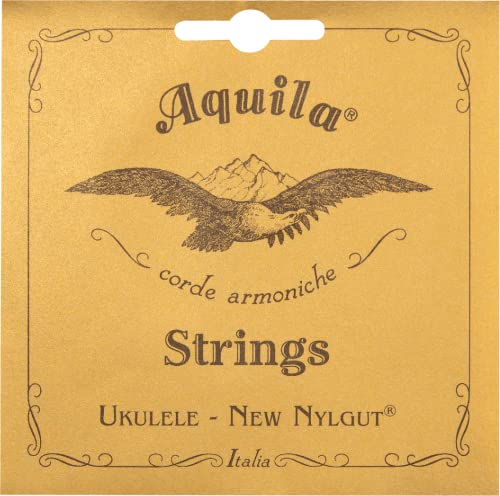
The 23U brings Aquila’s Nylgut material to the baritone size, and it is the warmest voice in this roundup. Nylgut is a synthetic blend made to echo the sound of natural gut, and on a larger baritone body it produces a round, woody tone with a soft attack that suits fingerpicking and gentle strumming. The listing tunes this set to GCEA with a high G, so it keeps standard ukulele chord shapes on a baritone-scale instrument rather than the usual DGBE baritone pattern. Four unwound strings keep the feel consistent across the set, and the maker notes that the material resists moisture better than plain gut.
Specs
- Brand: Aquila
- Model: 23U
- Material: Nylgut
- Size: Baritone
- Tuning: GCEA, high G
- String gauge: High G
- Colour: White
- Number of strings: 4
- Item weight: 0.32 ounces
- Product dimensions: 4.25 x 4.25 x 1.5 inches
Best for: Baritone players who want a warm, gut-like voice with standard GCEA chord shapes.
Watch out for: This set tunes to GCEA, not the DGBE pattern many baritone players expect, so confirm the tuning fits your playing before ordering.
ASIN: B00GXMNO52
D’Addario EJ99T Pro-Arte Carbon Tenor Ukulele Strings

The EJ99T is the tenor counterpart to the EJ99SC, built on the same Pro-Arte Carbon fluorocarbon material in a longer tenor scale. Fluorocarbon is denser than nylon, so the set sounds brighter and more focused, with the projection a tenor needs to fill a room without amplification. D’Addario designs the set for standard GCEA tuning, and the medium gauge keeps tension comfortable while the strings settle. The packet uses corrosion-resistant packaging, which helps a spare set stay fresh in a case pocket. For a tenor that gets played often, this is the safe first choice when the current set sounds dull or muddy.
Specs
- Brand: D’Addario
- Model: EJ99T
- Material: Pro-Arte Carbon fluorocarbon
- Size: Tenor
- String gauge: Medium
- Tuning: Standard GCEA
- Ends: Non-ball end
- Number of strings: 4
- Item weight: 0.32 ounces
- Product dimensions: 4.32 x 0.32 x 4.5 inches
Best for: Tenor players who want clear projection and a bright, modern voice for regular playing.
Watch out for: The strings tie on at the bridge, so check that your bridge accepts tie-on ends before ordering.
ASIN: B00QXRGPEY
D’Addario EJ87T Pro-Arte Titanium Tenor Ukulele Strings

The EJ87T takes the tenor voice in a brighter direction with Pro-Arte Titanium monofilament, a dense single-strand material with a polished feel. Titanium trebles give a crisp, contemporary sound with strong volume and clarity, which suits players who want their tenor to cut through a mix or carry a melody line. The set is gauged for standard GCEA tuning on a tenor scale, and the material holds its tone well over weeks of playing. It reads as the most modern voice in this roundup, a useful contrast to the rounder Nylgut sets. Players who find nylon too soft will likely prefer the firmer, more direct response here.
Specs
- Brand: D’Addario
- Model: EJ87T
- Material: Pro-Arte Titanium monofilament
- Size: Tenor
- Tuning: Standard GCEA
- Number of strings: 4
- Colour: Natural
- Product dimensions: 4.8 x 0.33 x 4.8 inches
Best for: Tenor players who want a bright, contemporary voice with strong volume and clarity.
Watch out for: Titanium sounds brighter than nylon or Nylgut, so it suits players who want cut rather than mellow warmth.
ASIN: B006MB99WQ
Aquila AQ-30 New Nylgut Soprano Ukulele Strings in Fifths
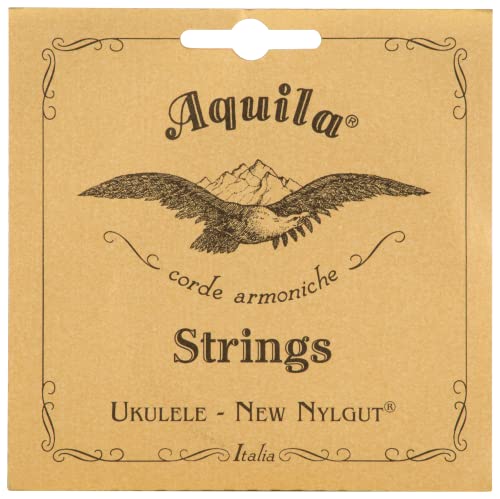
The AQ-30 is the unusual pick in this roundup, a soprano set tuned in fifths, GDAE, the same interval pattern used on mandolin-family instruments. It uses Aquila’s New Nylgut, a blend of three synthetic components with a gut-like feel and tuning stability that outlasts plain nylon. A fifths tuning gives a soprano a different voicing altogether, with chord shapes that will feel unfamiliar to a GCEA player but open up melodic lines for anyone who doubles on mandolin. The set is hand-crafted in Italy and sold as four strings. Treat this one as a specialist choice rather than a direct replacement for a standard set.
Specs
- Brand: Aquila
- Model: AQ-30
- Material: New Nylgut synthetic blend
- Size: Soprano
- Tuning: Fifths (GDAE) per the product title
- Number of strings: 4
- Origin: Hand-crafted in Italy
Best for: Soprano players who double on mandolin-family instruments or want a different voicing from a small ukulele.
Watch out for: Fifths tuning changes every chord shape, and the listing copy also mentions high G, so confirm the tuning on the listing before ordering.
ASIN: B00MXUIMI2
Which One Fits Your Situation
You play a soprano or concert ukulele
Small ukes need strings that add definition without adding harshness. The EJ99SC gives a soprano or concert a clear, focused voice that carries well, and its fluorocarbon material holds pitch once settled. If you want a different flavour altogether, the AQ-30 offers a fifths-tuned soprano set for melodic playing, though it changes every chord shape you know. Either way, buy the size printed on the packet and check the tuning before ordering.
You play a tenor and want warmth
Tenor players have two clear choices here, and the difference is one of character. The EJ99T fluorocarbon set sounds focused and projecting, with a clean top end that suits strumming and melody work. The EJ87T titanium set sounds brighter still, with a modern edge that cuts through a group. If warmth is the goal, the EJ99T sits closer to it, while the EJ87T suits players who want their tenor to sound as present as possible.
You play a baritone
Baritone players have one pick in this roundup, and it is a good one. The Aquila 23U brings Nylgut warmth to the largest ukulele size, with a round, woody voice that suits fingerpicking and gentle strumming. Note the tuning: this set runs GCEA with a high G, so it keeps standard ukulele chord shapes on a baritone body. Players who want the usual DGBE baritone pattern should look for a DGBE set instead of fitting this one.
You restring often and want easy upkeep
Frequent players should weigh how a set behaves after the first week. Fluorocarbon and titanium hold their tone well and resist moisture, so they suit instruments that live outside a case. Nylgut stretches more when new, so expect to retune often for the first few days until the strings settle. Keep a spare set in the case, store it in its sealed packet, and change strings before a gig rather than after a string fails mid-song.
Common Mistakes
- Buying a set made for the wrong size, which leaves the strings too loose or too tight for the scale.
- Ignoring the tuning on the packet, so a GCEA set lands on an instrument tuned to DGBE or fifths.
- Fitting a low G single string into a high G set without checking that the nut slot and bridge can take it.
- Judging a new set on the first day, before the strings have stretched and settled into stable pitch.
- Cutting the spare length off at the headstock before the strings have fully seated and stopped slipping.
Frequently Asked Questions
Do ukulele strings really change the tone that much?
Yes, more than most players expect. The same instrument can sound round and mellow with Nylgut, clear and focused with fluorocarbon, or bright and modern with titanium. Material, gauge and age all shape the voice, so a restring is the cheapest way to hear a different side of an instrument you already own.
How often should I change ukulele strings?
It depends on how much you play. A daily player may want fresh strings every few months, while an occasional player can go much longer. Change them when the tone turns dull, intonation drifts, or the strings feel rough under the fingers. A set that has lost its voice will not come back with cleaning.
Can I put tenor strings on a concert ukulele?
No, not as a straight swap. Tenor sets are gauged for a longer scale, so they will sit at the wrong tension on a concert neck and may not reach pitch cleanly. Buy the set made for your size, and if you want a different feel, change the material or gauge within the right size instead.
What is the difference between high G and low G tuning?
High G tuning is re-entrant: the fourth string sounds higher than the third, which gives the classic bright ukulele voice. Low G tuning drops that string an octave, so the notes run in a straight line from low to high and the instrument gains a deeper bottom end. Low G suits melody playing, while high G suits the traditional strumming sound.