Key takeaways
- Compare the best seam gauges for hems and seam allowances, from the classic Dritz 620 to a classroom 12-pack, with specs, sizing help, and FAQs.
A seam gauge is the small ruler that does one job better than any full-size ruler can: it holds a short measurement so you can repeat it dozens of times without re-reading a scale. The classic format is a slim 6-inch rule with a sliding marker. You set the marker to your hem depth, seam allowance, or buttonhole spacing, and it stays there while you work your way around a skirt, down a row of pleats, or along a line of buttonholes, marking the same distance every time. That single trick is why nearly every sewing kit carries one, and why the differences between models come down to how well the slider holds, how the scale is printed, and what else the tool can do.
This guide compares five seam gauges that cover the main formats. Three are classic single gauges with sliding markers, including the long-running Dritz 620 and the SINGER 00220. One adds a point turner for pushing out corners. One is a 12-pack of the same 6-inch gauge, built for classrooms and shared sewing rooms. The last is a T-shaped 5-in-1 set that trades the slim profile for a wider, multi-function layout. All five are hand gauges for marking hems and seam allowances at the cutting table, not machine attachments.
As an Amazon Associate, we earn from qualifying purchases.
Quick answer
For most sewists, the Dritz 620 is the seam gauge to buy first: a 6-inch rule whose sliding marker stays in place for repeated marking of hems, tucks, pleats, and buttonholes. The SINGER 00220 covers the same ground with inches and centimeters on one rule. Choose the Dritz 658 if you also want a point turner, the Dritz 12-pack for classes or shared kits, and the 5-in-1 T-shaped set if you prefer a wider acrylic gauge with a companion ruler.
Dritz 620 Sewing Gauge

The Dritz 620 is the reference design for this category, a 6-inch sewing gauge built around a sliding measure with a marker that stays in place for repeated marking. Set it once to a hem depth or seam allowance and it holds that setting while you mark around a garment, which is the entire reason the tool exists. Prym Consumer USA, the maker behind the Dritz brand, positions it for hems, tucks, pleats, and buttonholes, and that list covers the great majority of seam gauge work in garment sewing and alterations.
The gauge is light enough to live permanently in a notions pouch, and its compact profile suits sewists who measure at the cutting table and again at the ironing board. There are no accessories and no learning curve: slide the marker, lock your distance, and mark. The trade-offs match the simplicity. You get exactly one gauge, so there is no spare when it wanders off. The listing does not publish a detailed material specification, so buyers who specifically want an all-metal gauge should check the product page before ordering.
Specs
- Length: 6 inches
- Slider: sliding measure with marker that stays in place
- Primary uses: hems, tucks, pleats, buttonholes
- Weight: 0.32 ounces
- Package quantity: 1
- Material: not stated
- Manufacturer: Prym Consumer USA
Who it’s for / who should skip
This is the pick for garment sewists who want the classic, no-nonsense gauge for hemming and alterations. Skip it if you sew in a group setting and need several gauges at once, or if you want extra functions such as a point turner or a T-square layout in the same tool.
SINGER 00220 Sewing Gauge, 6-Inch
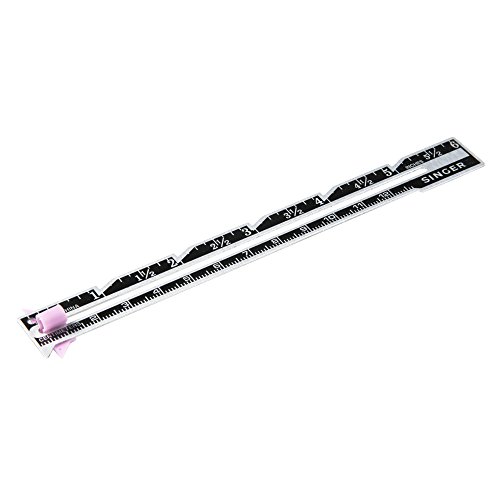
The SINGER 00220 covers the same classic ground as the Dritz 620 in a 6-inch format, with one practical difference: the ruler is printed with both inches and centimeters, which suits sewists who move between US commercial patterns and metric indie patterns. Its slider holds position for repeated marking and can also be used for drawing circles, and the stated jobs are measuring hem depth, spacing buttonholes, and spacing tucks and pleats evenly.
As a budget-oriented single gauge, the 00220 is the straightforward starter option. It does the essential work without multipack pricing or extra attachments, and the familiar SINGER notions format means it drops into any basic sewing kit. The compromises are the same ones the whole single-gauge class carries: one tool only, no point turner, and a plain layout with no specialty geometry. If your sewing is mostly mending, hemming, and first garments, that plain layout is usually all you need.
Specs
- Length: 6 inches
- Slider: sliding marker that holds position for repeated marking
- Scales: inches and centimeters
- Primary uses: hem depth, buttonhole spacing, tucks, pleats, drawing circles
- Package quantity: 1
- Material: not stated
- Model: 00220
Who it’s for / who should skip
Choose the 00220 if you are building a first sewing kit or want an inexpensive backup gauge for a travel kit or drawer. Skip it if you need multiples for a class, or if you press hems with the gauge under the iron and need a model whose listing confirms a heat-tolerant build.
Dritz 658 Seam Gauge with Point Turner, 7-Inch

The Dritz 658 stretches the classic format to 7 inches and adds the feature its name advertises: a point turner at one end, so the same tool that marks your seams can gently push out the corners of collars, lapels, and cuffs after turning. The gauge itself is a small metal ruler with a sliding right-angle marker that stays in place for repeated marking. That right-angle marker makes it easy to keep a consistent offset from a fabric edge while you work along it.
The stated uses cover both halves of the tool. With the gauge, you measure and mark hem depths and seam allowances, establish buttonhole spacing and length, and evenly space tucks and pleats. With the point, you shape corners without resorting to scissors or a chopstick, which are the usual improvised substitutes and the usual way corners get poked through. At 7 inches it is slightly longer than the standard 6-inch gauges in this guide, which gives a little more reach on deeper hems. The point turner is a gentle shaping point rather than a sharp creaser, so sewists who want a firm creasing edge as well will still want a separate creaser.
Specs
- Length: 7 inches
- Material: metal
- Slider: sliding right-angle marker
- Extra feature: built-in point turner for collars, lapels, and cuffs
- Primary uses: hem depths, seam allowances, buttonhole spacing and length, tucks, pleats
- Package quantity: 1
- Model: 658
Who it’s for / who should skip
This is the pick for sewists who sew collared shirts, jackets, and cuffs and want the marking gauge and the corner tool in one hand. Skip it if you never turn pointed corners, because a plain 6-inch gauge does the measuring half of the job in a smaller package.
Dritz 6-Inch Seam Gauges, 12-Pack

This listing is the Dritz 6-inch seam gauge bought the way sewing teachers buy it: twelve at a time. Each gauge in the pack is the familiar format, a 6-inch rule with a metal sliding marker that locks in a set-and-stay position for repeat measurements. The slider also carries holes that, used with the end of the gauge, let you draw scallops and circles, which is a small bonus for marking decorative hems and applique shapes.
The value of the pack is distribution rather than features. A dozen identical gauges can live in a classroom set, be handed out in a workshop, or be split across several project bags and sewing stations so a gauge is always within reach. For a solo sewist the arithmetic still works if you lose tools regularly, but most home sewists will find twelve of the same gauge more than they need. The pack does not add the point turner of the 658 or the T-shaped layout of the 5-in-1 set. What it adds is sameness: every student or station works with the same tool, set the same way.
Specs
- Length: 6 inches
- Package quantity: 12 gauges
- Slider: metal sliding marker, set-and-stay locking
- Marking extras: holes in slider and gauge end for drawing scallops and circles
- Primary uses: seam allowances, hems, tucks, pleats, buttonhole spacing
- Model: BLK171
- Material: not stated
Who it’s for / who should skip
Choose the 12-pack if you teach sewing, run a shared studio, or outfit several kits at once. Skip it if you sew alone and only need one or two gauges, because the single Dritz 620 gives you the same measuring format without the surplus.
5-in-1 Sewing Gauge Measuring Tool Set, 2-Piece

The outlier in this guide swaps the slim metal rule for a wide T-shaped acrylic gauge, sold as a two-piece set with a straight ruler alongside the sliding gauge. The T shape gives the tool a broader contact edge against fabric folds and pattern pieces, and the 5-in-1 layout combines the jobs of a seam gauge, hem gauge, buttonhole spacer, and marking guide in one flat tool. At about 8.8 inches across, it is noticeably larger than the 6-inch gauges above, which makes it easier to read and handle on a cutting table but less pocket-friendly in a notions pouch.
The acrylic build keeps the gauge see-through on fabric, which helps when you are aligning marks over prints or plaid, and the set format means one gauge can stay at the machine while the other stays at the cutting table. The trade-offs are material and size. Acrylic should be kept away from a hot iron, where a metal gauge is the safer companion, and the wide shape is more tool than you need for a quick hem check on a pair of trousers. Quilters and crafters who already work with acrylic rulers will feel at home with it; garment sewists loyal to the classic slim gauge may not.
Specs
- Format: T-shaped sliding gauge, 2-piece set
- Length: 8.8 inches
- Material: acrylic
- Functions: seam allowance, hemming, buttonhole spacing, marking
- Includes: sliding gauge and straight ruler
- Scales: inches and centimeters
- Package quantity: 2
Who it’s for / who should skip
This is the pick for quilters and mixed crafters who want a wider, see-through gauge with a companion ruler. Skip it if you press as you measure and need a metal gauge that tolerates the iron, or if you want the smallest possible tool for a travel kit.
Frequently asked questions
What is a seam gauge used for?
A seam gauge holds one short measurement so you can repeat it accurately: hem depths, seam allowances, buttonhole spacing and length, and evenly spaced tucks and pleats. You set the sliding marker once and mark the same distance around a garment instead of re-reading a ruler for every mark.
What size seam gauge should I buy?
The standard 6-inch gauge covers most garment work, including typical hem depths and seam allowances. A 7-inch model adds a little reach, and wide T-shaped gauges around 8.8 inches suit quilters who want a broader marking edge. Most sewists only need the 6-inch format.
Can I use a seam gauge with an iron?
Only if the gauge is metal and the listing supports it. Acrylic and plastic gauges can warp or melt under a hot iron, so keep them at the cutting table and use a metal gauge, or a dedicated pressing tool, at the ironing board. When a listing does not state the material, treat the gauge as cutting-table only.
How many seam gauges do I need?
One is enough for most home sewists, with a second as a spare if you work at both a cutting table and a machine station. Multipacks such as a 12-pack make sense for classrooms, workshops, and shared studios where many people measure at the same time.
Final verdict
Start with the Dritz 620 if you want the classic single gauge, or the SINGER 00220 if dual inch and centimeter scales matter more. The Dritz 658 earns its place when point turning joins your regular work, the 12-pack is the classroom and shared-studio answer, and the 5-in-1 T-shaped set suits quilters who prefer a wide acrylic layout. Every gauge here does the same core job of repeating one measurement faithfully; the right choice is the format that matches how and where you sew.
Product and ASIN Reference
| Product | ASIN |
|---|---|
| Dritz 620 Sewing Gauge | B000YZ8N46 |
| SINGER 00220 Sewing Gauge, 6-Inch | B009D0O306 |
| Dritz 658 Seam Gauge with Point Turner, 7-Inch | B0054P8UUS |
| Dritz 6-Inch Seam Gauges, 12-Pack | B08HZDYCZG |
| 5-in-1 Sewing Gauge Measuring Tool Set, 2-Piece | B0D2D4XJJZ |