Key takeaways
- Compare the best yarn ball winders for knitting and crochet, from heavy-duty hand-crank metal models to electric winders that form tidy center-pull cakes.
A yarn ball winder turns a loose skein or hank into a flat-bottomed, center-pull cake that feeds smoothly while you knit or crochet, without rolling across the floor or collapsing into tangles. It is one of the simplest upgrades in a fiber craft kit: clamp the winder to a table, thread the yarn through the guide, and a few minutes of cranking replaces draping a hank over a chair back or a volunteer’s hands.
The five winders below cover the main shapes worth considering. Two are heavy-duty hand-crank models built for big skeins, two are electric winders that do the turning for you, and one is a compact budget crank for everyday 100 g skeins. Between them they span capacities from about 4 oz up to 10 oz, so the right pick depends on how much yarn you wind at once and whether you want a motor to do the turning.
As an Amazon Associate, we earn from qualifying purchases.
How to Choose a Yarn Ball Winder
Capacity comes first. Standard winders hold roughly 3.5 to 4 oz of yarn, which covers a typical 100 g skein of fingering, sport, or worsted yarn in a single pass. If you regularly buy 200 g or 250 g hanks, knit sweater quantities, or wind bulky yarn that eats space quickly, step up to a 7 oz or 10 oz model so you are not forced to break a skein into two cakes.
Manual or electric is the second decision. A hand crank gives you direct control over speed and tension, costs less, and has little to go wrong. An electric winder replaces the cranking with a motor and a speed knob, which matters if you wind many skeins in one sitting or if repetitive cranking bothers your wrist or shoulder. Look for stepless speed control and an automatic pause on jams, both of which protect delicate yarn from being yanked tight.
Build and mounting matter more than they look. Metal frames and gears tolerate years of regular use, while plastic bodies keep a winder light and inexpensive. Most winders clamp to a table edge, so check the clamp opening against your tabletop thickness before ordering.
Plan for a swift if you wind hanks. A winder alone handles yarn that is already in a pull skein or a loose pile of leftovers. Hanks, the twisted loops most hand-dyed yarn arrives in, need to be held open under light tension while they unwind, and that is the job of an umbrella or tabletop swift; winding a hank without one usually ends in a tangled knot. Tension also deserves respect on any model: wind at a steady pace and avoid cranking fast enough to stretch the strand, because yarn wound under too much tension can lose its loft.
Stanwood Needlecraft Large Metal Yarn Ball Winder, 10 oz

The Stanwood Large Metal winder is the heavy-duty end of the hand-crank category. Its frame is built from 3-millimeter-thick steel with a rust-resistant powder coating, and it winds center-pull cakes of up to 10 oz, roughly two and a half times what the same brand’s compact winders hold. That capacity is the reason to choose it: full sweater quantities, large worsted skeins, weaving yarn, and strands held double all fit in one cake instead of several.
The design is deliberately simple: no electronics and no settings, just a clamp-on steel body, a yarn guide, and a hand crank. The listing recommends pairing it with an umbrella or Amish-style swift for hank winding. Because the mechanism is exposed metal rather than a sealed housing, it is easy to brush out fiber dust and lint after a session. The trade-offs are size and effort: it is a substantial piece of hardware that wants a sturdy table edge, and your arm supplies all the power.
Specs
- Type: Hand-operated crank
- Capacity: 10 oz
- Model: MYBW-1
- Construction: 3 mm steel, rust-resistant powder coating
- Mounting: Table clamp
- Output: Center-pull cake
- Item weight: not stated
Who it’s for: Knitters, crocheters, and weavers who wind large skeins or sweater quantities and want a metal winder built for frequent, heavy use.
Who should skip: Anyone short on storage space, anyone who winds only the occasional 100 g skein, and anyone who would rather let a motor do the cranking.
Caydo Electric Yarn Ball Winder Pro, 10 oz (Blue)

The Caydo Electric Yarn Ball Winder Pro replaces the hand crank with a motor while keeping a jumbo 10 oz capacity, so it handles the same large skeins as the big manual winders without the arm work. A stepless speed knob lets you dial the pace up or down for different yarns, running fast for sturdy worsted and slowing for slippery or delicate strands.
Tension is managed by a dual-spring design at the base, which the maker says keeps the strand steady and reduces vibration as the cake builds. The housing is ABS and POM plastic, and the unit runs on low-voltage DC power through the included cable. It pauses automatically after eight minutes of continuous operation or if the yarn jams, and you restart it by resetting the knob. Assembly is minimal.
Specs
- Type: Electric
- Capacity: 10 oz
- Speed control: Stepless knob adjustment
- Tension: Dual-spring system
- Material: ABS and POM
- Power: DC 5V, rated power 3W, cable included
- Auto-pause: After 8 minutes of continuous running or on a yarn jam
- Model: not stated
- Item weight: not stated
Who it’s for: High-volume winders, anyone with wrist or shoulder strain from cranking, and crocheters who process large 10 oz skeins regularly.
Who should skip: Anyone who prefers the tactile control of a hand crank, works where outlets and cables are impractical, or only winds a skein now and then.
Etcokei Electric Yarn Ball Winder (Purple)

Etcokei’s electric winder is the compact counterpart to the Caydo: a smaller powered unit for people who wind standard skeins and want to skip the cranking. Its stepless speed knob adjusts the pace to the yarn, and the listing rates the motor at up to six rotations per second, enough to finish a cake in about two minutes at full speed. A dual-spring tension setup keeps the strand feeding evenly as the cake grows.
Like the Caydo, it pauses automatically after eight minutes of continuous operation or when the yarn jams, which protects both the motor and the yarn. The body is sized for a desk or craft table rather than a dedicated studio bench. One caution: sources disagree on this model’s capacity, so it is marked not stated below. Treat it as a standard-skein machine for 50 g and 100 g balls, and size up to a 10 oz model if you routinely wind oversized skeins.
Specs
- Type: Electric
- Model: AEKUS002377
- Speed control: Stepless knob adjustment
- Tension: Dual-spring system
- Dimensions: 7.48 x 7.09 x 6.5 inches
- Auto-pause: After 8 minutes of continuous operation or on a yarn jam
- Capacity: not stated
- Material: not stated
Who it’s for: Knitters and crocheters who wind standard skeins often and want powered winding in a compact footprint.
Who should skip: Anyone winding jumbo or sweater-quantity skeins in a single pass, and anyone who wants a metal hand-crank tool with no motor or cable.
Knit Picks Yarn Ball Winder (Purple)
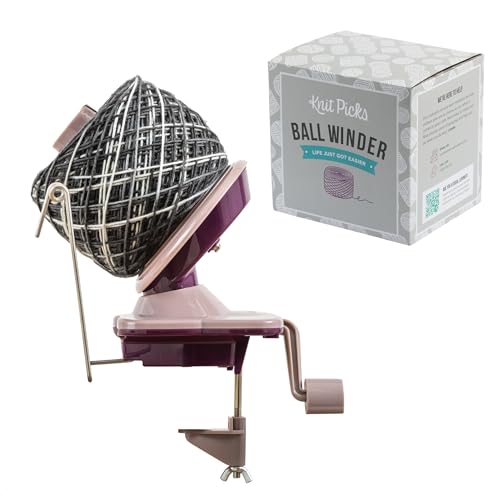
The Knit Picks winder is the classic entry point to ball winding: a small hand-operated winder, finished in purple, that clamps to a table edge and turns a standard skein into a neat center-pull cake. Its capacity is about 100 g, or 3.5 oz, which matches the most common skein size sold, so most everyday yarn goes on in a single pass.
Operation is as simple as the category gets. Clamp it down, run the yarn through the guide arm, slot the end into the bobbin, and crank steadily. The finished cake slides off the bobbin and stacks flat for storage. Knit Picks also sells a matching umbrella swift, and the two together form the standard beginner setup for winding hand-dyed hanks. The limits are the expected ones for a compact plastic-class winder: oversized skeins have to be split into two cakes, and there is no motor, so your hand sets the speed and the tension.
Specs
- Type: Hand-operated crank
- Model: 82500
- Capacity: About 100 g (3.5 oz)
- Color: Purple
- Mounting: Table clamp
- Output: Center-pull cake
- Material: not stated
- Item weight: not stated
Who it’s for: Beginners buying a first winder, and any knitter or crocheter whose stash is mostly standard 50 g and 100 g skeins.
Who should skip: Anyone who regularly winds 200 g hanks, bulky yarn in quantity, or enough skeins at once to want electric power.
Adhafera Yarn Winder

The Adhafera winder is a compact hand-crank model in ABS plastic, sized for small to standard skeins of up to about 4 oz. It follows the familiar clamp-on layout: a table clamp holds the body steady, a guide arm feeds the strand, and the crank builds a center-pull ball, so the ball sits still instead of bouncing around the room.
At 390 g, it is light enough to toss in a project bag or store in a drawer. The clamp fits typical table edges, and the simple mechanism has no electronics to maintain. This is not the tool for production winding: the plastic construction and 4 oz ceiling are aimed at home use, a few skeins at a time, rather than a dyer working through pounds of yarn. It pairs with any standard umbrella swift for hank winding.
Specs
- Type: Hand-operated crank
- Model: AdYarn-001
- Material: ABS plastic
- Capacity: Up to about 4 oz
- Dimensions: 5.5 x 3.5 x 7.1 inches
- Item weight: 390 g
- Mounting: Table clamp
- Output: Center-pull ball
Who it’s for: Budget-minded knitters and crocheters who wind small and standard skeins occasionally and need something compact to store.
Who should skip: Anyone winding large or bulky skeins, anyone who wants metal construction, and high-volume winders who would be better served by a 10 oz or electric model.
Frequently Asked Questions
Do I need a swift with a yarn ball winder?
If you buy yarn in hanks, yes. A swift holds the hank open under light tension and rotates as the winder pulls, which keeps the strand from tangling. For pull skeins, leftover yarn, and frogged projects, you can feed the winder directly without a swift, as long as the yarn can unwind freely.
What size winder do I need for 100 g skeins?
A standard winder rated around 3.5 to 4 oz handles a 100 g skein in one pass. Bulky yarn takes up more room per ounce than fingering weight, so if you work mostly with bulky yarns or buy 200 g and 250 g hanks, choose a 7 oz or 10 oz model to avoid splitting skeins.
Can a yarn ball winder stretch or damage yarn?
It can if you wind too fast or pull the strand tight, especially with elastic fibers like wool. Wind at a steady, moderate pace, let the yarn run lightly through your fingers, and the finished cake should feel soft rather than drum-tight. Electric models with jam protection and adjustable speed help keep tension consistent.
Are electric yarn ball winders worth it?
They are worth it if you wind often, process many skeins in one session, or find hand cranking uncomfortable. For a few skeins a month, a manual winder does the same job with less to maintain. The deciding factors are volume and comfort, not cake quality, which is similar either way when tension is kept steady.
Final Verdict
Match the winder to your skeins. For heavy use and the biggest cakes, the Stanwood Needlecraft Large Metal winder is the durable hand-crank choice, while the Caydo Electric Yarn Ball Winder Pro offers the same 10 oz capacity with a motor and adjustable speed. The Etcokei electric winder suits standard skeins in a smaller footprint. If your stash is mostly 100 g skeins, the Knit Picks winder is the straightforward classic, and the Adhafera covers the same ground in a lighter package. Add a swift if you wind hanks, keep your tension gentle, and any of the five will turn a messy stash into orderly, ready-to-use cakes.
Product and ASIN Reference
| Product | ASIN |
|---|---|
| Stanwood Needlecraft Large Metal Yarn Ball Winder, 10 oz | B0078T6KQY |
| Caydo Electric Yarn Ball Winder Pro, 10 oz (Blue) | B0DKSM5GRW |
| Etcokei Electric Yarn Ball Winder (Purple) | B0CGWQW255 |
| Knit Picks Yarn Ball Winder (Purple) | B09XBNGC7D |
| Adhafera Yarn Winder | B09WMXY5NZ |