Our Short List of 3

- Best for: parking areas and driveways where cables or hoses must cross under traffic.
- Material: recycled rubber
- Section size: 72.8 x 12.2 x 2.2 inches
- Load capacity: 22,000 lb
- Channels: 2 underside channels for cables or drainage
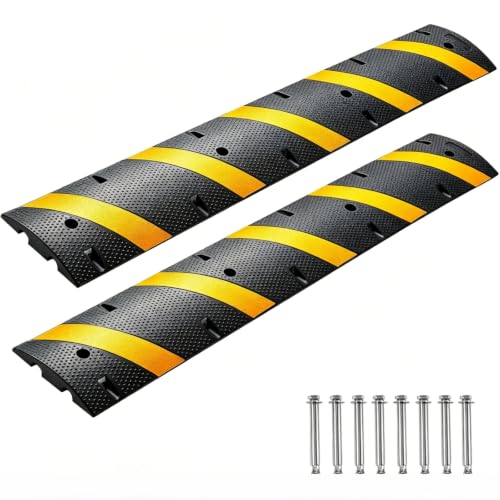
- Best for: wide asphalt lanes and shared drives that need one continuous twelve-foot crossing.
- Material: recycled rubber
- Section size: 72 x 11.8 x 2 inches
- Load capacity: 25,000 lb
- Channels: 2 integrated cable channels

- Best for: smaller properties and crews that want a lighter set with a lower, car-friendly profile.
- Material: rubber
- Section size: 72 x 12.5 x 1.8 inches
- Load capacity: 28,000 lb
- Item weight: 39 lb
All 5 Picks at a Glance
| Product | Specs | Action |
|---|---|---|
| VEVOR 2-Pack 6 FT Rubber Speed Bump |
| Check price on Amazon |
| PioneerWorks 6 Ft Rubber Speed Bump 2 Pack |
| Check price on Amazon |
| OranLite 6 Ft Heavy Rubber Speed Bump |
| Check price on Amazon |
 OrangeStar 2-Pack 6 Ft Rubber Speed Bump |
| Check price on Amazon |
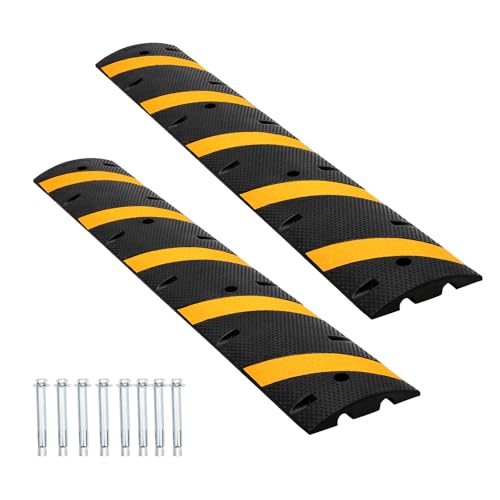 ExploreHorizon 6FT Rubber Speed Bump 2-Pack |
| Check price on Amazon |
Key takeaways
- Five rubber speed bumps for asphalt compared by height, load capacity, cable channels and mounting hardware, for driveways, lots and private roads.
Bolting a rubber bump onto asphalt sounds simple until you stand in the lane with a drill and realize the sections you ordered are too short for the width, too tall for the low cars that use the lot, or missing the anchors that actually hold in asphalt rather than concrete. The real decision is matching profile height, section length, and fastening hardware to your surface and your traffic, because a bump that creeps sideways or gets torn out by a plow blade is worse than none at all.
This roundup is for property managers, HOA volunteers, warehouse operators, and homeowners sharing a private drive. Every pick below is a rubber speed bump sold on Amazon, chosen from the dimensions, load figures, channel layouts, and included hardware printed on its own listing, so you can compare section sizes and mounting parts without guessing.
Quick Picks
As an Amazon Associate we earn from qualifying purchases.
| Product | Best for | Key spec from title |
|---|---|---|
| VEVOR 2-Pack 6 FT Rubber Speed Bump | Driveways that also carry cables or hoses | 72.8 x 12.2 x 2.2 in, 22,000 lb capacity |
| PioneerWorks 6 Ft Rubber Speed Bump 2 Pack | Wide asphalt lanes needing full coverage | 72 x 11.8 x 2 in, 25,000 lb capacity |
| OranLite 6 Ft Heavy Rubber Speed Bump | Smaller crews and a gentler profile | 72 x 12.5 x 1.8 in, 28,000 lb capacity |
| OrangeStar 2-Pack 6 Ft Rubber Speed Bump | Bolt-down installs with hardware included | 72 x 11.8 x 1.8 in, 22,000 lb capacity |
| ExploreHorizon 6FT Rubber Speed Bump 2-Pack | Heavy delivery and work-truck traffic | 6 ft sections, 66,000 lb capacity |
How to Choose
Profile height decides how hard the bump slows traffic
Height is the number that shapes driver behavior. A 2.2-inch profile like the VEVOR pair forces a genuine slowdown and suits parking lot entrances where cars roll through too fast, while a 1.8-inch profile like the OranLite and OrangeStar sets is gentler on low-clearance cars and EVs. Match the height to the vehicles that actually cross: delivery vans and pickups tolerate a taller bump, but a lane used by sports cars or low sedans argues for staying under two inches so nobody scrapes a bumper or avoids your lane entirely.
Section length and pack count set your real coverage
Most rubber bumps arrive as six-foot sections, so a single section rarely spans a full lane. Work out your crossing width first, then count sections: a two-pack of six-foot pieces covers twelve feet end to end, enough for a standard lane or a wide residential drive. Longer seven-foot sections exist for broader crossings. Also check whether end caps are part of the listing or a separate purchase, because unfinished section ends catch tires and plow blades. Buying the right pack count up front beats discovering a two-foot gap after the anchors are already drilled.
Load capacity has to match your heaviest vehicle
Listings state capacity in total pounds, and the spread is wide: 22,000 pounds on several six-foot sets, 25,000 on the PioneerWorks pair, 28,000 on the OranLite, and 66,000 on the ExploreHorizon two-pack. A lane crossed only by passenger cars sits comfortably with the lower figures. If garbage trucks, loaded delivery vans, or RVs cross the same asphalt, step up to the higher numbers, because an under-rated rubber section compresses, cracks around the bolt holes, and starts to rock under repeated heavy axle loads.
Anchoring hardware matters more on asphalt than concrete
Asphalt is softer than concrete, so the fastener style decides whether a bump stays put. Look for listings that name their hardware: the VEVOR set includes twelve screws and a drill bit, the OrangeStar ships eight expansion screws, and the TROPOW-style kits use long spikes driven into the surface. Pre-drilled holes in the sections save layout time. Whatever the kit, plan to drill pilot holes sized for asphalt anchors rather than concrete lag bolts, and re-check tightness after the first weeks of traffic, since new rubber settles under load.
The 5 Best Options
VEVOR 2-Pack 6 FT Rubber Speed Bump
- Best for: parking areas and driveways where cables or hoses must cross under traffic.
- Material: recycled rubber
- Section size: 72.8 x 12.2 x 2.2 inches
- Load capacity: 22,000 lb
- Channels: 2 underside channels for cables or drainage
parking areas and driveways where cables or hoses must cross under traffic.
each section weighs 59 pounds, so plan for two people when positioning and anchoring.
This VEVOR pair is the pick when the crossing has a second job: two channels run along the underside of each section, giving extension cords, hoses, or network cables a protected path under traffic. Each recycled rubber section stands 2.2 inches tall, the tallest profile in this group, so it suits lot entrances and warehouse approaches where drivers need a firm reminder. The box includes twelve screws and a drill bit, which removes the separate hardware run. At 59 pounds per section, positioning is a two-person task, but that mass also helps the bump stay planted between anchor points.
PioneerWorks 6 Ft Rubber Speed Bump 2 Pack
- Best for: wide asphalt lanes and shared drives that need one continuous twelve-foot crossing.
- Material: recycled rubber
- Section size: 72 x 11.8 x 2 inches
- Load capacity: 25,000 lb
- Channels: 2 integrated cable channels
wide asphalt lanes and shared drives that need one continuous twelve-foot crossing.
the near-96-pound set weight makes repositioning a deliberate, two-person job.
PioneerWorks builds this two-pack from recycled rubber with a two-inch profile that the listing positions for low cars and trucks alike, claiming a working pace in the 5 to 15 mph range as vehicles cross. Joined together, the two 72-inch sections cover just over twelve feet, which fits a standard lane without a leftover gap. The sections carry two cable channels and pre-drilled mounting holes, and the listing describes expansion screws holding the rubber against shifting. At roughly 96 pounds for the set, it is a substantial install, better suited to a permanent lane than a crossing you reposition often.
OranLite 6 Ft Heavy Rubber Speed Bump
- Best for: smaller properties and crews that want a lighter set with a lower, car-friendly profile.
- Material: rubber
- Section size: 72 x 12.5 x 1.8 inches
- Load capacity: 28,000 lb
- Item weight: 39 lb
smaller properties and crews that want a lighter set with a lower, car-friendly profile.
the 1.8-inch height slows traffic less aggressively than the 2.2-inch options, so fast lanes may need the taller profile.
OranLite takes a different shape from the channel-underneath designs: this is a one-piece integrated cable cover ramp, so the cord route is built into the body of the bump itself. The profile drops to 1.8 inches, the gentlest in this group, which helps low-clearance cars cross without drama while still slowing them. The listing states a 28,000-pound capacity, the highest figure here after the ExploreHorizon, yet the set weighs only 39 pounds, far easier for one person to carry, position, and store. Installation parts are included, and the maker lists a two-year warranty, unusual in this category.
OrangeStar 2-Pack 6 Ft Rubber Speed Bump
- Best for: straightforward bolt-down installs on asphalt lots and community roads.
- Material: rubber
- Section size: 72 x 11.8 x 1.8 inches
- Load capacity: 22,000 lb
- Item weight: 81 lb
straightforward bolt-down installs on asphalt lots and community roads.
the black finish has no yellow sections, so nighttime visibility relies on headlights and any markings you add.
OrangeStar keeps the formula straightforward: two six-foot rubber sections, two channels underneath, and eight expansion screws in the box so the bump can go straight onto asphalt, concrete, or gravel the day it arrives. The 1.8-inch height matches the OranLite, keeping the crossing mild for ordinary cars, while the 81-pound set weight gives it more planted heft than the lightest options. The all-black finish blends into asphalt instead of standing out, which some properties prefer visually. This is the set for a buyer who wants bolt-down hardware included and no extra end-cap or accessory decisions to make.
ExploreHorizon 6FT Rubber Speed Bump 2-Pack
- Best for: service yards and lot entrances crossed by heavy delivery and work trucks.
- Material: rubber
- Section length: 6 ft
- Load capacity: 66,000 lb
- Pack: 2 sections
service yards and lot entrances crossed by heavy delivery and work trucks.
the listing publishes fewer dimension details than rivals, so verify the section size fits your crossing before ordering.
ExploreHorizon leads with the biggest number in this group: a stated 66,000-pound capacity across its two six-foot rubber sections, aimed at crossings that see loaded work trucks and delivery vehicles rather than just family cars. Eight bolts come with the set for mounting, and the two-section layout lets you cover one lane or split the pair between two separate slow points on the same property. The listing keeps its published details leaner than the others here, so treat the capacity figure as the headline and confirm the section dimensions against your lane width before ordering. For heavy traffic, that headroom is the point.
Which One Fits Your Situation
A shared residential drive with a speeding problem
Start with the OranLite set. Its 1.8-inch profile slows neighbors and visitors without punishing low cars, the 39-pound weight lets one person handle the install, and the integrated cable cover handles the hose or cord that often crosses a home driveway. If drivers still roll through too fast, the taller VEVOR profile is the step up.
A parking lot entrance with cables crossing the lane
Choose the VEVOR two-pack. The dual underside channels protect the cords feeding a gate, camera, or payment post while the 2.2-inch profile enforces a real slowdown at the entrance. The included screws and drill bit shorten the install, and the twelve-foot combined coverage spans a typical single entrance lane without leaving an open gap at either side.
A warehouse yard crossed by loaded trucks
Look at the ExploreHorizon pair first, since its 66,000-pound stated capacity is built for repeated heavy axle loads, and bolt it down firmly. For a yard lane that also needs full twelve-foot coverage with cable routing, the PioneerWorks set is the alternative, trading some capacity headroom for channels and pre-drilled mounting holes.
A community road the HOA maintains
The OrangeStar two-pack fits a volunteer install day: hardware is in the box, the sections bolt straight onto asphalt, and the mild 1.8-inch profile keeps residents with low cars on side. Buy enough sets to span the full lane in one pass, because a partial-width bump just trains drivers to steer around it.
Common Mistakes
- Measuring the driveway apron instead of the full lane width, then ordering a pack that leaves a gap drivers steer through.
- Using concrete lag bolts in asphalt, where they loosen quickly; asphalt needs its own anchor or spike style.
- Picking the tallest profile for a lane used by low-clearance cars, which leads to scraping complaints and pressure to remove the bump.
- Ignoring the vehicles that cross weekly, like garbage and delivery trucks, and choosing a capacity figure meant only for passenger cars.
- Leaving section ends unfinished without end caps where plows or street sweepers pass, so edges catch and tear the rubber.
Frequently Asked Questions
How tall should a rubber speed bump be for a home driveway?
For most home driveways, a profile between 1.8 and 2.2 inches works. The lower end suits lanes used by low-clearance cars and EVs, while 2.2 inches gives a firmer slowdown for shared drives with cut-through traffic. Check the stated height on the listing rather than judging from photos, since sections that look identical can differ by half an inch.
Can rubber speed bumps stay on asphalt through winter?
Solid rubber sections handle cold, water, and road salt well, and several listings here describe all-weather construction. The weak point is usually the crossing itself: if a snowplow works your lot, either choose sections you can unbolt and store, or accept that a blade can catch an edge. Recheck anchor tightness in spring, because freeze and thaw cycles loosen fasteners in asphalt.
Do I need end caps for a six-foot speed bump?
End caps finish the outer edges of a run, giving tires a tapered transition instead of a squared rubber edge. Some sets include them and others list them separately, so check the contents line before ordering. On a full-width permanent install they reduce edge wear and plow catches; for a temporary single section laid across a narrow drive, they matter less.
Will a speed bump damage low cars or EV battery packs?
A bump at or under two inches, crossed at walking pace, is designed for ordinary cars, and the PioneerWorks listing specifically addresses low-clearance vehicles. Damage risk rises with taller profiles and higher crossing speeds. If your lane serves sports cars or lowered vehicles, stay with a 1.8-inch option and place the bump where drivers can approach it slowly and squarely.