Our Short List of 3
All 4 Picks at a Glance
| Product | Specs | Action |
|---|---|---|
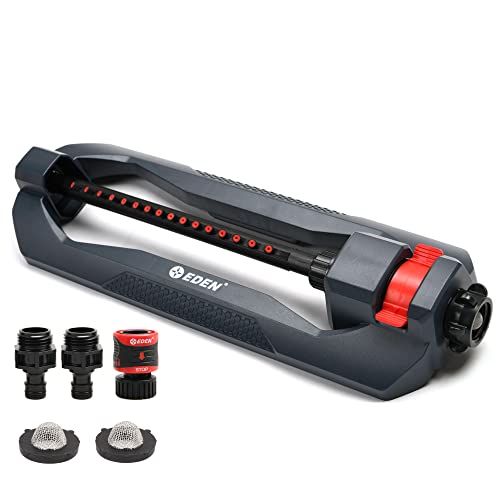 Eden 96213 Essential Turbo Oscillating Sprinkler | Check price on Amazon | |
 Eden 94110 Heavy-Duty Metal Oscillating Sprinkler | Check price on Amazon | |
 Biswing Impact Sprinkler on Tripod Base (2 Pack) | Check price on Amazon | |
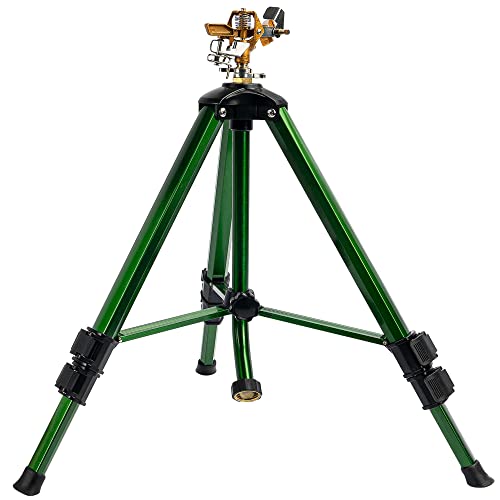 Hourleey Impact Sprinkler on Tripod Base | Check price on Amazon |
Key takeaways
- Sprinklers suited to gravel surfaces: weighted oscillating models and tripod impact heads with gravel-filtering washers, compared on coverage and base type.
As an Amazon Associate we earn from qualifying purchases.
Gravel changes what a sprinkler needs to be. On a lawn, almost any base works: a spike pushes into soil, a sled sits in grass, and the surface itself helps hold everything still. On gravel there is nothing to push a spike into — loose stone shifts under a spike, a thin sled base rocks on uneven stones, and a light sprinkler walks itself sideways under its own water pressure until it is watering the driveway instead of the bed beside it. Watering a gravel area, a bed edged with gravel, a gravel courtyard with planted pockets, or ground beside a gravel path therefore calls for a specific shortlist: sprinklers that stand on top of the surface with weight, width or legs, rather than sprinklers that anchor into the ground.
An honesty note before the picks, because it shapes this whole guide. Sprinkler makers rarely claim gravel use on their product pages, and none of the four pages below claims its sprinkler is made for gravel surfaces. What the pages do state is the evidence this guide is built on: weighted and extra-large bases, metal bases, tripod legs with flip locks and weighted legs, and — on the two tripod models — a filter washer that the page says filters sand and gravel so the nozzle does not clog. The gravel reasoning is then straightforward and is presented as reasoning, not as a maker claim: a weighted flat base or a three-legged tripod can stand on loose stone where a spike cannot, and a filter that handles gravel in the water supply matters when a hose has been dragged across a gravel yard. Every product below is a sprinkler, every ASIN was read from an amazon.com/dp link or the product information on the Amazon US page, and every specification comes from that page.
Disclosure: This article contains affiliate links. If you buy through these links, we may earn a commission at no additional cost to you.
How to Choose a Sprinkler for Gravel Areas
Rule out spike bases first. A spike sprinkler needs soil soft enough to accept the spike and firm enough to hold it upright under pressure. Gravel gives it neither: the spike either will not seat between stones or it seats loosely and leans as the stone shifts. If you are watering from a gravel surface, the base question is not a preference, it is the first filter. The two base families that work on top of loose stone are weighted flat bases, which use mass and a wide footprint to sit still, and tripod bases, whose three legs find their own level on uneven ground and whose height can be adjusted leg by leg in effect by extending the tripod.
Weight is stability. On gravel, a sprinkler is pushed by two forces: the reaction of its own jet, and the tug of a hose lying across loose stone. A weighted base or a metal base resists both. Pages in this guide state weighted bases, extra-large bases for added stability, solid metal construction and weighted tripod legs. Compare the stated weight and base material, and prefer metal where the sprinkler will live outdoors on stone through a season, because gravel is abrasive and a sprinkler gets dragged across it.
Match the spray pattern to a gravel layout. Gravel areas are rarely neat rectangles of thirsty lawn. They are courtyards, strips beside paths, planted pockets and beds with stone mulch, often next to surfaces you do not want to soak. Oscillating sprinklers lay down a rectangle whose length can be trimmed with range tabs, which suits a bed or strip beside gravel. Impact sprinklers on tripods throw a circle or a part-circle from a height, which suits watering planted pockets across a gravel yard and clearing low obstacles, and the part-circle adjustment keeps water off paths and walls. Decide which geometry your space needs before comparing coverage numbers.
Use coverage figures as tested ceilings, not promises. The oscillating models below state coverage tested at 40 PSI in a wind-free environment. Your pressure, your hose length and a breeze across an open gravel yard will all trim the real figure. Treat the stated square footage as a comparison between models under the same test, and size up rather than down if your area sits near a model’s ceiling.
Check the filter, because gravel gets into everything. Hoses dragged across gravel pick up grit, and well or yard supplies can carry sand. Two tripod models below include a rubber filter washer or O-ring that their pages say filters sand and gravel to reduce nozzle clogging. The oscillating models below answer the same problem differently, with clog-resistant nozzles and, on one, a built-in cleaning tool. On a gravel property this is not a minor feature; a clogged nozzle mid-season is the most common way a sprinkler quietly stops covering its area.
Think about height. A tripod lifts the head above low planting, edging and mounds of stone, and lets the jet clear obstacles a ground-level sprinkler would soak or be blocked by. The tripod models below adjust from low to a stated maximum height with quick-release or flip-lock leg clips. If your gravel area is flat and open, a low weighted base is simpler and has nothing to tip. If it is planted, uneven or obstacle-strewn, height earns its complexity.
Eden 96213 Essential Turbo Oscillating Sprinkler
The Eden 96213 is the straightforward gravel answer in this guide: a flat, weighted base that sits on top of the surface instead of anchoring into it. The page describes it as a turbo oscillating sprinkler on a weighted base, adds that the extra-large base provides added stability and durability, and lists the style as a heavy weight base. On loose stone that combination — mass plus footprint — is what keeps an oscillating bar sweeping its rectangle instead of creeping across the yard.
The watering figures are stated with their test conditions, which makes them easy to use honestly. Coverage runs up to 3,600 square feet, tested at 40 PSI in a wind-free environment, through 16 clog-resistant nozzles driven by a patented, sealed turbo drive motor. Sliding tab range controls adjust the length of the watering area, so the rectangle can be shortened for a bed beside a gravel path or opened up for a larger lawn area reached from a gravel standing spot. The page gives maximum pressure as 40 PSI and maximum flow as 30 gallons per minute in its product information, dimensions of 5.11 by 15.74 by 2.36 inches, and a plastic construction. A built-in cleaning tool helps unclog nozzles, which matters in gritty conditions.
This is the pick for a gravel courtyard edge, a driveway-side strip or any flat gravel standing spot where the target is a defined rectangle and the sprinkler needs to be placed, used and lifted away without fuss. Its limit is geometry: it waters a rectangle from ground level, so it will not throw over tall planting the way the tripods below can.
Eden 94110 Heavy-Duty Metal Oscillating Sprinkler
The Eden 94110 keeps the same sit-on-top logic as the 96213 and hardens it. Where the 96213 is plastic on a weighted base, the 94110 is built on a metal base — aluminium in the product information — with an anti-rust coating, and the page describes the metal base as ensuring lasting performance and unmatched stability. On gravel, that construction matters twice: the weight steadies the sprinkler on loose stone, and the metal tolerates being set down, dragged and stored in a way that abrades lighter bases over time.
Coverage is up to 3,315 square feet through 18 precision nozzles, again with a rectangular pattern tested at 40 PSI in a windless setting, adjustable through sliding range control tabs that customise the watering area. The drive is the same patented turbo drive motor family, described as giving smooth operation and a longer gear life, and the nozzles are clog-resistant. The product information gives dimensions of 15.95 by 5.11 by 2.16 inches, a maximum pressure of 100 PSI, and a quick connect bundle in the box. It fits standard US garden hoses and watering tools.
Choose the 94110 over the 96213 when the sprinkler will live a harder life on stone: a permanent standing spot on a gravel yard, frequent moves across abrasive ground, or a property where the sprinkler stays outdoors through the season. Choose the 96213 when the job is lighter and the larger stated coverage is the deciding figure. Both water rectangles; neither needs the ground to hold it up, which is the whole point on gravel.
Biswing Impact Sprinkler on Tripod Base (2 Pack)
The Biswing takes the other route onto gravel: three legs instead of a flat base. A tripod does not care that the surface is loose stone, because each leg ends in a point of contact and the head stays level enough to throw evenly while the legs stand on top of the gravel. The page describes a heavy-duty metal impact head on a solid alloy metal tripod, with extension legs that adjust the height from 16 to 37 inches using quick-release leg clips, and weighted legs for added stability. It is sold as a 2 pack, which suits a larger gravel yard watered in two stations.
The head adjusts from 20 to 340 degrees in its part-circle settings and can run a full 360 degrees, with a stated coverage area of 20 to 35 feet in radius. Recommended water pressure is stated as 20 to 60 PSI, with a maximum pressure of 60 PSI in the product information, and the unit weight is given as 8.24 pounds — real mass, which helps it stay planted when the impact mechanism is working. The connection detail is the one place in this guide where a page names gravel directly: the goose neck hose connector carries a filter washer that, in the page’s words, filters sand and gravel to reduce the possibility of nozzle clogging. That is a water-supply claim, not a surface claim, and this guide reports it as exactly that — but on a gravel property, where hoses live on stone, it is a genuinely relevant one.
Choose the Biswing when the gravel area is planted, uneven or large: height to clear planting, part-circle control to keep water off paths, and a second unit to cover ground without moving a hose mid-session. Its limit is setup: a tripod takes longer to place and level than a flat base takes to set down.
Hourleey Impact Sprinkler on Tripod Base
The Hourleey is the second tripod in this guide, built around a brass impact head rather than the Biswing’s alloy construction. The page describes the sprinkler head as premium heavy-duty brass and stainless steel, sturdy, waterproof and corrosion resistant, on a tripod base with extension legs and flip locks. Brass is the traditional impact sprinkler material for a reason: it takes knocks, weather and gritty water without the wear that plastic heads show, which suits a sprinkler that will be set up on stone rather than on soft lawn.
Coverage is stated as 0 to 360 degrees — a full circle or any part of it — for large-area watering. The product information gives a maximum pressure of 80 PSI and a maximum flow rate of 15 gallons per minute. The connection is a gooseneck hose attachment for a 3/4 inch US standard garden hose, and like the Biswing it carries the gravel-relevant filter detail: a rubber filter O-ring that the page says can filter the sand and gravel and prevent the nozzle from clogging. The page also notes that each pole has a clamp to lock the sprinkler system so it keeps standing sturdy, with no worry about wind or water pressure influencing stability — a claim made for the tripod design generally, and a useful one on an exposed gravel yard where there is no turf to shelter a low sprinkler.
Choose the Hourleey when you want one brass-headed tripod unit rather than a pair, and when corrosion resistance is the priority for a sprinkler stored outdoors or used with gritty water. Choose the Biswing when two stations or the stated radius figures matter more. Both stand on gravel by design; neither asks the ground for anything but footing.
Comparison Table
| Feature | Eden 96213 | Eden 94110 | Biswing Tripod (2 Pack) | Hourleey Tripod |
|---|---|---|---|---|
| ASIN | B09N9ZQWQS | B0CPKPH7XL | B09JCKBM7X | B09PB9Y8BH |
| Type | Oscillating | Oscillating | Impact on tripod | Impact on tripod |
| Base | Weighted, extra-large | Metal (aluminium) | Alloy tripod, weighted legs | Tripod, flip locks, leg clamps |
| Coverage | Up to 3,600 sq. ft. | Up to 3,315 sq. ft. | 20–35 ft radius | Large area, 0–360 degrees |
| Nozzles / head | 16 clog-resistant | 18 precision | Metal impact head | Brass impact head |
| Pattern control | Sliding range tabs | Sliding range tabs | 20–340 degrees or full circle | 0–360 degrees |
| Gravel stated on page | No surface claim | No surface claim | Filter washer filters sand and gravel | Filter O-ring filters sand and gravel |
| Max pressure stated | 40 PSI | 100 PSI | 60 PSI | 80 PSI |
| Height | Ground level | Ground level | Adjustable 16–37 in | Adjustable extension legs |
Frequently Asked Questions
Why not use a spike sprinkler on gravel?
A spike needs soil that accepts it and holds it upright under pressure. Loose stone does neither reliably: the spike will not seat, or it seats at an angle and leans further as stones shift and the jet pushes. Weighted flat bases and tripods stand on top of the surface, which is why every pick in this guide uses one of those two designs.
Do any of these pages actually claim gravel use?
Not for the surface. None of the four product pages claims its sprinkler is made for gravel ground, and this guide does not pretend otherwise. The two tripod pages do name gravel in one specific place: their filter washers are stated to filter sand and gravel from the water supply to reduce clogging. The surface suitability in this guide is a design judgement — weight, footprint and legs that stand on loose stone — stated openly as judgement rather than as a maker claim.
Which type is better for a gravel courtyard with planted pockets?
A tripod impact sprinkler. Its height clears low planting and edging, its part-circle adjustment keeps water off the surrounding stone and paths, and its legs stand on the gravel itself. A weighted oscillating model is better for a single defined bed or strip, where its adjustable rectangle wastes less water.
Will gravel dust and grit clog these sprinklers?
Grit is a real risk on gravel properties, mainly through the water supply and through nozzles sitting close to stone dust. The models here answer it with clog-resistant nozzles on the Eden pair, a built-in cleaning tool on the 96213, and filter washers or O-rings on both tripods that are stated to filter sand and gravel. Rinsing the filter and checking nozzles at the start of the season is still sensible upkeep.
How accurate are the coverage figures on gravel?
The oscillating figures are tested at 40 PSI without wind, and an open gravel yard rarely offers either condition for long. Expect less than the stated ceiling, especially at the end of a long hose. The tripod radius figures depend on pressure in the same way. Use the figures to compare models, not as a guarantee for your yard.
Can these sprinklers water lawn or beds as well as gravel areas?
Yes. All four are general lawn and garden sprinklers — the Eden pages describe lawns, vegetable gardens and flower beds, and the tripod pages list lawn, garden, patio and greenhouse use among their applications. The gravel angle of this guide is about where the sprinkler stands, not a restriction on what it can water.
Conclusion
On gravel, the base is the buying decision. The four sprinklers here divide into two proven ways of standing on loose stone: the weighted and metal flat bases of the Eden 96213 and Eden 94110, which water tidy rectangles from ground level, and the tripods of the Biswing and Hourleey, which lift a brass or metal impact head above planting and adjust their circle to the space. None of their makers claims gravel use for the surface, and the two filter claims that do name gravel concern the water, not the ground — but by design, every one of them can do the one thing a spike sprinkler cannot on stone: stand up, stay put, and water.