Key takeaways
- Learn how to choose the best sprinklers for slopes, cut runoff, and water evenly with cycle-and-soak timing, rotary heads, and smart placement tips for lawns.
As an Amazon Associate we earn from qualifying purchases.
A sloped lawn forces a choice that a flat lawn never does: water it quickly and watch most of it run downhill, or water it slowly enough for the soil to absorb it before gravity takes over. The right sprinkler for a slope therefore matters less for how far it throws water than for how gently it applies it, how evenly it spreads it across uneven ground, and how easily it can be run in short cycles with pauses in between.
This guide is for homeowners with a hillside front lawn, a terraced backyard, or a side slope that always looks dry at the top and soggy at the bottom, as well as for renters and new homeowners setting up a first system on uneven ground. The sprinkler types, features, and watering schedules discussed here were chosen from names and specifications on the Amazon product page, so you can compare real features rather than vague promises and pick a setup that fits your slope, soil, and water pressure.
Why Slopes Are Hard to Water
Water moves downhill before it moves downward into soil, and that simple fact explains most slope problems. On a steep bank, a fast spray can sheet off the surface within minutes, leaving the crest dry while the base turns soft and muddy. Clay soil makes the problem worse because it absorbs water slowly, while sandy soil on a slope can drain so fast that the top dries out between waterings. A sprinkler that works well on flat ground can therefore fail on a slope even when it is set up correctly.
Slope direction matters too. A south-facing bank dries faster in sun and wind, while a shaded north-facing slope may stay damp longer and need less frequent watering. Wind pushes fine spray off course, which is a bigger problem on exposed hillsides than in a sheltered flat garden. Uneven ground also changes the distance between the sprinkler and the grass: the head may sit close to the turf uphill and far above it downhill, so the same spray pattern lands differently on each side.
The goal on a slope is not to soak the lawn in one long session. It is to apply water at a rate the soil can take in, give it time to move downward, and then apply a little more. That approach keeps the top of the slope from drying out, keeps the bottom from becoming waterlogged, and keeps fertiliser and topsoil from washing away with the runoff. Once you accept that slower watering wins on a slope, choosing the sprinkler becomes much simpler.
Sprinkler Types That Work Best on Slopes
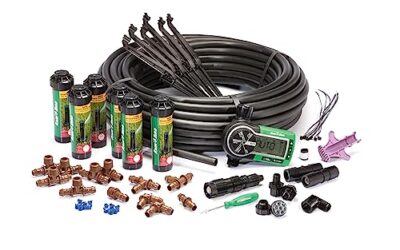
Rotary and gear-drive rotor sprinklers are usually the strongest starting point for a slope. They throw water in slow, rotating streams rather than a continuous fan, so the application rate stays low and the soil has time to absorb each pass. Many rotor heads let you adjust the arc from a narrow partial circle to a full circle, which helps you aim water at the slope itself instead of spraying the path, driveway, or fence at the edge. Look for models with a rain-curtain style nozzle pattern, which breaks the stream into larger droplets that resist wind and land more evenly.
Rotary nozzles fitted to pop-up spray bodies are another good option, especially for smaller slopes and terraced beds. These nozzles rotate slowly and apply water in multiple thin streams, giving a much lower application rate than a fixed spray head. They are useful where you already have an in-ground spray system and want to change only the nozzles, rather than replacing the whole layout. Check the stated radius and arc for each nozzle, because a nozzle that is too large for a narrow terrace will overshoot the edge.
Impact sprinklers on a tripod or stake can work on a slope when they are placed carefully, because you can raise the head, aim the arc, and move the unit between sessions. Their slow, pulsing throw suits larger open banks, and the adjustable legs help on uneven ground where a flat-based sprinkler would tip. They are less suited to narrow slopes, where a wide throw is hard to control, and they need a clear line of sight so the spray is not blocked by a wall or hedge halfway up the bank.
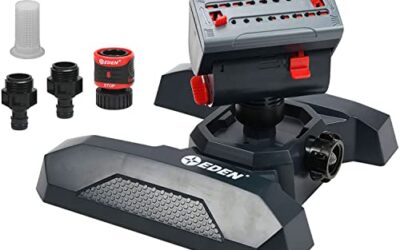
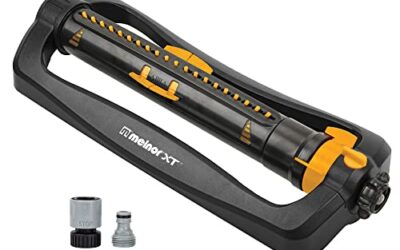
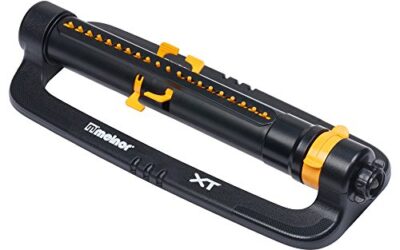
Oscillating sprinklers and fixed fan spray heads are usually the weakest choices for a slope. An oscillating sprinkler lays down a heavy band of water quickly, which is exactly the pattern that runs off a hillside, and a fixed spray head applies water even faster over a short radius. Drip irrigation is not a sprinkler, but it deserves a mention for steep planted banks and shrub slopes, where slow emitters at the root zone avoid runoff altogether. For grass, though, a slow rotor or rotary nozzle remains the more practical choice.
How to Choose
Precipitation Rate and Application Speed
Precipitation rate is the single most important number for a slope, because it describes how quickly water lands on the grass. A low rate gives clay and compacted soil time to absorb water instead of letting it run downhill, while a high rate can overwhelm the surface in minutes. Rotary nozzles and gear-drive rotors are built around this idea, applying water slowly in rotating streams. Before you buy, compare the stated rate of each option and favour the slower one when two models cover a similar area. If the rate is not listed, look at nozzle size and radius: smaller nozzles and shorter throws usually mean gentler watering.
Adjustable Arc, Radius, and Spray Pattern
A slope rarely forms a neat rectangle, so a sprinkler that can only water a full circle will waste water on paths and beds. An adjustable arc lets you shape coverage to the bank itself, watering a narrow strip along a fence or a wide curve at the base. Radius adjustment matters just as much, because the distance from the head to the top of the slope is shorter than the distance to the bottom. Choose a head that lets you shorten the throw with a screw or a nozzle change, and test it first. A pattern that looks even on flat ground can leave dry stripes on a slope.
Stability, Height, and Placement on Uneven Ground
A sprinkler that tips over on a slope is worse than no sprinkler at all, because it can flood one spot while leaving the rest dry. For hose-end models, a tripod with adjustable legs or a heavy spiked base holds its position better than a light sled base on a bank. For in-ground heads, the pop-up height should clear the grass without sticking up so far that mowing or foot traffic damages it. Place heads across the slope rather than in a single line down it, so each head waters its own band and runoff from one zone does not drown the next.
Water Pressure, Soil Type, and Zone Size
Water pressure decides whether a rotor turns smoothly or stalls halfway through its arc, so check the operating range listed for the head and compare it with your home supply. Low pressure is common at the top of a long garden hose run, and it shows up first on the highest part of a slope. Soil type sets the pace: clay needs short, repeated cycles, sandy soil needs more frequent but still gentle watering, and loam sits in between. Zone size then decides how many heads you need. One large rotor may cover a wide bank, but two smaller heads with overlapping arcs often water a slope more evenly.
Setting Up a Cycle-and-Soak Schedule
Cycle-and-soak watering is the technique that makes slope sprinklers work. Instead of running a zone for one long stretch, you split the total watering time into two or three short cycles with a pause of half an hour or more between them. During each pause, water moves down into the soil instead of running off the surface, so the next cycle starts on damp ground that absorbs water more readily. The total amount of water stays similar, but far more of it ends up in the root zone.
Start with short cycles of five to ten minutes for a rotor on a moderate slope, then watch what happens at the bottom of the bank. If water starts to pool or run onto a path, shorten the cycle and add another one later rather than lengthening the first. On clay soil, shorter cycles with longer pauses work best, while sandy soil may tolerate slightly longer cycles before runoff appears. Early morning is the best time to water a slope, because the grass dries during the day and the soil has the whole morning to absorb each cycle before the heat arrives.
A simple timer or a controller with a cycle-and-soak setting makes this far easier than standing by the tap. Set the timer for the first cycle, add a pause, and let it repeat the pattern until the zone has had its full watering. Keep a note of the cycle length that works for your slope in each season, because a schedule that suits spring may run off in summer when the soil is baked hard. Adjust the timing before you buy a different sprinkler, since many slope problems are scheduling problems rather than equipment problems.
Which One Fits Your Situation
A Steep Front Lawn That Always Dries at the Top
Choose a slow gear-drive rotor or a rotary nozzle with a low application rate, and run it in short cycles. Aim the arc so the spray lands across the slope rather than straight down it, and place the head near the top of the bank so the upper grass is watered first. Avoid fixed spray heads here, because their fast output will run off before the crest absorbs it.
A Terraced Backyard With Narrow Beds and Steps
Choose rotary nozzles on pop-up bodies or a small adjustable rotor that can be set to a short radius and a narrow arc. Each terrace needs its own coverage, so do not try to water two levels with one wide throw from the bottom. Water the highest terrace first, let it soak, and then move down, so runoff from above does not flood the level below.
A Large Open Bank With No In-Ground System
Choose a tripod impact sprinkler or a gear-drive sprinkler on a spike base that you can move between sessions. Raise the tripod to clear low shrubs, set a partial arc that follows the shape of the bank, and overlap each position slightly with the last. This portable setup suits renters and anyone who does not want to dig up a large slope for a fixed system.
A Shaded Slope That Stays Damp at the Bottom
Choose the slowest application rate you can find and water less often than a sunny slope needs. A rotary nozzle with adjustable radius lets you shorten the throw at the damp base and keep coverage on the drier top. Skip extra cycles at the bottom of the bank, and check the soil before watering again, because a shaded slope can look dry while the soil below is still moist.
Common Mistakes
- Watering a slope in one long session, which sends most of the water downhill and leaves the top dry while the base turns soggy.
- Choosing a fixed spray head or an oscillating sprinkler for a steep bank, where the fast application rate overwhelms the soil and causes runoff.
- Placing a single sprinkler at the bottom of a slope and spraying uphill, so the spray loses reach before it gets to the driest grass at the top.
- Setting a full-circle arc on a narrow slope, which wastes water on paths, fences, and beds that do not need it.
- Ignoring soil type and pressure, so a rotor that needs steady pressure stalls on the highest part of the garden and leaves dry patches behind.
Frequently Asked Questions
What type of sprinkler is best for a sloped lawn?
A slow gear-drive rotor or a rotary nozzle is the best choice for a sloped lawn, because both apply water at a low rate that soil can absorb. Pair it with cycle-and-soak watering, running short cycles with pauses, so water moves downward instead of running off. Avoid fixed spray heads on steep banks, since their fast output causes runoff.
How do I stop water running off my sloped lawn?
Split watering into short cycles with pauses of half an hour or more, so each application soaks in before the next. Aim the sprinkler across the slope rather than down it, shorten the radius at the edges, and water in the early morning when the soil absorbs well. If runoff still appears, shorten the cycles further before changing the sprinkler.
Should I water the top or the bottom of a slope first?
Water the top first, because it dries fastest and loses water downhill. A head placed near the crest can cover the upper grass while some water moves down to help the middle of the bank. Watering the bottom first leaves the top dry and can make the base waterlogged before the upper lawn has received enough.
Can I use a normal sprinkler on a slope?
You can use a normal sprinkler on a gentle slope, but a steep bank needs a slower head and a different schedule. A standard oscillating or fixed spray model will often run off before the soil absorbs it. Switch to a rotor or rotary nozzle, shorten the cycles, and check the bottom for pooling after the first few waterings.