Our Short List of 3

- Best for: large open lawns where an elevated impact head must hold its pattern in steady wind.
- Up to 90 ft diameter coverage; 6,360 sq ft at full circle
- Zinc impact head, adjustable from partial to full circle
- Tripod adjusts from 22 to 48 inches in height
- Deflector shield and anti-backsplash arm
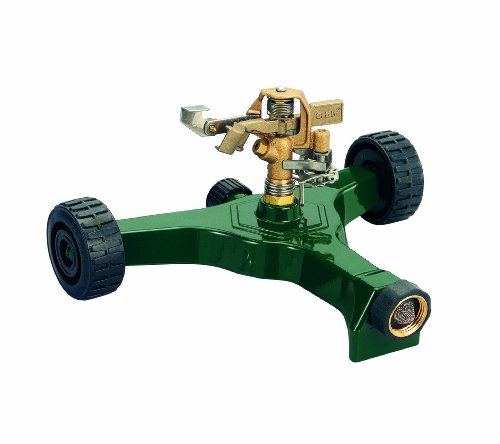
- Best for: long yards where one sprinkler is pulled from section to section along the hose.
- Brass impact head on a metal wheel base
- Coverage up to 50 ft in diameter on the Amazon listing; Orbit’s own description states up to 90 ft
- Adjustable from a partial section to a full 360-degree circle
- Deflector shield and diffuser screw adjust the stream

- Best for: small or sloped lawns that need a low, stable sprinkler with no staking.
- Brass impulse head on a heavy-duty circular metal base
- Coverage up to 70 ft in diameter; some retailer listings state 72 ft
- Adjustable partial and full-circle patterns
- Deflector flap adjusts stream length
All 3 Picks at a Glance
| Product | Specs | Action |
|---|---|---|
| Orbit 56667Z Zinc Impact Sprinkler on Tripod |
| Check price on Amazon |
| Orbit 56186N Brass Impact Sprinkler on Wheel Base |
| Check price on Amazon |
| Dramm ColorStorm Circular Base Impulse Sprinkler |
| Check price on Amazon |
Key takeaways
- Wind keeps blowing your spray off the lawn? These 3 impact sprinklers throw heavy, low streams that stay on target through gusty weather all season.
Wind changes the watering job. A sprinkler that looks fine on a calm morning can throw its water onto the sidewalk or the driveway once the afternoon gusts arrive. The real decision is not which sprinkler covers the most ground on paper, but which one throws heavy droplets on a low arc the wind cannot bend. That points toward impact and impulse heads with adjustable arcs and streams you can shape with a deflector, rather than fine misting designs that drift away before they land.
This guide is for homeowners with exposed lawns, corner lots, and yards on hills or near the coast, where wind is a daily factor rather than a nuisance. It also suits anyone watering a large area in sections and tired of moving a sprinkler that never puts the water where it was aimed. The three picks below were chosen from the names and specifications on their Amazon listings, judged on droplet size, spray height, base stability, and the pressure each head needs.
Quick Picks
As an Amazon Associate we earn from qualifying purchases.
| Product | Best for | Key spec from title |
|---|---|---|
| Orbit 56667Z Zinc Impact Sprinkler on Tripod | Large open lawns in steady wind | 360-degree rotating, adjustable-height tripod |
| Orbit 56186N Brass Impact Sprinkler on Wheel Base | Moving one sprinkler across a big yard | 1/2 in. brass impact sprinkler with metal wheel base |
| Dramm ColorStorm Circular Base Impulse Sprinkler | Low, ground-hugging spray without staking | Circular base impulse sprinkler with heavy-duty metal base |
How to Choose
Throw heavy water, not mist
Wind punishes fine droplets. A misting or oscillating sprinkler breaks water into a thin fan that a gust can carry sideways, leaving dry stripes across the lawn and wet patches where nothing grows. An impact head throws a single pulsing stream of larger droplets that holds its line far better, and a diffuser or deflector lets you break that stream up only as much as conditions allow. When you compare two sprinklers, look at the head type first and the coverage figure second. A smaller claimed circle from an impact head usually waters more evenly in wind than a bigger claimed circle from a fine-spray design, so treat the head type as the deciding feature.
Keep the arc low and adjustable
Height is the wind’s best friend. A stream launched high into the air spends longer in the moving air, so it drifts further before it lands. Low-angle heads and adjustable deflectors keep the water closer to the ground, which shortens the flight and keeps the pattern where you set it. Equally important is an arc you can limit to a partial section, so the sprinkler never throws water over a path, a patio, or a bed that should stay dry. Before buying, check that the listing names a partial-to-full-circle adjustment and a deflector or diffuser screw, not just a fixed full circle.
Match the base to your lawn
The base decides whether the sprinkler stays put and whether you will actually move it when the job changes. A tripod lifts the head above tall grass and lets you water over low plantings, but its legs need level ground and can catch the wind themselves if they are light. A weighted circular base sits flat, needs no staking, and suits small or sloped lawns where you cannot push a spike into the soil. A wheeled base is the right answer when one sprinkler must cover a long yard in stages, because you pull it along by the hose instead of carrying it.
Check pressure and coverage honestly
Every coverage figure on a sprinkler listing assumes enough water pressure behind it. Run an impact head on a weak hose and the stream falls short, the rotation stalls, and the pattern turns patchy, which many buyers blame on the sprinkler itself. Check the pressure range on the listing and compare it with what your outdoor tap actually delivers, especially if you share the supply with the house or run a long hose. Also treat maximum coverage as a ceiling measured in still air, not a promise for a windy day. Plan on the lower coverage figure when listings disagree, and overlap the patterns slightly.
The 3 Best Options
Orbit 56667Z Zinc Impact Sprinkler on Tripod
- Best for: large open lawns where an elevated impact head must hold its pattern in steady wind.
- Up to 90 ft diameter coverage; 6,360 sq ft at full circle
- Zinc impact head, adjustable from partial to full circle
- Tripod adjusts from 22 to 48 inches in height
- Deflector shield and anti-backsplash arm
large open lawns where an elevated impact head must hold its pattern in steady wind.
other sources quote a different tripod height range for this model, so confirm the height and coverage figures on the listing you open, and check that you are looking at the tripod version rather than a spike version.
The Orbit 56667Z suits a large lawn where the wind has a clear run and the sprinkler needs height to clear the grass. Its zinc impact head throws a pulsing stream that resists drift better than a fan of mist, and the tripod raises the head so the spray clears low plantings while the arc adjustment keeps the water inside the lawn. The deflector shield and anti-backsplash arm let you shape the stream rather than accept whatever the wind does with it. It connects to a standard garden hose, so setup is unfolding the legs, attaching the hose, and setting the arc.
Watch out for: other sources quote a different tripod height range for this model, so confirm the height and coverage figures on the listing you open, and check that you are looking at the tripod version rather than a spike version.
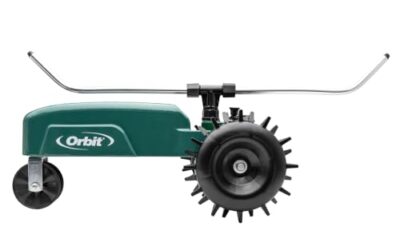
Orbit 56186N Brass Impact Sprinkler on Wheel Base
- Best for: long yards where one sprinkler is pulled from section to section along the hose.
- Brass impact head on a metal wheel base
- Coverage up to 50 ft in diameter on the Amazon listing; Orbit’s own description states up to 90 ft
- Adjustable from a partial section to a full 360-degree circle
- Deflector shield and diffuser screw adjust the stream
long yards where one sprinkler is pulled from section to section along the hose.
the listing disagrees with itself on coverage, so plan on the 50 ft figure and verify the diameter on the listing before ordering; also confirm the wheel base will pass through your gates and along your paths.
The Orbit 56186N fits a long yard that one sprinkler must cover in stages. Its brass impact head delivers the same heavy, pulsing stream as the tripod model, while the metal wheel base lets you pull the whole unit to the next section by the hose instead of lifting and repositioning it. The arc adjusts from a partial section to a full circle, and the deflector shield and diffuser screw let you shorten the stream when the wind picks up. The listing shows conflicting coverage figures, so this guide uses the lower one for planning.
Watch out for: the listing disagrees with itself on coverage, so plan on the 50 ft figure and verify the diameter on the listing before ordering; also confirm the wheel base will pass through your gates and along your paths.
Dramm ColorStorm Circular Base Impulse Sprinkler
- Best for: small or sloped lawns that need a low, stable sprinkler with no staking.
- Brass impulse head on a heavy-duty circular metal base
- Coverage up to 70 ft in diameter; some retailer listings state 72 ft
- Adjustable partial and full-circle patterns
- Deflector flap adjusts stream length
small or sloped lawns that need a low, stable sprinkler with no staking.
Dramm lists a 40 PSI minimum, so a weak hose may leave the stream short; also confirm the color on the listing, since each color has its own listing and this guide uses the berry variant.
The Dramm ColorStorm suits a smaller lawn where you want the spray kept low and the sprinkler held steady without driving a spike into the ground. Its brass impulse head sits on a heavy-duty circular metal base that resists tipping, and the head is designed to water closer to the ground, which cuts evaporation and keeps the stream under the wind. The deflector flap adjusts the stream length, and the pattern switches between partial and full circle. It comes in six bright colors, so it is easy to spot on the grass before mowing.
Watch out for: Dramm lists a 40 PSI minimum, so a weak hose may leave the stream short; also confirm the color on the listing, since each color has its own listing and this guide uses the berry variant.
Which One Fits Your Situation
A big, open lawn that catches every gust
Choose the Orbit 56667Z tripod. The zinc impact head clears the grass and throws a heavy pulsing stream that holds its line in steady wind, while the tripod lets you set the height for each section. Set a partial arc along the windward edge so the gusts push the water back onto the lawn instead of off it, and use the deflector to shorten the stream on the gustiest days.
A long yard you water in sections
Choose the Orbit 56186N wheel base. Its brass impact head gives you the same wind-resistant stream as the tripod models, and the wheels turn repositioning into a pull on the hose rather than a carry across wet grass. Work down the yard in overlapping sections, and plan on the lower 50 ft coverage figure, since the listing states two different diameters and the smaller one is the safe number.
A small lawn where you cannot stake anything
Choose the Dramm ColorStorm circular base. The weighted base sits flat on soil or a slope without a spike, and the low, ground-hugging spray stays under the wind instead of arcing over it. The partial-circle setting keeps water off paths and beds, and the colors make the unit easy to spot before mowing. Check your tap pressure first, because this head asks for at least 40 PSI to reach its stated pattern.
A low-pressure hose or a shared supply
Choose the Orbit 56667Z tripod. Its maximum flow is 1.8 GPM, the lowest of the three, so it asks less of a weak supply than heads that need more water to throw their full pattern. Place it closer to the tap, use a short hose, and water one section at a time rather than splitting the supply. If the stream still falls short, the shortfall is in the supply, not the head.
Safety Notes
Check the pressure limits on the listing before first use: the Orbit tripod lists a maximum of 80 PSI and the Dramm lists a maximum of 90 PSI, and a supply above those figures can strain seals and fittings. Never aim a running sprinkler at people or pets, since a concentrated stream at full pressure can sting, and keep the hose and sprinkler clear of walkways where they can trip someone. Brass in these products may contain lead, so wash your hands after handling the head and do not use a lawn sprinkler as a drinking-water source. Drain the sprinkler and store it indoors before freezing weather, because trapped water can crack the head and the base.
Common Mistakes
- Buying an oscillating or fine-mist sprinkler for a windy yard, then wondering why the lawn has dry stripes
- Setting a full circle when half the arc lands on a driveway, path, or patio that never needed water
- Running an impact head on a weak supply and blaming the sprinkler for a short, patchy pattern
- Leaving a tripod or wheeled sprinkler out through freezing weather, which can crack the head
- Placing the sprinkler where the wind carries the spray onto a neighbor’s yard or a walkway
Frequently Asked Questions
Why do impact sprinklers handle wind better than oscillating sprinklers?
Impact heads throw a stream of heavy droplets that holds its line in moving air, while oscillating sprinklers break water into a thin fan of fine droplets a gust can push sideways. Heavier droplets spend less time in the air, so they land closer to the aim point. That is why all three picks here use impact or impulse heads.
What water pressure do these sprinklers need?
Each listing states its own range, so check it before ordering. The Dramm ColorStorm lists 40 to 90 PSI, so it needs a strong tap to reach its stated pattern. The Orbit tripod lists a maximum of 80 PSI and a maximum flow of 1.8 GPM. A long hose, a shared supply, or a low tap can all reduce what the head delivers.
Should the sprinkler sit low or high in windy weather?
Low is better in wind, because a high stream spends longer in the air and drifts further before landing. A weighted base or a low deflector setting keeps the water close to the ground. Raise the head only when tall grass or plantings would block a ground-level spray, and shorten the stream with the deflector when the gusts pick up.
Can I run two impact sprinklers from one hose?
You can, but only if the supply can feed both heads. Splitting a hose divides the flow, so each head throws a shorter pattern and may stall. The Orbit 56186N includes a flow-through outlet that supports series use, but the tap still has to deliver enough water. Water one section at a time if the streams fall short.