Key takeaways
- Find the best marine binoculars with compass for boating and sailing, with waterproof 7x50 picks, compass types, and a clear buying guide before you buy.
A good pair of marine binoculars does two jobs at once. It brings a distant buoy, channel marker, or approaching vessel close enough to identify, and its built-in compass gives a bearing to that object without reaching for a separate hand compass. That combination matters on a moving boat, where a bearing taken a few seconds late can already be out of date. The best marine binoculars with compass pair steady, bright optics with a readable compass, waterproof and fogproof sealing, and a body that can survive spray, drops, and the occasional trip overboard. This guide focuses only on models with a built-in compass, not on plain marine binoculars that leave navigation to another instrument. The two picks below are the models with verifiable Amazon US listings found during research, and the buying guide explains how to judge the compass, the optics, and the sealing before choosing.

As an Amazon Associate, we earn from qualifying purchases.
Quick Picks
| Product | Best For | Standout Feature |
|---|---|---|
| Nikon 7×50 OceanPro CF WP Global Compass | Serious sailors and navigation-first boaters | Illuminated global compass with automatic declination |
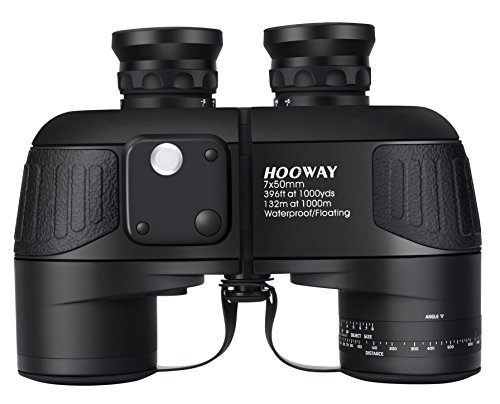
| Hooway 7×50 Waterproof Fogproof Military Marine Binoculars | Value-conscious boaters who want compass and rangefinder | Internal rangefinder and illuminated compass in one body |
1. Nikon 7×50 OceanPro CF WP Global Compass
The Nikon 7×50 OceanPro CF WP Global Compass is the navigation-first pick in this guide, and it is aimed at boaters who want a trusted optics brand and a compass that works in either hemisphere. Its headline feature is a built-in illuminated global compass with automatic declination for northern and southern hemisphere locations, so the same binocular stays useful on a passage that crosses the equator rather than being tuned to one half of the world. An integral scale is also listed for estimating the size of, and distance to, a sighted object, which adds a practical navigation aid alongside the bearing itself.
The optical format is the marine standard: 7x magnification with 50 mm objective lenses. Seven-power magnification is steady enough to hold on a rolling deck, while the large objectives gather plenty of light at dawn, at dusk, and in heavy overcast. Published specifications list a real angular field of view of 7.2 degrees, a field of view of 377 feet at 1,000 yards, a 7.1 mm exit pupil, and 22.7 mm of eye relief, which is a genuine comfort advantage for anyone who wears glasses.
Construction is built around marine conditions. The listing describes a rubber-armored polycarbonate body that is waterproof and fogproof, with multicoated Eco-glass lenses intended to deliver bright, crisp views. Central focus is used here, with a single focus control and a diopter adjustment, which many boaters find quicker than focusing each eyepiece separately when handing the binocular to another crew member. A floating nylon neck strap is included, so the binocular can be retrieved if it goes over the side, and the published weight is 39.9 ounces.
There are a few honest trade-offs to weigh. The 7×50 format is fixed, so there is no zoom and no higher-magnification option for picking out fine detail at very long range. The central-focus design adjusts both eyes together, which suits quick sharing but gives less independent control than individual-focus models. The compass needs a battery for its illumination, so keeping a spare cell aboard is sensible. Finally, stock for this exact compass model should be confirmed live before ordering, because retailer listings for the same model number have shown out-of-stock status at times, and the compass version is distinct from the otherwise similar OceanPro model without a compass.
Key specifications:
- Magnification: 7x
- Objective lens diameter: 50 mm
- Compass: Built-in illuminated global compass with automatic declination
- Field of view: 377 feet at 1,000 yards; 7.2 degrees real angular field of view
- Eye relief: 22.7 mm
- Exit pupil: 7.1 mm
- Focus: Central focus with diopter adjustment
- Body: Rubber-armored polycarbonate, waterproof and fogproof
- Included: Floating nylon neck strap
- Weight: 39.9 ounces
Pros:
- Illuminated global compass works in northern and southern hemispheres
- Bright 7×50 optics with long eye relief for glasses wearers
- Waterproof and fogproof rubber-armored body
- Floating strap helps with retrieval after a drop overboard
- Integral scale for size and distance estimation
Cons:
- Fixed 7×50 format with no zoom option
- Heavy at nearly 40 ounces for extended handheld use
- Compass illumination needs a battery
- Compass version must not be confused with the OceanPro model without a compass
2. Hooway 7×50 Waterproof Fogproof Military Marine Binoculars
The Hooway 7×50 is the value pick in this guide, and it is the model to shortlist when the budget matters but the compass and rangefinder still need to be in the same instrument. The Amazon listing describes it as a waterproof military-style 7×50 marine binocular with an internal rangefinder and compass for navigation, boating, and fishing. That pairing of tools is the point of the model: one device for spotting a marker and another reading for its bearing and approximate distance, without carrying a separate compass and range card.
Like the Nikon, it uses the 7×50 marine format, with 7x magnification and 50 mm objective lenses. That format keeps the image relatively steady on a moving boat while gathering enough light for dawn and dusk use. The compass is illuminated, and the internal rangefinder uses a reticle scale visible in the view, so distance and size estimates are made by reading the scale against the object rather than by pressing a button.
The body is described as waterproof and fogproof, with a military-style rugged housing suited to boating, fishing, and general outdoor use. A floating neck strap is listed among the included accessories in several descriptions of this model, which is a useful safeguard on a small boat where gear is handled close to the rail. The illuminated compass and rangefinder are switched on for low-light use, so the navigation aids stay readable as the light fades.
The trade-offs are the ones that usually come with a value-priced marine binocular. The rangefinder is a manual reticle system, so estimating distance means reading the scale and doing the arithmetic, not getting a digital readout. The compass is a built-in analog unit, and like other compasses of this type it can be affected by nearby metal, engines, and magnetic interference, so bearings are best taken away from large metal objects when possible. Fit and finish are functional rather than refined, and long-term salt resistance depends on rinsing and drying the binocular after exposure to spray.
Key specifications:
- Magnification: 7x
- Objective lens diameter: 50 mm
- Compass: Built-in illuminated compass for direction finding
- Rangefinder: Internal rangefinder reticle for distance and size estimation
- Body: Waterproof and fogproof marine construction
- Use: Navigation, boating, fishing, and outdoor viewing
Pros:
- Compass and rangefinder in one value-priced body
- Steady 7×50 format suited to a moving deck
- Illuminated compass and reticle for low-light use
- Waterproof and fogproof construction for wet conditions
- Floating strap included in the listed package
Cons:
- Manual reticle rangefinder requires reading a scale and doing the math
- Compass can be affected by nearby metal and magnetic interference
- Basic fit and finish compared with premium marine binoculars
- Optical clarity in poor light is unlikely to match premium glass
Why the Compass Changes the Choice
A marine binocular without a compass is simply a viewing tool. A marine binocular with a compass is a navigation tool as well, and that changes what to look for. The compass lets the person on watch take a bearing to a buoy, a headland, or another vessel and report it as a number, which can then be plotted, compared with the chart, or passed to the helm. Without it, the same sighting is a description rather than a measurement, and descriptions are harder to act on in poor visibility or at night.
Compass designs vary, and the differences are worth understanding. The Nikon in this guide uses a global compass with automatic declination, which is designed to stay accurate in both hemispheres. Many budget models use a simpler illuminated compass that reads magnetic north and is perfectly usable in home waters but may need more care when traveling far from where it was set up. Some premium marine binoculars use a fluid-damped, stabilized compass that settles faster in rough water, while simpler units can swing more as the boat rolls. None of these designs replaces a proper ship compass or a chartplotter, but a good built-in compass turns a quick look into a usable bearing. The rangefinder reticle found on the Hooway and on many similar models is a related but separate tool: a scale etched into the view that lets the user estimate the distance to, or the size of, an object of known height. It works, but it is manual and approximate, and it takes practice to use quickly.
Buying Guide
Magnification: Why 7×50 Dominates on the Water
Most marine binoculars with a compass use 7x magnification and 50 mm objective lenses, and that is not an accident. Seven-power magnification is low enough to hold steady by hand on a boat that is rolling and pitching, while 50 mm objectives collect enough light for a bright image at dawn, at dusk, and in fog. Higher magnification, such as 10×50, shows more detail but shakes more, which makes it harder to read a compass scale and harder to hold a target in view.
The Compass Itself
Read the compass description carefully before ordering, because not every marine binocular has one, and the details differ. Look for whether the compass is illuminated, because an unlit compass is hard to read at night or in a dark wheelhouse. Check whether it is a global compass or a single-hemisphere unit, and whether it uses automatic declination. Also check how the compass is powered: illuminated models need a small battery, so confirm the battery type and keep a spare aboard. Finally, remember that any magnetic compass is affected by nearby metal, so a reading taken next to an engine block or a steel rail deserves a second check from a different position.
Waterproof, Fogproof, and Floating
Waterproof and fogproof sealing are not optional extras on a boat. A waterproof body keeps spray and rain out of the optics, while nitrogen filling and O-ring seals help prevent internal fogging when moving between warm cabins and cold decks. Some models state a formal waterproof rating, while others simply describe the body as waterproof and fogproof without a number. Either way, the sealing claim should be stated on the listing, not assumed. A floating design or a floating strap is a separate advantage: a binocular that floats, or that is attached to a strap that floats, can be recovered after a drop overboard, while a sinking model is usually gone for good.
Focus System and Eye Relief
Marine binoculars generally use one of two focus systems. Central focus uses a single wheel and is quick to adjust and easy to share between crew members. Individual focus sets each eyepiece separately and then stays set, which suits a single regular user and avoids accidental changes. Neither is clearly better for everyone, but the choice matters for how the binocular will actually be used. Eye relief is the distance from the eyepiece at which the full field of view is visible, and longer eye relief is more comfortable for glasses wearers. The Nikon in this guide lists 22.7 mm of eye relief, which is generous, while many budget models list shorter figures or do not publish the number at all.
Weight, Size, and Handling
Marine binoculars are large instruments, and the models in this guide weigh roughly two and a half pounds. That weight is the cost of 50 mm objectives, a sealed body, and a built-in compass. Before choosing, consider how long the binocular will be held up at a stretch, and whether a neck strap or a harness will carry the weight between uses. A rubber-armored body improves grip with wet hands and protects the optics from knocks, and fold-down eyecups help glasses wearers find a comfortable viewing position.
What Else to Check Before Ordering
Confirm the exact model before ordering, because compass and non-compass versions of the same binocular often share a name and look nearly identical. The Bushnell Marine 7×50 is a good example: the compass version carries model number 137500, while the otherwise similar model 137501 has no compass, so the model number matters more than the product name. The same caution applies to the Steiner Navigator line, where compass and non-compass versions exist side by side and where current and older generations have been listed together. The Fujinon Mariner 7×50 WPC-XL is another compass model worth checking live, but no verified Amazon US listing was found for it during this research. Check the listing for the words compass, rangefinder, waterproof, and fogproof, confirm the battery type for illumination, and re-check stock and the seller before ordering.
How to Take a Bearing With a Compass Binocular
Hold the binocular steady, center the object in the view, and read the compass scale visible at the edge of the field of view. Note the bearing, then check it a second time to make sure the reading is stable and not swinging with the roll of the boat. If the compass is illuminated, switch the light on in low light and off again afterwards to save the battery. Keep the binocular away from large metal objects, engines, and magnetic mounts while reading, and compare the bearing with the chart or the ship compass when the situation allows.
Care and Maintenance
Salt water is the main enemy of a marine binocular, even a waterproof one. Rinse the body with fresh water after exposure to spray, dry it with a soft cloth, and store it in its case out of direct sunlight. Clean the lenses with a lens cloth or a blower rather than a shirt sleeve, which can drag grit across the coatings. Check the compass battery before a trip, carry a spare cell of the correct type, and check the floating strap for wear, because a strap that fails at the wrong moment is worse than no strap at all.
Frequently Asked Questions
Do I need a compass in my marine binoculars?
Not every boater does, but a built-in compass is useful whenever bearings matter. If the boat is used for coastal sailing, night passages, or navigation in poor visibility, a compass binocular lets the lookout report a bearing as a number that can be plotted or passed to the helm. For short daytime trips in familiar waters, a plain marine binocular may be enough.
Is 7×50 really the best format for marine use?
For most boaters, yes. Seven-power magnification is steady enough to hand-hold on a moving boat, and 50 mm objectives gather enough light for dawn, dusk, and overcast conditions. Higher magnification shows more detail but shakes more, which makes both the image and the compass harder to read.
Will the built-in compass work in the southern hemisphere?
It depends on the model. The Nikon OceanPro in this guide uses a global compass with automatic declination, which is designed for use in both hemispheres. Simpler compasses may be balanced for one hemisphere and can read less accurately far from home waters. Check the listing for the words global compass or automatic declination if a passage across the equator is planned.
How accurate is a built-in binocular compass?
A built-in compass is a practical navigation aid, not a survey instrument. Accuracy depends on the compass design, the steadiness of the reading, and nearby magnetic interference from engines, metal rails, and electronics. Readings are best taken away from large metal objects, repeated to check stability, and cross-checked against the ship compass or chart when the situation allows.
Do compass binoculars need batteries?
Most illuminated compass models do. The illumination is usually powered by a small button cell, and the battery type should be stated on the listing. Keep a spare cell aboard, switch the light off when it is not needed, and check the battery before a trip. Models without illumination need no battery for the compass itself, but the scale is then harder to read in low light.
Conclusion
The best marine binoculars with compass combine steady 7×50 optics, a readable illuminated compass, and waterproof and fogproof sealing in a body that can survive life on a boat. The Nikon 7×50 OceanPro CF WP Global Compass is the stronger choice for serious navigation, with its global compass, long eye relief, and trusted optics, while the Hooway 7×50 offers compass and rangefinder functions in a value-priced body. Whichever model is chosen, confirm the exact compass version, the model number, and live stock before ordering. A compass binocular earns its place aboard the first time a bearing needs to be taken quickly in poor visibility, and the right model is the one that is in hand, readable, and ready when that moment arrives.