Key takeaways
- Compare the best kids compasses for hiking and exploring, from durable toy compasses to real working compasses with clear dials for young explorers.
A compass turns a walk in the woods into a small adventure. Kids who can read a needle and follow a bearing learn direction, patience, and confidence on the trail, and the right compass makes that lesson fun instead of confusing. The picks below range from a classic pocket compass to binoculars with a built-in compass, so there is a match for a first hike, a scout camp, or a backyard treasure hunt.
Every compass here is a real working compass with a clear dial, sized for young hands. We looked for durable cases, dials kids can read at a glance, and designs that survive being dropped in a backpack or clipped to a jacket. Two of the picks pair the compass with binoculars, one adds survival tools, and one slips onto a wristband for hands-free carrying.
Quick Picks
As an Amazon Associate we earn from qualifying purchases
| Product | Best for | Key spec |
|---|---|---|
| Coghlan’s Magnetic Pocket Compass | Classic pocket carry | Luminous dial with jeweled needle |
| GeoSafari Compass Binoculars | Spotting and navigating | 4x magnification, 30mm lenses |
| Coghlan’s Seven Function Binoculars | Multi-tool fun | Seven functions in one pair |
| Sun Company Outsider 4-in-1 | Survival kit carry | Luminous liquid-filled compass |
| Sun Company Slip-On Wrist Compass | Hands-free wear | Slips onto a watch band or bracelet |
How to Choose
Dial clarity comes first
A kids compass lives or dies by its dial. Look for large numerals, a needle that settles quickly, and markings a child can read without squinting. Luminous dials help on cloudy days and in shaded woods, and a liquid-filled capsule steadies the needle when small hands shake. Avoid dials crowded with tiny numbers or decorative symbols that hide the cardinal points. If your child is under eight, a simple dial with bold N, E, S, and W beats a busy orienteering dial every time. Hold the compass flat, let the needle settle, and check that north stays put when you turn.
Size and durability for young hands
Kids drop things. A compass for a child needs a case that can take a tumble onto rock or trail dirt without cracking, and a size small enough to fit a jacket pocket or a small palm. Metal cases age well and feel solid, while rugged plastic keeps weight down for younger hikers. A lanyard hole, a carabiner clip, or a wristband mount keeps the compass attached instead of lost at the bottom of a pack. Skip delicate glass faces and oversized adult models with heavy brass bodies. The best kids compass is the one your child can carry all day without noticing it until the trail turns.
Real compass or toy compass
Not every compass sold for kids actually points north. Toy compasses with plastic needles that spin freely teach nothing and disappoint young navigators. A real working compass has a magnetized needle in a liquid-filled or jeweled housing, and it settles on north every time you hold it level. Check the product description for words like magnetic needle, liquid-filled, or jeweled movement, and skip anything described as a party favor or a pretend-play accessory. A working compass turns a hike into a lesson in direction; a toy one turns it into a guessing game.
Extra tools and how much is too much
Many kids compasses bundle extras: binoculars, a thermometer, a whistle, a magnifier, or a fire starter. Extras can spark interest, but each one adds weight and distraction, and a child who fiddles with a whistle all afternoon learns little about bearings. Match the extras to the trip. Binoculars suit bird-watching hikes, a thermometer suits weather-curious kids, and a whistle suits safety-minded families. If the compass itself is hard to read, no bundle of extras saves it. Pick the compass first, then let one or two useful extras decide between two close options.
The 5 Best Options
1. Coghlan’s Magnetic Pocket Compass
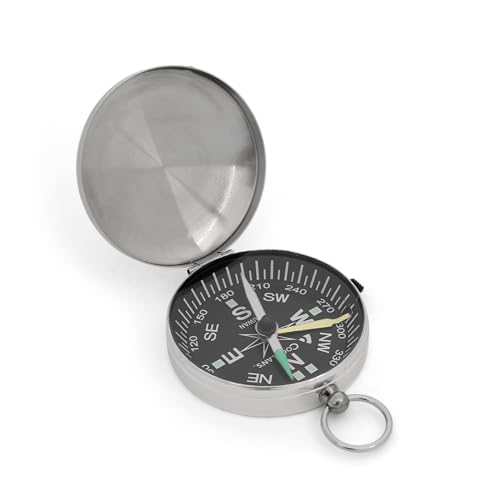
The classic pocket compass, done right. Coghlan’s chrome-cased pocket compass has guided generations of young hikers, and its luminous dial stays readable when the trail darkens under tree cover. The jeweled needle settles smoothly, so kids can watch north swing into place instead of guessing. It slips into a pocket or a small pouch, and needs no batteries or setup. For a first compass, this is the honest, no-frills pick: a real instrument a child can learn on, carry anywhere, and keep for years.
Specs
- Chrome metal case
- Luminous dial
- Jeweled needle
- Model 8048
- UPC 056389080485
Best for: First-time young hikers learning to read a compass.
Watch out for: The small case can be easy to misplace in a crowded pack, so keep it in a fixed pocket.
ASIN: B000ECUEA0
2. Educational Insights GeoSafari Compass Binoculars
Binoculars first, compass second — but the compass here is a genuine working feature, not decoration. The GeoSafari pair gives kids 4x magnification through 30mm glass lenses, so distant birds and trail markers come into view, while the built-in compass sits right where young eyes can check direction without putting the binoculars down. The build suits ages five and up, with a size and weight kids can hold steady. It is the pick for children who want to spot things and navigate at the same time.
Specs
- 4x magnification
- 30mm glass lenses
- Built-in compass
- Ages 5 and up
- Model 5274
Best for: Kids who want to spot wildlife and check direction in one tool.
Watch out for: The compass sits on the binocular body, so teach kids to hold the pair level for a steady reading.
ASIN: B000ERAIW4
3. Coghlan’s Seven Function Binoculars for Kids
Seven tools in one pair makes this the most playful pick on the list, and the compass is listed first among them. Alongside the compass, kids get a magnifier, a telescope, a mirror, and more, all in a 4×30 binocular sized for small hands. It is the kind of gadget that keeps a child busy on a long trail, turning every stop into a chance to look closer or check direction. The multi-tool design means the compass shares space with other functions, so it suits curious kids who enjoy exploring rather than serious navigation practice.
Specs
- 4×30 magnification
- Compass, magnifier, telescope, and mirror
- Seven functions in one pair
- Model 0235
Best for: Curious kids who love multi-tool gadgets on the trail.
Watch out for: With seven functions sharing one body, the compass dial is smaller than a dedicated pocket compass.
ASIN: B000FXWLGI
4. Sun Company Outsider 4-in-1
The Outsider packs a compass, a thermometer, a fire starter, and a whistle into a key-ring tool a child can clip to a pack. Its luminous liquid-filled compass is easy to read, the cushion-mounted thermometer reads in both Fahrenheit and Celsius down to minus 20 degrees Fahrenheit, and the flint rod and whistle add real trail skills to practice. At about 1.3 ounces, it rides on a key ring without weighing a pack down. This is the pick for older kids and young scouts who want a compact survival kit rather than a single-purpose compass.
Specs
- Luminous liquid-filled compass
- Cushion-mounted thermometer, Fahrenheit and Celsius scales
- Flint rod and striker
- Survival whistle
- Key ring attachment
- About 1.4 x 2.2 x 0.5 inches
- About 1.3 ounces
- Model 880-F
Best for: Older kids and young scouts building a compact survival kit.
Watch out for: The fire starter needs adult supervision, so treat it as a teaching tool, not a toy.
ASIN: B07PN6HVLC
5. Sun Company Slip-On Wrist Compass
The Slip-On is the simplest compass here: it slides onto a watch band or a paracord bracelet and stays on the wrist all day. Kids who hate carrying gear love it, because there is nothing to hold, nothing to clip, and nothing to lose in a pack. The dial is large and easy to read, with clear markings a child can follow at a glance, and it works as a backup compass even when a bigger compass rides in the pack. It is the pick for hands-free hiking, biking, and playground adventures where a pocket compass would only get in the way.
Specs
- Slips onto a watch band or paracord bracelet
- Large, easy-to-read dial markings
- Model DC204WB
- UPC 792758860004
Best for: Kids who want a compass on the wrist with nothing to carry.
Watch out for: A wrist compass is a backup navigator, so pair it with a full-size compass for serious route finding.
ASIN: B001949J1W
Which One Fits Your Situation
First hike with a young child
Pick the Coghlan’s pocket compass or the GeoSafari binoculars. A young child needs one clear dial and one simple job: watch the needle and follow north. The pocket compass teaches the basics with no distractions, while the binoculars add spotting fun for kids who lose focus on a plain dial. Either way, walk a short loop, stop often, and let your child call out the direction at each turn.
Scout camp or outdoor club
The Sun Company Outsider fits camp life. Scouts practice real skills at camp, and a compass paired with a thermometer, a whistle, and a fire starter gives them four tools to learn in one small kit. Clip it to a pack or a belt loop, and it is always within reach for orienteering games and trail walks. Remind young scouts that the fire starter is for supervised practice only.
A child who loses everything
The Slip-On wrist compass is made for this child. It lives on a watch band or a paracord bracelet, so there is no pocket to forget and no clip to unhook by accident. Direction stays on the wrist through hikes, bike rides, and playground games, and the large dial is easy to check mid-activity. For a backup, keep the Coghlan’s pocket compass in the family pack.
Backyard treasure hunts and nature walks
The Seven Function binoculars turn a backyard into an expedition. Kids can scan the trees, magnify a leaf, check the mirror, and read the compass, all without leaving the yard. The multi-tool design keeps curious minds busy, and the compass gives the game a real sense of direction. Hide a few markers, hand over a simple map, and let the compass lead the way.
Common Mistakes
- Buying a toy compass with a free-spinning plastic needle instead of a real magnetized one.
- Choosing an adult orienteering compass with a dial too busy for a child to read.
- Forgetting a lanyard, clip, or wrist mount, so the compass ends up lost on the first hike.
- Handing a child a fire starter or whistle tool without showing them how and when to use it.
- Expecting a wrist or binocular compass to replace a full-size compass on a long route.
Frequently Asked Questions
What age is right for a first compass?
Most kids are ready for a simple compass between ages five and seven, once they can tell left from right and follow a basic direction. A clear dial with bold cardinal points matters more than extra features at this age. Walk short trails together first, and let your child practice finding north before adding longer hikes or busier tools.
Are compass binoculars real compasses?
Yes, when the compass is a listed feature with a working needle. Both binocular picks here carry genuine compasses built into the body, and the needle settles on north like any pocket compass. The difference is size: a binocular compass dial is smaller, so hold the pair level and give the needle a moment to settle before reading it.
Do kids need a liquid-filled compass?
A liquid-filled compass steadies the needle, which helps when small hands shake or the trail bounces underfoot. It is not required for learning the basics, and a jeweled pocket compass works well too. If your child hikes on rough ground or checks direction while walking, the steadier needle is worth having.
How do I teach my child to use a compass?
Hold the compass flat in the palm, wait for the needle to settle, then turn the body until the needle points to the N mark. Pick a landmark in that direction and walk toward it, checking the needle every few minutes. Short practice walks with a simple map build confidence faster than long lessons, and a treasure hunt gives the skill a fun goal.