Our Short List of 3

- Cutting range: 1 cm to 15 cm diameter (about 6 inches maximum)
- Blade: COB-1 carbon steel, 6 blades included
- Replacement blade: OLFA COB-1
- Model number: 9911 (CMP-1)

- Blade: 18 mm rotary wheel, stainless steel
- Replacement blade: OLFA RB18-2
- Cutting range: not stated
- Model number: 1057028 (CMP-3)
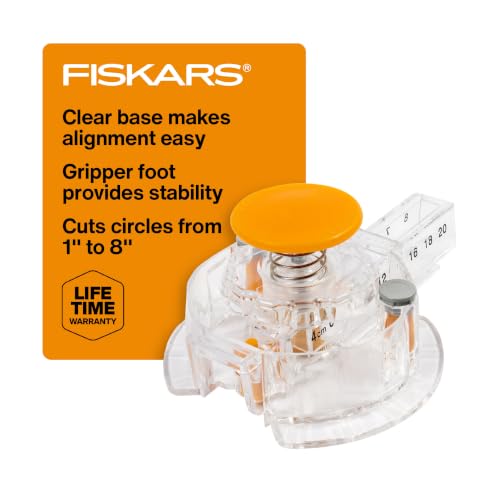
- Cutting range: 1 inch to 8 inches diameter
- Blades included: 3 replacement blades
- Replacement blade: Fiskars 193820-1001
- Model number: 193800-1001
All 4 Picks at a Glance
| Product | Specs | Action |
|---|---|---|
| 1. OLFA Compass Circle Cutter (CMP-1) |
| Check price on Amazon |
| 2. OLFA 18mm Rotary Circle Cutter (CMP-3) |
| Check price on Amazon |
| 3. Fiskars Circle Cutter (193800-1001) |
| Check price on Amazon |
 5. NT Cutter Heavy-Duty Circle Cutter (C-2500P) |
| Check price on Amazon |
Key takeaways
- Compare the best circle cutters for paper, cardstock and fabric, with diameter ranges, blade types and pivot styles for compass, rotary and punch tools.
Cutting a clean circle freehand with scissors or a craft knife is harder than it looks. One wobble in the middle of the curve leaves a flat spot, and trimming it out only makes the circle smaller and less round. Circle cutters solve the problem mechanically: a fixed center point anchors the tool while a blade travels around it at a set radius, so the finished edge is smooth and the diameter is the one you dialed in.
The five tools below cover the main designs worth considering. Compass-style cutters from OLFA and NT Cutter handle the widest range of materials, from tissue paper and photographs to leather and light wood. OLFA’s rotary model swaps the fixed blade for a small rolling wheel that quilters prefer for fabric, and the Fiskars cutter uses a clear base and a rotating knob that many scrapbookers find easier to control. Each entry lists the verified diameter range, blade type and replacement blade, so you can match the tool to the work you actually do.
As an Amazon Associate, we earn from qualifying purchases.
How to Choose a Circle Cutter
Start with the diameter range, because it decides which projects the tool can handle at all. Most compass-style cutters cover roughly three quarters of an inch up to about six or seven inches, which suits card making, photo cropping and appliqué. If you regularly cut larger circles for banners, quilt blocks or lampshade liners, check the maximum diameter before anything else, and note the minimum too: some heavy-duty models cannot close down small enough for tiny medallions or button covers.
Blade style is the second decision. A fixed compass blade, like the ones on the OLFA CMP-1 and the NT Cutter models, drags through the material as you rotate the tool, giving excellent control in paper, film, acetate and thin leather, and the blades are cheap to replace. A rotary circle cutter instead rolls an 18 mm wheel around the pivot, which slices fabric with less bunching and is kinder to layered quilting cotton. Knob-turned designs such as the Fiskars sit at the simple end: position, turn, and lift out a finished disc.
The center pivot matters more than most buyers expect. A bare metal spike leaves a pinhole in every circle, fine for appliqué that will be sewn down but ruinous on a photograph or gift tag. Tools with a rubber center pad, like the NT Cutter iC-1500P, grip without piercing. Whichever style you pick, work on a cutting mat, keep steady pressure on the center, and check the replacement blade code before buying; a cutter is only as useful as the fresh blades you can still get for it.
1. OLFA Compass Circle Cutter (CMP-1)
- Cutting range: 1 cm to 15 cm diameter (about 6 inches maximum)
- Blade: COB-1 carbon steel, 6 blades included
- Replacement blade: OLFA COB-1
- Model number: 9911 (CMP-1)
The OLFA CMP-1 is the classic compass-style circle cutter and the one most crafters meet first. A sliding arm sets the radius, a center spike anchors the tool, and a small carbon steel blade scores and cuts as you sweep the arm around. OLFA rates it for circles from 1 cm to 15 cm in diameter, which covers everything from small photo crops to six-inch medallions, and the listing confirms it works for right- and left-handed users. It ships with six COB-1 blades in total, so the first few years of refills are already in the box.
Because the blade is fixed rather than rolling, the CMP-1 handles a broader material list than rotary designs: paper, film, acetates, cardboard, light wood, vinyl, leather and fabric are all within its stated range. Owners use it heavily for foam core and model work, where the screw-fixed blade stays put under pressure. The trade-off is technique. The blade can tear delicate paper if you rush the turn, and the center spike leaves a small pinhole, so plan for that on finished faces.
Who it’s for: Model makers, scrapbookers and general crafters who want one inexpensive compass cutter for paper, foam core, film and light leather work.
Who should skip: Anyone cutting mostly fabric circles, who will prefer the rolling blade of the CMP-3, and anyone who cannot accept a pinhole at the center of the finished piece.
2. OLFA 18mm Rotary Circle Cutter (CMP-3)
- Blade: 18 mm rotary wheel, stainless steel
- Replacement blade: OLFA RB18-2
- Cutting range: not stated
- Model number: 1057028 (CMP-3)
The CMP-3 takes OLFA’s circle-cutting idea and rebuilds it around an 18 mm rotary wheel, the same blade family as OLFA’s smallest straight rotary cutters. Instead of dragging a fixed point through the material, the wheel rolls around the center pivot, which makes it the natural choice for fabric: quilting cotton, appliqué shapes and layered yardage cut without the pulling and distortion a fixed blade can cause. A ratchet-style handle lets you adjust and lock the diameter setting, and the handle design is intended to reduce wrist fatigue on long cutting sessions.
Published diameter figures for this model vary between sources, so the exact range is marked not stated below; independent sewing coverage consistently describes it as a small-to-medium circle tool for fabric work rather than a large-format cutter. The blade is stainless steel and replaceable with the standard RB18-2, widely stocked wherever OLFA rotary supplies are sold.
Who it’s for: Quilters and sewists cutting repeated fabric circles, appliqué pieces and small blocks who already own a cutting mat and want a rolling blade instead of a dragging one.
Who should skip: Paper crafters who need a verified wide diameter range, and anyone cutting thick leather or foam core, where a fixed heavy blade holds a line better.
3. Fiskars Circle Cutter (193800-1001)
- Cutting range: 1 inch to 8 inches diameter
- Blades included: 3 replacement blades
- Replacement blade: Fiskars 193820-1001
- Model number: 193800-1001
Fiskars takes a different approach: instead of a compass arm you hold, its circle cutter sits on a clear base that you place over the material, and a rotating top knob drives the blade around the chosen diameter. The clear base is the headline feature, because you can see exactly where the circle will fall before you cut, which matters when you are centering a photograph or cutting a window in a finished card. The stated cutting range runs from 1 inch to 8 inches, the widest maximum in this group.
The tool ships with three replacement blades, and Fiskars sells refills as a separate two-pack under model 193820-1001. The design is aimed squarely at paper crafting: scrapbooking, stationery and card projects are the uses Fiskars itself highlights. It is not built for leather, wood or thick foam. For crafters who found compass spikes fiddly, this is the most forgiving design here.
Who it’s for: Scrapbookers and card makers who cut paper and cardstock circles and want to see the exact placement before committing to the cut.
Who should skip: Anyone cutting fabric, leather or foam core, and anyone who needs circles smaller than one inch or larger than eight inches.
4. NT Cutter Circle Cutter (iC-1500P)
The NT Cutter iC-1500P is a compass-style cutter built around one clever detail: its center point is designed to leave no pin trace on the material. Where most compass cutters pierce the sheet with a spike, the iC-1500P anchors without punching a hole, which makes it a favorite for photographs, presentation graphics and finished artwork where a center pinhole would show. Its stated range runs from 3/4 inch to 6-3/4 inches in diameter, covering most paper and light craft work.
Six blades come in the package, with spares stored in the tool, and the blade is sharpened on one side; NT advises always turning toward the sharpened edge, which takes a little practice. The same design cuts thin leather cleanly at around half a millimeter, along with paper, film and card. The main learning curve is keeping the center anchored: if the pivot hand wanders, the circle spirals. Held firmly, it produces clean, hole-free discs that spike-based tools cannot match.
Specs
- Cutting range: 3/4 inch to 6-3/4 inches diameter
- Center point: pin-free design, leaves no center hole
- Blades included: 6
- Model number: iC-1500P
- Blade style: fixed, single-edge sharpened
- Item weight: not stated
Who it’s for: Photographers, graphic artists and crafters cutting finished prints, photos and presentation pieces where a center pinhole is unacceptable.
Who should skip: High-volume fabric cutters, and beginners who want a tool that needs no technique practice to keep the pivot steady.
5. NT Cutter Heavy-Duty Circle Cutter (C-2500P)
- Cutting range: 1-3/16 inches to 6-5/16 inches diameter
- Model number: C-2500P
- Build: heavy-duty
- Blade style: fixed compass blade
The C-2500P is the heavy-duty member of NT Cutter’s circle cutter family, built for thicker and tougher stock than the iC-1500P handles comfortably. Its stated cutting range runs from 1-3/16 inches to 6-5/16 inches in diameter, and the heavier build is meant for materials such as thick card, leather, rubber sheet and similar dense stock that would flex a light compass tool or tear out mid-cut. If your circles are structural parts rather than decorations, this is the appropriate end of the range.
The trade-offs follow from the brief. The minimum diameter is larger than on the other tools here, so small medallions and tiny photo crops are outside its range, and it is more tool than a paper crafter needs for cardstock. Within its intended territory, though, it offers sturdiness the lighter compass cutters lack, from a maker whose cutting tools are a workshop staple in Japan.
Who it’s for: Crafters and light workshop users cutting circles from thick card, leather, rubber and other dense sheet materials that overwhelm light compass cutters.
Who should skip: Paper crafters cutting small circles, who are better served by the iC-1500P or the Fiskars, and fabric quilters, who should choose the rotary CMP-3.
Frequently Asked Questions
What is the difference between a compass circle cutter and a rotary circle cutter?
A compass cutter drags a small fixed blade around a center pivot, which gives precise control in paper, film, card and thin leather. A rotary circle cutter rolls a round wheel blade around the pivot instead, which cuts fabric more smoothly and with less pulling. Choose the fixed blade for mixed paper and craft materials, and the rotary wheel for repeated fabric work.
Will a circle cutter leave a hole in the center of my circle?
Most spike-pivot tools do leave a small pinhole, which is invisible on pieces that get glued or sewn down but can spoil a photograph or a finished print. If the center face matters, choose a pin-free design such as the NT Cutter iC-1500P, or a base-style tool such as the Fiskars, which does not pierce the material at the center.
What surfaces can circle cutters handle?
Compass-style cutters typically handle paper, cardstock, film, acetate, photographs, vinyl, fabric and thin leather, and the OLFA CMP-1 is also rated for light wood. Heavy-duty models such as the NT Cutter C-2500P extend that to thicker, denser sheet stock. Always work on a cutting mat, and make a test cut in scrap material before cutting a finished piece.
How do I stop the cutter from spiraling or slipping mid-cut?
Keep firm downward pressure on the center pivot with one hand and turn the blade arm slowly with the other, letting the blade score a light first pass on delicate material before completing the cut. A fresh blade matters too: a dull blade drags, and dragging is what pulls the pivot off center.
Final Verdict
For most crafters, the OLFA CMP-1 is the sensible default: simple, wide-ranging, with spare blades in the box. Quilters should step up to the OLFA CMP-3, whose rolling 18 mm wheel treats fabric more kindly, while paper crafters will like the Fiskars for placement accuracy. For a flawless center, the NT Cutter iC-1500P is the specialist, and the heavy-duty C-2500P is the pick when the stock gets thick and stubborn.
Product and ASIN Reference
| Product | ASIN |
|---|---|
| OLFA Compass Circle Cutter (CMP-1) | B000BK7NWC |
| OLFA 18mm Rotary Circle Cutter (CMP-3) | B001CEAMCY |
| Fiskars Circle Cutter (193800-1001) | B0006HUJ0S |
| NT Cutter Circle Cutter (iC-1500P) | B001OYA8C6 |
| NT Cutter Heavy-Duty Circle Cutter (C-2500P) | B001V7JZE8 |